In 1992, Mario Paint was released for the Super NES as a showcase for the 'Mouse' peripheral that would then see fairly common use through the rest of the life of the Super NES. The main attraction of the game was, of course, the painting: you got 40 different colors, 60 textures, some stamps, and a couple coloring-book pages if you want them; have fun.
There was also a music composition device. You were given 16 different sounds and a musical scale. It doesn't sound like much, and the default song given doesn't exactly inspire greatness:
Surely, I never came close to making anything decent. Neither did my brother, despite playing the trumpet in middle school. Perhaps it was because of too much time spent making "elephant noises", and as you can plainly see, there is no elephant available on the menu.
But when any sort of creative tool is given to a mass of people who have grown up surrounded by technology, there is always going to be somebody who can take a minimal amount of tools and get maximum value out of them.
A hack of the tool has been made, Mario Paint Composer, which over time has added the ability to further fine-tune the tempo, speed it up way past the high end allowed by the Super NES, and a few other things, including, over time, four new sounds, but has stuck to the spirit of the original tool.
Which means with enough talent, someone can go do this...
...or this...
...or even this, which has got to be the king of Mario Paint compositions, with extra credit for sticking to the original 16 sounds...
I'm still not anything resembling musical. Though I at least now know that music composition isn't supposed to go "Okay, we had an A flat, so now we should have a sharp, let's say F sharp, and then we should have a C to balance it out. What haven't we had in a while? B? Get one of those in; make it a flat." Maybe you can do better.
Friday, January 7, 2011


Thursday, January 6, 2011
Wednesday, January 5, 2011
That Was Tina Fey, Dammit
From XKCD:
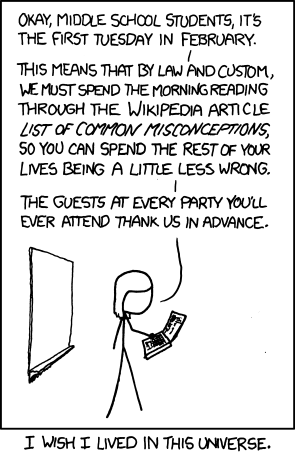
That's a hell of an idea. Get cracking. Odds are sooner or later we'll get to one or more items on the list in further detail, and in fact we did get to one of them on Friday, but to get you started:
*Sarah Palin didn't say 'I can see Russia from my house',
*Al Gore didn't say he invented the Internet,
*Napoleon wasn't short,
*You can't see the Great Wall of China from the moon,
*Cold weather doesn't give you colds,
*Shaving doesn't make your hair thicker,
*Guys don't think about sex every couple seconds, and even if we do, there's no way you can actually test that,
*If a guy's in the water waving his hands and screaming that he's drowning, he's not drowning,
*A fatwa is not a death sentence,
*A jihad is not a holy war,
*And they don't dump toilet waste out of moving airplanes.
Now never say these things again.
Tuesday, January 4, 2011
Nature Doesn't Care
A recent poll from Pew Research showed a partisan split on the question of global warming. When asked "Is there solid evidence the Earth is warming?", self-identified Republicans come down 53-38 against the existence of global warming, while self-identified Democrats are convinced be a 79-14 margin. Indies are convinced 59-31.
A sub-question asked those convinced why there's global warming. The Dems and indies come down on the side of human activity over natural patterns, 53-18 and 32-17 respectively, while the convinced Republicans come down 18-16 on the side of natural patterns.
A Fark headline from earlier today, as Fark headlines so often do, cut right to the point:
And there's the rub.
Nature doesn't care.
When nature decides it wants to do something badly enough, it really doesn't care what the humans think of it. It doesn't care what speeches are made, what laws are passed, who wins an election, how much money is spent, whether the budget's been drained. The only thing the humans can do is make something strong enough to stop it. There had better be a barrier high enough, long enough, thick enough and strong enough to hold back the water, or there's going to be a flood. There had better be enough water to cool the lava flow quickly enough, or it's going to swallow up whatever it wants, and even then it may not be enough. The heating or heat retention system had better be robust enough, or you're going to freeze in that blizzard. And on the inverse, when nature doesn't want to make any more of a finite resource, you'd better be done using it by the time it runs out, or there's a whole lot of things that aren't going to be usable anymore. Hope you didn't need them.
Quite often, the human resources required to hold back these acts of nature are far beyond what humans could ever hope to muster. Too bad. Nature doesn't care. If human capacity were, hypothetically, only strong enough to earthquake-proof structures against, say, an 8.0 quake, and then a 9.0 comes along, those buildings are coming down. Humanity's best just isn't good enough. And if it's not good enough, there's little humanity can do except run for its life.
And there's no partial credit given either. A $10 million levee that barely fails and a $10 levee that completely fails end up looking exactly the same in the end. Either way, there's a gigantic floodplain and a bunch of broken construction remnants afterwards. The levee holds, or it doesn't. The house withstands the earthquake, or it doesn't. The house is rendered unlivable by mold, or it isn't. The volcano swallows up the house, or it doesn't. The ground underneath the house on a hill is stable enough to keep from being part of a mudslide, or it isn't. The house is high enough to stay out of the flood, or it isn't. People survive through a natural disaster, or they don't.
This also applies to proactive measures taken by humans. You don't believe in global warming? Fine then. We won't use global warming as an example. Let's set that entire discussion aside. We'll use invasive species. No denying the existence of those and in order to be considered invasive, a species' introduction must be indisputably the act of human intervention. We could use starlings, rabbits, killer bees, the Asian long-horned beetle, carp, or anything else you find on this list, but we'll focus here on kudzu, which is common throughout the heavily-Republican south (imagine that). Japan introduced it in 1876 at the Centennial Exposition in Philadelphia; it looked nice enough that Americans used it for decoration. In the 1920's, people started actively planting it, and in the 1930's, it was promoted as a form of erosion control during the Dust Bowl, with farmers being paid to plant it by the 40's. It grew very well. Too well. Way, way too well. So well that it started choking out everything that wasn't kudzu. So well that by 1972, it had gone from being something the government paid to have planted to being something the government called a weed.
Kudzu grows better in the United States than in its native Asia, mainly for the reason that when it came over, the insects that eat kudzu didn't come with it. And that's a common theme with invasive species: the places to which they're introduced lack their natural predators, and in nature, no predators means unchecked growth.
But even after being called a weed, kudzu is still hell to remove. Once again, nature doesn't care what kudzu is called. If you want it out, it means an effort that lasts several years to get rid of a single weed. As nature.org advises, "To successfully control kudzu, its extensive root system must be completely eradicated by cutting vines just above the ground and mowing every month for two growing seasons—all cut material must be destroyed." Clemson University goes even further, saying "Because of its rapid growth (up to 60 feet per year), a single surviving kudzu plant can spread and re-infest a site within a few growing seasons. Eradication requires multiple broadcast applications of herbicide and follow-up spot treatments over a period of 4 to 10 years. Establishment of pine trees or other crops should not be attempted for at least 4 years after control measures are initiated."
If you can't muster that effort, too bad. Kudzu doesn't care. Have fun with your kudzu, and as Southerners will advise, close your windows at night or the kudzu will creep in.
Believe in global warming or don't. But, like kudzu, like any form of nature's wrath, if and when the consequences of it show up at your doorstep, either be ready to deal with them, or be ready to run. Nature never asked your opinion about it. Nature does not refrain from plowing over humanity because that might not poll well. Nature doesn't care.
A sub-question asked those convinced why there's global warming. The Dems and indies come down on the side of human activity over natural patterns, 53-18 and 32-17 respectively, while the convinced Republicans come down 18-16 on the side of natural patterns.
A Fark headline from earlier today, as Fark headlines so often do, cut right to the point:
"Pew poll finds 53% of Republicans do not believe in global warming. No word on whether global warming cares what Republicans think of it"
And there's the rub.
Nature doesn't care.
When nature decides it wants to do something badly enough, it really doesn't care what the humans think of it. It doesn't care what speeches are made, what laws are passed, who wins an election, how much money is spent, whether the budget's been drained. The only thing the humans can do is make something strong enough to stop it. There had better be a barrier high enough, long enough, thick enough and strong enough to hold back the water, or there's going to be a flood. There had better be enough water to cool the lava flow quickly enough, or it's going to swallow up whatever it wants, and even then it may not be enough. The heating or heat retention system had better be robust enough, or you're going to freeze in that blizzard. And on the inverse, when nature doesn't want to make any more of a finite resource, you'd better be done using it by the time it runs out, or there's a whole lot of things that aren't going to be usable anymore. Hope you didn't need them.
Quite often, the human resources required to hold back these acts of nature are far beyond what humans could ever hope to muster. Too bad. Nature doesn't care. If human capacity were, hypothetically, only strong enough to earthquake-proof structures against, say, an 8.0 quake, and then a 9.0 comes along, those buildings are coming down. Humanity's best just isn't good enough. And if it's not good enough, there's little humanity can do except run for its life.
And there's no partial credit given either. A $10 million levee that barely fails and a $10 levee that completely fails end up looking exactly the same in the end. Either way, there's a gigantic floodplain and a bunch of broken construction remnants afterwards. The levee holds, or it doesn't. The house withstands the earthquake, or it doesn't. The house is rendered unlivable by mold, or it isn't. The volcano swallows up the house, or it doesn't. The ground underneath the house on a hill is stable enough to keep from being part of a mudslide, or it isn't. The house is high enough to stay out of the flood, or it isn't. People survive through a natural disaster, or they don't.
This also applies to proactive measures taken by humans. You don't believe in global warming? Fine then. We won't use global warming as an example. Let's set that entire discussion aside. We'll use invasive species. No denying the existence of those and in order to be considered invasive, a species' introduction must be indisputably the act of human intervention. We could use starlings, rabbits, killer bees, the Asian long-horned beetle, carp, or anything else you find on this list, but we'll focus here on kudzu, which is common throughout the heavily-Republican south (imagine that). Japan introduced it in 1876 at the Centennial Exposition in Philadelphia; it looked nice enough that Americans used it for decoration. In the 1920's, people started actively planting it, and in the 1930's, it was promoted as a form of erosion control during the Dust Bowl, with farmers being paid to plant it by the 40's. It grew very well. Too well. Way, way too well. So well that it started choking out everything that wasn't kudzu. So well that by 1972, it had gone from being something the government paid to have planted to being something the government called a weed.
Kudzu grows better in the United States than in its native Asia, mainly for the reason that when it came over, the insects that eat kudzu didn't come with it. And that's a common theme with invasive species: the places to which they're introduced lack their natural predators, and in nature, no predators means unchecked growth.
But even after being called a weed, kudzu is still hell to remove. Once again, nature doesn't care what kudzu is called. If you want it out, it means an effort that lasts several years to get rid of a single weed. As nature.org advises, "To successfully control kudzu, its extensive root system must be completely eradicated by cutting vines just above the ground and mowing every month for two growing seasons—all cut material must be destroyed." Clemson University goes even further, saying "Because of its rapid growth (up to 60 feet per year), a single surviving kudzu plant can spread and re-infest a site within a few growing seasons. Eradication requires multiple broadcast applications of herbicide and follow-up spot treatments over a period of 4 to 10 years. Establishment of pine trees or other crops should not be attempted for at least 4 years after control measures are initiated."
If you can't muster that effort, too bad. Kudzu doesn't care. Have fun with your kudzu, and as Southerners will advise, close your windows at night or the kudzu will creep in.
Believe in global warming or don't. But, like kudzu, like any form of nature's wrath, if and when the consequences of it show up at your doorstep, either be ready to deal with them, or be ready to run. Nature never asked your opinion about it. Nature does not refrain from plowing over humanity because that might not poll well. Nature doesn't care.
Monday, January 3, 2011
Random News Generator- Belize
First RNG of the new year. We are taken to Belize today, where they, after having made TIEA's (Tax Information Sharing Agreements) with Australia, Belgium, Denmark, the Faroe Islands, Finland, France, Greenland, Iceland, Norway, Portugal, Sweden and the United Kingdom, they have been removed from the blacklists of the OCED and G20.
This is important to Belize because they offer themselves as a tax haven, and being on the blacklist would ruin that economic approach by preventing investors from the first world from putting their money into the country. Coming off the blacklist comes at a price, however; with the TIEA's in place, investors cannot remain anonymous, which for some is part of the appeal of doing business in Belize in the first place.
Which, to bring us full circle, is why the OCED and G20 want Belize to have the TIEA's: to limit the options for those kind of investors as much as possible. Anonymous investors in tax havens normally aren't doing nice things.
Here's the problem, though: TIEA's aren't what you would call 'effective'. The Guardian's Richard Murphy goes into more detail, but suffice to say that you can't ask for anything from prior to when the agreement was made, and come to think of it, you have to ask for information, and asking has more hurdles attached to it than a Freedom of Information Act request about Jimmy Hoffa. As Murphy puts it, "To ask a successful question under the terms of a TIEA means you already have to know the answer." The result: barely anybody asks anybody about anything.
All hat, but very little cattle, so to speak.
Sunday, January 2, 2011
Go Away, I'm Watching The Packers
Here. Name all the elements of the periodic table in 15 minutes and shut up while Daddy watches his stories.
Saturday, January 1, 2011
Houses Made of Diamonds: A Bad Investment
The Mega Millions jackpot has gone unclaimed for long enough that the jackpot has grown to $290 million. This is about the point where everybody and their mother buys a ticket and fantasizes about what they're going to do with $290 million; the linked article, although brief, makes sure you know about some of the larger jackpots claimed in lottery history. Not even former jackpot winners are immune from the lure of a second payday.
Far too often, these same people, after winning these gigantic jackpots, are found years later broke, miserable, and wishing they had never bought the ticket at all.
So where do so many people go astray? My theory is that a lot of the winners simply have no real-world concept of the larger jackpots. One it gets up into $290 million territory, the number... the exact number is irrelevant. The previous jackpot was $242 million, but the $48 million difference does not register. It all reads "$Texas" to some people. If this jackpot goes unclaimed, and it climbs past $300 million, it won't make much difference there either. When it's given to you in one big pile, it looks like All The Money In The World. Which as people who are actually rich for a living will tell you, it is not.
This is if you take the lump sum option, at least. If you were to split that up into 30 parts, as would happen in an annuity, it's still a lot of money, but one is much more easily able to wrap their head around the idea of $10 million as opposed to the idea of $300 million.
The problem is, despite any argument you may hear about which of the two payment options is better- the lump-sum or the annuity- when it actually comes time for the winners to choose, it turns out to be barely a debate at all. Winners almost unanimously pick the lump-sum, shown on the official Powerball website as "cash", save for the smallest of jackpots. Since 2003, Powerball records only three winners as having gone to the annuity, with the three jackpots having sat at $18.7 million, $19.8 million, and $20 million. One additional group opted for 'mixed'- which means at least one person took lump-sum and at least one person took the annuity- and this jackpot was quite large: $208.6 million. The jackpot was, however, split among 100 people, and 99 of these 100 winners chose the lump sum, leaving just over $2 million for the person who opted for the annuity. Every other winner since 2003, every single other person, has taken the lump sum.
And this costs all of these winners roughly half of their jackpot straightaway, even before taxes. What a lot of people don't realize is that the amount advertised is the amount they think you'd get if you took the annuity. The Powerball people have this misconception covered in their FAQ:
Here's the other thing. You only win that jackpot once. As earlier stated, when you first come into such a large amount of money, it's hard to wrap your head around it, and a fair amount of people get blinded by that. Sometimes they get their heads back on straight. Sometimes they don't. But with the annuity, you've got 30 attempts to figure out how to deal with the money, spread over 29 years. Eventually, with practice and a bit of smarts, you can figure out how to handle large amounts of money. That's not a guarantee that you will- some people will never get the hang of it- but you give yourself the best possible chance at success. With the lump-sum, you've only got one shot. Blow all the money in the first annuity payment, you've got 29 more coming. You've hopefully got the stupid spending out of your system. Blow all the money in the lump-sum, and that's the ballgame. You're right back to where you were, and sometimes even worse off than when you started if you can't figure out where your winnings end and your pre-existing net worth begins. And if you're the kind of person to blow hundreds of millions of dollars in one big splurge, odds are you can't. If you want more money, you're just going to have to win the lottery twice.
Good luck with that.
And that bit of smarts is a crucial factor. To see why, you need only look to another source of windfall income: professional sports. You've surely heard about the lack of emphasis in college football and college basketball on actually educating the students and the increased emphasis in finding talent for the NFL and NBA. (Ask yourself: when's the last time you saw a televised game mention a student's major?) There's little to be said about all the college kids that never make the pros. There's no windfall for them, and so there's nothing really to discuss. The players that do make the pros, however, having had such a focus on making the pros, come out of their schooling ill-prepared to handle the giant amounts of money given to them. They were steered towards the next game. They had teachers under pressure to give them good enough grades to make them academically eligible to play. Players at big-name programs are routinely funneled into specific classes regardless of what they actually want to be studying, for the purposes of having large segments of the team in the same place. Often, the students left college early. In some scattered cases in the NBA, including that of Lebron James and Kobe Bryant, they never went to college at all.
What happens when the bright lights go away? Most of them, never having gotten the kind of financial education they needed for this type of lifestyle, and in some cases having what education they did get beaten out of them on the field, quickly go broke. According to a March 2009 article from Sports Illustrated's Pablo S. Torre, 60% of all NBA players, regardless of money earned or time in the league, are broke within five years of their departure. 78% of all NFL players, regardless of money earned or length of time in the league, are broke within two years. Athletes on the financial scrapheap can be easily found regardless of the sport. The article did not show the figures for Major League Baseball, but listed the former players in similar situations as "numerous". The fourth page of the article even comes right out and says:
And it doesn't just happen in those three leagues. Here you'll find a list of 25 athletes who went broke. Just 25. In addition to the NFL, NBA and MLB, you'll also find representation from the NHL, soccer, track, boxing, tennis, the WNBA, even figure skating, represented by Dorothy Hamill. Michael Vick made the list at #4 prior to his comeback.
There's one key difference between athletes and lottery winners, though. Lottery winners choose when they get to play. High-level athletes, unless mandated otherwise, are usually pressured by the demands of any given sport to focus on it as soon as physically capable. If you wait until you've gotten your college degree to focus on it, it's too late. They're already looking at the kids coming up behind you. As a result, few athletes get the education they need to handle any sort of windfall payout, and most are dumped by the financial wayside.
Quick, how many players or managers in MLB on June 1, 2009 had a college degree of any kind? 26. That's enough to fill one team. Out of thirty.
However, it takes no skill to play a lottery. Drive down to the gas station and hand the cashier a dollar. You don't even have to pick your own numbers if you don't feel like it. And you can play whenever you want. You can get lottery tickets as birthday presents the day you turn legal. You can be 90 years old and in a wheelchair and still have enough physical capability to say "Quick Pick".
What that means is that before you play the lottery, you have all the time you need to go educate yourself on how to handle the money should you win. And even if you don't win, you can still apply the same principles to whatever smaller amounts of money you handle.
If you do win, keep your head on as straight as you can, realize that the money is finite, and really, give some thought to the annuity. Consider letting the lottery people invest that jackpot for you. They handle large amounts of money for a living. They know what they're doing.
And they'd really prefer to not have their winners become cautionary tales.
Far too often, these same people, after winning these gigantic jackpots, are found years later broke, miserable, and wishing they had never bought the ticket at all.
So where do so many people go astray? My theory is that a lot of the winners simply have no real-world concept of the larger jackpots. One it gets up into $290 million territory, the number... the exact number is irrelevant. The previous jackpot was $242 million, but the $48 million difference does not register. It all reads "$Texas" to some people. If this jackpot goes unclaimed, and it climbs past $300 million, it won't make much difference there either. When it's given to you in one big pile, it looks like All The Money In The World. Which as people who are actually rich for a living will tell you, it is not.
This is if you take the lump sum option, at least. If you were to split that up into 30 parts, as would happen in an annuity, it's still a lot of money, but one is much more easily able to wrap their head around the idea of $10 million as opposed to the idea of $300 million.
The problem is, despite any argument you may hear about which of the two payment options is better- the lump-sum or the annuity- when it actually comes time for the winners to choose, it turns out to be barely a debate at all. Winners almost unanimously pick the lump-sum, shown on the official Powerball website as "cash", save for the smallest of jackpots. Since 2003, Powerball records only three winners as having gone to the annuity, with the three jackpots having sat at $18.7 million, $19.8 million, and $20 million. One additional group opted for 'mixed'- which means at least one person took lump-sum and at least one person took the annuity- and this jackpot was quite large: $208.6 million. The jackpot was, however, split among 100 people, and 99 of these 100 winners chose the lump sum, leaving just over $2 million for the person who opted for the annuity. Every other winner since 2003, every single other person, has taken the lump sum.
And this costs all of these winners roughly half of their jackpot straightaway, even before taxes. What a lot of people don't realize is that the amount advertised is the amount they think you'd get if you took the annuity. The Powerball people have this misconception covered in their FAQ:
When we advertise a prize of $100 million paid over 29 years (30 payments), we actually have less than $50 million in cash. When someone wins the jackpot and wants cash, we give them all of the cash in the jackpot prize pool. If the winner wants the annuity, we invest the $50 million in cash to fund the annuity payments. The winner gets the cash plus the interest earned. When you see an estimated jackpot annuity prize, we are estimating both sales and what the market's prices on certain securities will be. The annuity jackpot amount and the cash jackpot amount that we announce are always estimates until sales are final and, for the annuity jackpot, until we take bids on the purchase of securities.
Federal and State Income tax apply to whatever income you actually receive in a given tax year, whether it is wages or lottery prizes. If you take the cash amount (say $50 million), then you pay income tax on $50 million). If you take the annuity (say $100 million), then you pay income tax on the money you actually receive each year. Just like your wages, a withholding amount is required to be taken out immediately. The lottery will send you a W2-G form and you figure your actual tax at tax time.
Here's the other thing. You only win that jackpot once. As earlier stated, when you first come into such a large amount of money, it's hard to wrap your head around it, and a fair amount of people get blinded by that. Sometimes they get their heads back on straight. Sometimes they don't. But with the annuity, you've got 30 attempts to figure out how to deal with the money, spread over 29 years. Eventually, with practice and a bit of smarts, you can figure out how to handle large amounts of money. That's not a guarantee that you will- some people will never get the hang of it- but you give yourself the best possible chance at success. With the lump-sum, you've only got one shot. Blow all the money in the first annuity payment, you've got 29 more coming. You've hopefully got the stupid spending out of your system. Blow all the money in the lump-sum, and that's the ballgame. You're right back to where you were, and sometimes even worse off than when you started if you can't figure out where your winnings end and your pre-existing net worth begins. And if you're the kind of person to blow hundreds of millions of dollars in one big splurge, odds are you can't. If you want more money, you're just going to have to win the lottery twice.
Good luck with that.
And that bit of smarts is a crucial factor. To see why, you need only look to another source of windfall income: professional sports. You've surely heard about the lack of emphasis in college football and college basketball on actually educating the students and the increased emphasis in finding talent for the NFL and NBA. (Ask yourself: when's the last time you saw a televised game mention a student's major?) There's little to be said about all the college kids that never make the pros. There's no windfall for them, and so there's nothing really to discuss. The players that do make the pros, however, having had such a focus on making the pros, come out of their schooling ill-prepared to handle the giant amounts of money given to them. They were steered towards the next game. They had teachers under pressure to give them good enough grades to make them academically eligible to play. Players at big-name programs are routinely funneled into specific classes regardless of what they actually want to be studying, for the purposes of having large segments of the team in the same place. Often, the students left college early. In some scattered cases in the NBA, including that of Lebron James and Kobe Bryant, they never went to college at all.
What happens when the bright lights go away? Most of them, never having gotten the kind of financial education they needed for this type of lifestyle, and in some cases having what education they did get beaten out of them on the field, quickly go broke. According to a March 2009 article from Sports Illustrated's Pablo S. Torre, 60% of all NBA players, regardless of money earned or time in the league, are broke within five years of their departure. 78% of all NFL players, regardless of money earned or length of time in the league, are broke within two years. Athletes on the financial scrapheap can be easily found regardless of the sport. The article did not show the figures for Major League Baseball, but listed the former players in similar situations as "numerous". The fourth page of the article even comes right out and says:
Salary aside, the closest analogue to a pro athlete is not a white-collar executive. It's a lottery winner—who's often in his early twenties. "With athletes, there's an extraordinary metamorphosis of financial challenge," says agent Leigh Steinberg, who has represented the NFL's No. 1 pick a record eight times. "Coming off college scholarships, they probably haven't even learned the basics of budgeting or keeping receipts." Which then triggers two fatal mistakes: hiring the wrong people as advisers, and trusting them far too much.
"That's the killer," Magic Johnson says. Johnson started out by admitting he knew nothing about business and seeking counsel from the power brokers who sat courtside at the old L.A. Forum, men such as Hollywood agent Michael Ovitz and Sony Pictures CEO Peter Guber. Now, Johnson says, he gets calls from star players "every day"—Alex Rodriguez, Shaquille O'Neal, Dwyane Wade, Plaxico Burress—and cuts them short if they propose relying on friends and family. "It won't even be a conversation," says Johnson. "They hire these people not because of expertise but because they're friends. Well, they'll fail."
And it doesn't just happen in those three leagues. Here you'll find a list of 25 athletes who went broke. Just 25. In addition to the NFL, NBA and MLB, you'll also find representation from the NHL, soccer, track, boxing, tennis, the WNBA, even figure skating, represented by Dorothy Hamill. Michael Vick made the list at #4 prior to his comeback.
There's one key difference between athletes and lottery winners, though. Lottery winners choose when they get to play. High-level athletes, unless mandated otherwise, are usually pressured by the demands of any given sport to focus on it as soon as physically capable. If you wait until you've gotten your college degree to focus on it, it's too late. They're already looking at the kids coming up behind you. As a result, few athletes get the education they need to handle any sort of windfall payout, and most are dumped by the financial wayside.
Quick, how many players or managers in MLB on June 1, 2009 had a college degree of any kind? 26. That's enough to fill one team. Out of thirty.
However, it takes no skill to play a lottery. Drive down to the gas station and hand the cashier a dollar. You don't even have to pick your own numbers if you don't feel like it. And you can play whenever you want. You can get lottery tickets as birthday presents the day you turn legal. You can be 90 years old and in a wheelchair and still have enough physical capability to say "Quick Pick".
What that means is that before you play the lottery, you have all the time you need to go educate yourself on how to handle the money should you win. And even if you don't win, you can still apply the same principles to whatever smaller amounts of money you handle.
If you do win, keep your head on as straight as you can, realize that the money is finite, and really, give some thought to the annuity. Consider letting the lottery people invest that jackpot for you. They handle large amounts of money for a living. They know what they're doing.
And they'd really prefer to not have their winners become cautionary tales.
Subscribe to:
Posts (Atom)