Pages

Showing posts with label science. Show all posts

Thursday, August 25, 2011

If You Had Any More Tawdry Quirks, You Could Open Up A Tawdry Quirk Shop

AMY: Where are we?

DOCTOR: We're in trouble.

RORY: What is that?

DOCTOR: A star. A cold star. (runs to the doors and opens it, letting in a blinding light) That's why we're freezing. It's not a malfunction. We're drifting towards a cold sun. That's our danger for this version of reality. (closes door and looks at the larger monitor on the wall)

AMY: This must be the dream. There is no such thing as a cold star. Stars burn.

DOCTOR: So's this one. It's just burning cold.

RORY: Is that possible?

DOCTOR: I can't know everything. Why does everybody expect me to, always? (heads to console area and sits dejectedly)

--Doctor Who, "Amy's Choice"

...okay, we're not quite at that point, and we're certainly not getting blinding light off of it, but we do have a new record for coldest star, clocking in at 80 degrees Fahrenheit.

No, the elderly are not about to come bursting out of the senior center to come kill you. Yet.

Friday, August 19, 2011

Coffee Rings: Why?

First off, glorious, fantastic news for my fellow Cubs fans: general manager Jim Hendry has been fired.

That established... every so often I post a little science project here. Well, here's another one:

1. Drink a cup of coffee and make sure the cup leaves a stain.
2. Sit there watching that stain as it dries.

Yes. That is your science experiment for today. It formed a ring, right? Your question is, why did it form a ring?

"Because the cup's base formed a ring and the coffee just stuck to it?"

...ooookaaaay, there's that too... tell you what, go get a flat-bottom cup and do it again.

"More coffee? Can't I just skull a 5-Hour Energy or something?"

YOU WILL DO AS THE INTERNET COMMANDS YOU TO, CITIZEN.

...

"It formed another ring."

Okay, now why did it do that?

"Because Obama refuses to do something about the illegal Colombians taking the jobs of hardworking taxpayers!"

Holy hell, man. It's COFFEE. The University of Pennsylvania recently- and I'm sure they have some larger purpose for this I'm not thinking of yet- looked into not only why that happens, but how to prevent it.

I'll let them explain.

Friday, August 12, 2011

God Is On Hold

If you have felt strangely empty, desperate to feel like you're doing something with your life, why not make your computer do something and then take all the credit?

All this could be yours with the latest donate-screensaver-time-to-large-scale-computing project, LHC@Home 2.0. CERN- the guys with the Large Hadron Collider, the thing some people worried might create a black hole and kill us all- needs some help in looking for the so-called Higgs boson, aka the "God particle", a particle that gives mass to all other particles. They're looking to simulate particle collisions.

If you'd like to help out, head here. Or rather, bookmark it and come back in a bit. They got a tad overwhelmed with volunteers and are trying to make room for more. If you can't wait around that long, here are other projects. Or continue to feel strangely empty. Your call.

Sunday, July 31, 2011

What Killed The Neanderthals?

Apparently, us.

Yeah, sounds about right.

Wednesday, July 27, 2011

I Has A Sad

These are the saddest of all possible flicks,
Fire up 'Bambi' and 'Champ'.
Duo of movies as sad as the Styx,
Fire up 'Bambi' and 'Champ'.
Ruthlessly jerking the tears from our eyes,
Turning a giddy mood into a cry,
Watch them only to see happiness die.
Fire up 'Bambi' and 'Champ'.

Wednesday, July 20, 2011

Ur Mouth

One of the things we sell at work are those big letter stickers you use on your house or on signs or what have you. Every so often, some customer will come along and rearrange these stickers so as to form words or phrases, their own little unique take on the world and all its foibles.

Last night, one such person used these letters to announce to the world an earth-shattering hypothesis, something that could, if true, very well change everything we know about our civilization. According to this person, this prodigy, and I must take the utmost care in transcribing this theory to the letter, "BALLSACKINURMOUTH."

Now, for those unaware, 'ur' is a German prefix meaning original or primitive. Knowing that, what this theory clearly states is that not only did the first known mouth evolve after the invention of ball-related sports, but that a container for those balls could fit entirely inside this original, proto-mouth.

But like any potentially game-changing hypothesis, we should probably test it before we start throwing the Nobel Prize Minting Machine into overdrive so that we may shower this genius with the accolades befitting of a revelation on the scale of BALLSACKINURMOUTH.

So let's first figure out, when was this Ur Mouth conceived?

As it turns out, the origin of the mouth is caught up in a bit of a chicken-or-egg-type debate in evolutionary circles alongside the origin of the anus. Essentially, the debate is whether the anus came first and, as the gut evolved, it eventually reached the other side of the body to become a mouth; or whether the mouth evolved first and the gut eventually became an anus on the other side.

I'm not the best as deciphering the particulars here, but the focus centers around a certain part of the animal kingdom family tree. First comes bilaterians, which branch off to flatworms on one side of the tree, and protostomes and deuterostomes on the other. If none of these sound familiar except 'flatworm', that's because these aren't species. We're much higher up the classification scale, into the realm of subkingdoms and superphyla. (You were taught that it was just kingdom, phylum, class, order, family, genus, species, right? Not quite. Biologists have intermediate categories too. Also, there's another category, 'domain', that sits above kingdom as of 1990.)

We're not, however, interested in which came first. What we need is when the mouth showed up. That answer seems to be just as vexing as which came first. The answer is probably somewhere in a 2008 paper in the journal Nature called "Acoel development indicates the independent evolution of the bilaterian mouth and anus", by Andreas Hejnol and Mark Q. Martindale at the University of Hawaii, but the article costs $32 to read. Just in case you have $32 for this, here you go. It, by the way, appears to put together a weird third theory: that the gut came first in two parts- one for the mouth, one for the anus- and the whole mouth-or-anus question is simply a matter of which side the gut, which would of course connect into a single whole, busted through first. What I was able to coax out of the paper without having to hand over $32- which consists of three of the tables- seems to indicate that the paper centers around an acoel flatworm, Convolutriloba longfissura.

Outside of that paper, though, the focus on learning about it appears to center around how we can more effectively murder it (PDF), as it's seen as a pest in larger saltwater aquariums. As a result, we'll need to back up to the larger class, acoela, and go from there. Acoels, as it happens, date back to primitive times. We'll take that rough figure of 'primitive times', which in this context generally means hundreds of millions, potentially billions of years ago, and move to the other end of the equation, ball-based sports.

The question is, did ball-based sports come into existence billions of years ago? If so, we'll have to try and narrow things down further somehow. If not, though, eye-opening as it may seem, the BALLSACKINURMOUTH theory will have to go by the wayside.

Figuring out the ball's invention is murky as well; its creation can't be pinpointed to any one culture in particular. (Lot of definitive answers we're getting today, aren't there?) However, like the mouth, we can pin down a range. While documentation of the usage of balls dates to the Mayan culture, China's Ts'in Dynasty, and the ancient Romans and Greeks, the earliest of the known references to a ball used for sport comes out of ancient Egypt, at around 2500 BCE. Some in the Chinese camp claim as early as 5000 BCE.

The Ts'in Dynasty game vaguely resembles soccer. Two bamboo poles were set up, and a net was strung between them, with a hole cut in the net. In order to score, the ball- made of leather and stuffed with animal fur- had to be kicked through the hole in the net. Players could not use their hands.

The ancient Egyptian game, brought up by Robert W. Henderson at the University of Illinois to dispel myths about Abner Doubleday inventing baseball, maintains that balls were used in a fertility ritual, replacing human heads. Several different makes of ball have been figured upon, including cloth balls filled with seeds, catgut wrapped in leather or deerskin, and one ball made out of linen found in a tomb, visible here. The bocce ball crowd, in an attempt to re-one-up the Chinese, pegs a stone ball as being used in ancient Egypt as early as 5200 BCE, according to hieroglyphics. Naturally, the game resembles bocce ball.

However- tragically as it is- all of these dates are nearly hundreds of millions of years more recent than 'hundreds of millions of years ago', and almost billions of years more recent than 'billions of years ago'. This is to say nothing of the sack the balls need to have been in, or the size of Ur Mouth, which considering the size of acoels is many, many times smaller than these earliest balls, much less their sack.

In fact, the year difference is so far off that it's almost a perversion of intelligence to make claims about BALLSACKINURMOUTH. It's really rather disgusting.

Wednesday, June 15, 2011

Hold My Beer And Watch This

Guns and beer in Wisconsin are things that, even if you've never partaken in either, are pervasive in your daily life.

The beer should be obvious. For Bucky's sake, we have a professional baseball team called the Brewers, and they play at Miller Park. Milwaukee prides itself on being a beer capital, even if the major breweries have mostly moved away or folded. In some towns- like mine- drinking is almost a requirement in order to have any semblance of a social life.

On the flip side, state pride in beer leads to extremely lax drunk-driving laws, exacerbated by the fact that the state has the highest percentage of drunk drivers in the nation. Wisconsin is the only state in America where a first-offense DUI is not a crime, but rather a mere traffic ticket, this designation holding even after a toughening of drunk-driving laws in late 2009. Wisconsin also rates highly in underage and binge drinking, sometimes leading in one or both.

As for guns, every year, deer season comes along in the fall. And every year when I was in school, when deer season came along, half the class would vanish for at least one day, maybe several. They were out hunting. This is no exaggeration. Half, sometimes more. On one occasion in college, so many of my classmates were out hunting that class was cancelled. I'm positive that those of you in hunting-intensive regions have similar stories.

And what is a time-honored part of modern-day hunting? Drinking, of course.

These factors should have at least prepared me a bit for this study out of UC-Davis, but it proved no less troubling. According to the study, people who carry concealed weapons, and who engage in various irresponsible gun-related behaviors, are more likely to drink heavily- and drive drunk- than people who don't own guns. And the more dangerous the behavior, the more likely you are to drink heavily. One example showed that people who drive with loaded guns in their car were twice as likely to drink heavily as gun-owners who don't, who were in turn twice as likely to drink heavily as non-gun owners.

The data was gathered from the Centers for Disease Control and Prevention’s Behavioral Risk Factor Surveillance System, using the results of a phone poll done over eight states in 1996 and 1997- the most recent data available. The eight states are Alaska, Colorado, Hawaii, Mississippi, New Hampshire, New Jersey, North Dakota and Ohio.

The article, and study director Garen J. Wintermute, note that four states explicitly allow concealed guns in bars: Arizona, Georgia, Tennessee and Virginia. There is a provision that this is dependent on the person not drinking alcohol, but as Wintermute notes, because the gun is concealed, it seems difficult to enforce.

Wintermute notes the age of the data used, and calls for more research, with more recent data, to be done on the relationship between guns and alcohol. He will likely run into trouble, though. The only early responses we have are the comments in the linked article, and all eight comments as of this writing allege Wintermute of having an anti-gun bias.

They've had plenty of run-ins with Wintermute before. By 2007, he had racked up over 50 published articles on gun violence. Among his work is this piece on sales at gun shows, this piece exploring the risk factors of recently-purchased handguns being used in a crime or as part of trafficking, and this piece (PDF) on recently-purchased guns being used for suicides.

As the scientific community holds, though, that doesn't constitute a bias. Just a trend.

And as the trend goes any time Wintermute releases a study, he's in for another earful.

Tuesday, June 7, 2011

Fork You

It's been a while since you've had a science project to not try at home because mom's going to freak when she sees what you've done with her forks.

This is going to be a two-parter. First, we show the trick.


And then, we explain it. The video allows you the option of the long version or the short version. The long version takes 12 minutes; the short version takes six.

Sunday, May 8, 2011

And Now For Pencils

Okay, so while I figure out what I need to do to get 256 MB of RAM (never mind the fact that that is exactly how much my computer has), and how much it's likely to run me, onwards. Quick, let's find something.

Pencils. Lots of pencils around. That's a subject. Good for writing things. Plenty of yellow and green metal bands and pink erasers and always, always #2. Why? Why are they always #2? Where's the #1 pencil?

That's a scale of hardness. #2 is the standard, as it falls in the middle of the hardness scale. #1 is a softer grade; the scale goes to #4 for harder grades. But, that's only the American way of grading pencil hardness- just like the metric system, America and Europe rate this differently.

The European system works using a series of H's and B's- H for hardness, B for blackness. The more of each (up to 9), the closer you get to each extreme of the scale. There's an F (fine point) in the middle, as well as HB, one grade softer than F. A #2 pencil generally (but not always) corresponds to HB. Softer leads are preferred by artists who can more easily get a range of greys; harder leads are preferred by engineers who are more concerned with the lead's shape not deforming and smudging a line.

Where the pencil falls depends on the ratio of graphite to clay. Contrary to what you probably just guessed, the clay makes the pencil harder, not softer.

Also, while we're on the subject of pencils, according to the Straight Dope, if you stab a guy with a pencil and some of the graphite gets stuck under his skin, you can totally give him a tattoo. (This information is supplied for educational purposes. The blogger assumes no responsibility for frothing masses of pencil-wielding mobs randomly stabbing people in the streets.)

Thursday, April 21, 2011

Colleges Used For Things Other Than Football

There are two major principles in the world of scientific journals, or at least, two you'll need to know today:

1) Papers cite other papers.
2) The more your paper is cited, the more important it is.

These are the principles behind a set of interactive maps you'll find through this link. The idea is to map out the most important science cities in the world, or at least the top ones in physics, chemistry and psychology.

First, the mapmakers counted up the number of papers generated by each city. That number's represented by a circle laid on top of the city; the bigger the circle, the more papers you put out.

Second, the mapmakers examined the top 10% of papers cited. Each city was scored on how many papers they put out that were in that 10%, compared to how many that they should have had considering the number of papers they put out. This scores the quality of a city's papers as opposed to quantity. Cities that tend to put out important papers show up in green. Cities that put out a bunch of junk show up in red.

So:
Big green circle = a lot of good papers.
Small green circle = not many papers, but they make them count.
Big red circle = a mountain of garbage.
Small red circle = little impact on the community.

The system isn't perfect; the direct link asks about language barriers and researchers who only cite each other, but all in all, it's more useful than useless.

A short recap:

*In the physics map, Moscow has the biggest circle in the world, but it's also one of the reddest. The Soviet bloc as a whole doesn't do very well. Some of your better performers abroad: London and Cambridge, England; Paris, France; Prague, Czech Republic; Seoul, South Korea; Hefei, China; and Munich, Karlsruhe and Garching, Germany. Within the United States, Chicago and Urbana, Illinois; Santa Fe, New Mexico; Berkeley and University, California; New York, New York; and Cambridge, Massachusetts rate highly.

*In chemistry, it's the same story with Moscow. Urbana, Berkeley and both Cambridges score big again, as well as Houston, Texas; Kyoto, Japan; Beijing, China and Singapore.

*In psychology, all the circles loaded the same size for me. But South America and the Carolinas didn't do so hot; Spain and Turkey underperformed as well.

Sunday, April 17, 2011

Re, A Very High-Impact Drop Of Golden Sun

The movie Tangled (now on DVD in all your favorite stores!) tells the story- or at least Disney's interpretation of the story- of Rapunzel. You know the one even without the film. Girl in a high tower with hair so long you can climb it and amazingly not make Rapunzel scream in agony because there's a full-grown adult climbing up her hair.

As the movie tells it (which, being Disney, is a whole lot different from the actual story), a drop of golden sun grew a magic flower which had healing powers. After various shenanigans involving a witch, it wound up in the tea of a local pregnant queen, who gave birth to Rapunzel, whose hair carries the same healing powers.

All this from a drop of golden sun.

What would happen, you may be wondering, if--- no, not if your hair was like that too. What would happen if a drop of golden sun actually landed on Earth?

A drop would be about the size of a pinhead. If it landed near you, suffice to say that you would be thoroughly screwed. In fact, if it landed within 90 miles of you, you'd be dead from the radiant heat.

Which is why the Jet Propulsion Laboratory in Pasadena decided they'd only bring back some particles. They launched a capsule, Genesis, sent up in August 2001 to gather particles ejected from the sun due to solar wind, in order to find out what those particles were made of and otherwise poked and prodded for all manner of purposes. In September 2004, Genesis was set to return. They hoped to grab Genesis out of midair by helicopter on its way down, in hopes of preserving the particles.

It sounds very unlikely to be able to pull that off, but we'll never know for sure. All of Genesis' parachutes failed, and the capsule slammed into Utah's Dugway Proving Ground at 193 miles per hour on September 8, and it only came in that slow due to air resistance. Nobody had discussed that possibility much, or at least, not in public. The capsule broke open on impact, damaging most of the particles were contaminated. The good news is, some did come away undamaged, and in addition, some of the contamination was actually removable. Despite the crash, there were enough ultimately usable sun particles to do all the research they wanted to do.

A month later in the postmortem, it was found that the accelerometer was installed backwards, causing it to fail. This, interestingly enough, backwards accelerometers were the exact type of design flaw that led to the creation of Murphy's Law. A rocket-sled test was conducted in 1948, designed to impose 50-G forces on a test subject and then subject him to rapid deceleration. This caused significant physical trauma on the subject. Dr. John Stapp. The tester, Edward Murphy Jr., then had to announce the test was voided because all the accelerometers had been put in backward, causing them all to fail to produce any measurements.

Genesis did get a measurement. However, 'how big a crater can we make in the Utah desert' wasn't the measurement they intended.

Sunday, March 27, 2011

If You Try This At Home, You Deserve What You Get

Sometimes it's the simple everyday household questions that need answering. You've got a random bit of food, and you wonder whether it would taste good coming out of the microwave. You've got a non-food item, and you wonder whether it's microwave-safe.

Or you've got something that's obviously not microwave-safe and you're wondering what would happen, in which case, put it down, let these guys from Massachusetts do it, you can see what it looks like and you don't have to do it PUT DOWN THE MICROWAVE.


NO! YOU FOOL!

Wednesday, March 2, 2011

Doing It The Hard Way

For years now, we've been fretting about the long-term effects of global warming: rising sea levels, disappearing polar regions, vanishing polar species, more severe, unpredictable weather patterns. And the solutions are so complex, long-term and reliant on several mutually antagonistic countries taking actions they view as hamstringing themselves competitively, that implementing those solutions has been difficult-to-impossible.

If, though, one is truly serious about reducing global warming, right now, National Geographic has found a solution.

However, it comes with a couple minor tradeoffs...

Saturday, February 12, 2011

Where Is John Connor? I Require His Genetic Information

A study conducted by the University of Southern California in 2007 attempted to calculate just how much information storage existed in the world at the time. This was done via adding up the information stored on 60 digital and analog media- books, newspapers, computer hard drives, smartphones, magazines, USB drives, CD's, videocassettes, credit card microchips, vinyl long-play records, etc. That study was just released... well, sort of; the full paper is still under embargo at USC.

The amount, as of 2007, turned out to be 295 exabytes of data, only 6% of which was analog. (Not that analog is going away; over the course of the study, which looked at the period since 1986, paper-based capacity, for example, went from 8.7 to 19.4 petabytes.) How big is that? As CNET puts it, "An exabyte is 1,000 petabytes, and a petabyte is 1,000 terabytes, and a terabyte is about what you'd get in a desktop PC hard drive these days." So about 295 million current desktop PC's... as of 2007. Another statistic showed that storage capacity was growing by 23% per year.

Some other numbers:

*Broadcast information in 2007 amounted to 1.9 zettabytes. A zettabyte is 1,000 exabytes.
*To do, by hand, all the computing that the world's general-purpose computers do in one second would take you from here to the Big Bang. 2,200 times over.
*Every day, if you're average, you take in the equivalent of 174 newspapers, and spit out six back.
*Digital capacity overtook analog in 2002.
*All of the stored information amounts to under 1% of the information stored in a single human being's DNA. Of course, given the previous statistic, you shouldn't get too smug about it. Plus, you and the world aren't adding very much information on a net basis. That remains something of a constant. The computers are gaining ground, and momentum, every day.

The man who led the study, Martin Hilbert, shows some rather esoteric statistics involving homing pigeons and grains of sand, but you get the idea.

The next question that Hilbert wants to look at: how much of this information is actually of use. "What's the value of watching a silly cat video versus reading an overpriced book?"

Wednesday, January 26, 2011

For Science!

Science experiment day here at RHNF... dear God, now that I look at it, that acronym is awful and I am never using it again. It looks like what a dog would say when it's trying to bark at the mailman with a mouth full of marshmallows. 'Rhnf! Rhnf!'

Today, we are making a fire tornado. Needless to say, if you are considering trying this at home, please refer yourselves to the sentence below the title of this blog.

Friday, January 14, 2011

It's The Humidity

We know what absolute zero is. It's 459.67 degrees Fahrenheit below 0. It's 273.15 degrees Celsius below zero. It's Kelvin zero. That's as cold as something can possibly get.

You would think that, with an absolute coldest temperature, one might also know what the absolute hottest temperature is.

Not so much.

Wednesday, January 5, 2011

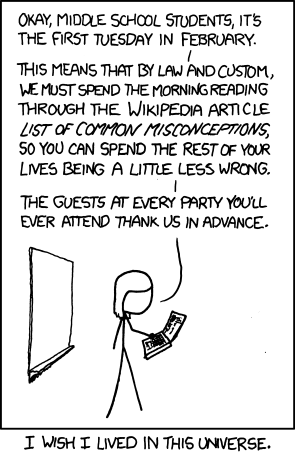
That Was Tina Fey, Dammit

From XKCD:


That's a hell of an idea. Get cracking. Odds are sooner or later we'll get to one or more items on the list in further detail, and in fact we did get to one of them on Friday, but to get you started:

*Sarah Palin didn't say 'I can see Russia from my house',
*Al Gore didn't say he invented the Internet,
*Napoleon wasn't short,
*You can't see the Great Wall of China from the moon,
*Cold weather doesn't give you colds,
*Shaving doesn't make your hair thicker,
*Guys don't think about sex every couple seconds, and even if we do, there's no way you can actually test that,
*If a guy's in the water waving his hands and screaming that he's drowning, he's not drowning,
*A fatwa is not a death sentence,
*A jihad is not a holy war,
*And they don't dump toilet waste out of moving airplanes.

Now never say these things again.

Sunday, January 2, 2011

Go Away, I'm Watching The Packers

Here. Name all the elements of the periodic table in 15 minutes and shut up while Daddy watches his stories.

Sunday, November 28, 2010

All Hail The Chinese Strongmen

The BBC aside, state-run media's usually not all that great a source. It often tends to be a little heavy-handed towards glorifying the state and the party that runs it. CCTV of China is no exception.

And you will see examples of that in the piece provided today, but if you can get past that, here's ten minutes on how weightlifters get those big heavy things over their heads. It is, after all, an Olympic sport, with plenty of medals up for grabs, and China knows a thing or two about those.

Wednesday, November 10, 2010

Things Black Holes Might Do

Burp. Or 'blow bubbles', as the article put it. I am probably going to make a mess of the explanation provided within, but here's my best shot:

You might have heard of 'Hawking radiation'- kudos if you have- but for those who haven't, it's a principle by Stephen Hawking that a black hole doesn't necessarily keep all the matter it sucks in forever, but rather leaks out the odd particle here and there, which pops up just outside the event horizon. How that's supposed to work, don't ask me. He's Stephen Hawking and I'm not. Eventually- billions of years down the road, maybe trillions- if the black hole doesn't suck in anything else, it will one day evaporate due to lack of mass.

That established, the article has found a big mass of gamma-ray-emitting gas, shaped like a pair of bubbles, on either end of the black hole at the center of the Milky Way. Douglas Finkbinder of Harvard, leader of a team of people that found it, thinks it might have come when the black hole took in a lot of matter at once and, basically, burped. Or "expelled jets of material".

Really, just click the link. I'm afraid to venture any further attempts on this one.