Fair enough.
But you should take it under advisement that Google+ is owned by Google, which has your Google account. And if you misbehave on Google+, Google can and will delete your Google account.
Think about all the things you have on your Google account.
I advise against being stupid on Google+. And if you're not willing to risk it, stick to Facebook.
Thursday, July 14, 2011


Wednesday, July 13, 2011
How Bad Would Default Be, Really?
The matter of the debt ceiling crisis has left everybody in America scrambling to try and figure out what, exactly, is going to happen. After all, the United States has never defaulted on a debt.
I'm not going to claim I've got an answer either. But I will say that if there are no suitable analogs in the United States, that doesn't mean we have to run around in general chaos going We Have No Idea. In case anyone's forgotten, there are other countries in the world. And the rest of the world has had money problems too.
So what I'm going to do today is provide a sampling of foreign analogs to the American situation.
*The most commonly-referred to situation, when someone does go foreign, is Greece. Their debt per capita is similar, it's recent, it spawns from the same basic global meltdown, they're also tossing around the word 'austerity'. However, the one thing to keep in mind is the manner in which their austerity is being conducted. Namely, the Greek legislature literally has no choice in the matter. They've taken bailout money from the International Monetary Fund. The EU is more or less dictating to Greece what their remedy will be, on pain of possibly being kicked out of the Eurozone, as there has been discussion of doing. The United States has China as its major creditor, and buys a lot of treasury bonds, but a majority of American debt is internal- Medicare, Social Security, etc. Greece has a formal, explicit obligation to follow the rest of the Eurozone's instructions. Surrender of a degree of sovereignty is a condition of membership. The United States, being so fiercely independent, cannot relate. A bailout of the United States would almost certainly come from the IMF, but as that would entail the IMF imposing solutions of its own, taking a degree of control out of the hands of America, such a bailout seems unlikely, even if the IMF and United States have had historically cozy relations.
*There is a second European nation to considering the same Euro crisis, and that's Belgium. Their main characteristic is their partisanship. As the United States has Democrats and Republicans, the Belgians have ethnic Walloons in the south and Flemish in the north to serve a similar purpose. Flanders has a larger population, but the Belgian legislature is split nearly down the middle. Belgium has a multiparty parliamentary system, which if you're one of those people that wants to bust up the Dems and GOP and go to a multiparty system seems just fine. Belgium, however, shows the downside of a parliamentary system. No matter how you slice the population up, once the elections are over, some combination of people has to form a majority in order for the legislature to function and laws debated and passed.
Belgium has gone for over a year now without finding that majority, a world record. As such, the Belgian interim government is crippled and near-powerless to stop the crisis from reaching them unless they find a majority somewhere in their ranks; elections would leave the country completely government-less at a really bad time. And given that they aren't even speaking to each other, that appears an unlikely ask.
Some Flemish are talking of independence, or at least increased autonomy.
It sounds a fair bit like our situation, only turned up to 11. The problem with using this as an analog, though, is that we don't know how their story ends. The whole point here is to figure out what to do in our situation, and to do that, we need to know how the story ended for others in similar situations. We don't know if they get swept up in the Euro crisis, find common ground at the eleventh hour, or what.
So we have to keep looking.
*The largest pre-recession sovereign default was of Argentina in 1999. Their recession lasted until 2002, and while their economy is now growing more stable by the year, some would say they're still trying to get out from under the fallout. The reason for that is that, upon their default, all of their creditors scrambled to be repaid immediately, and first. Likewise, nobody was about to lend them a dollar more.
The tricky thing about Argentina, though, is in how they valued their currency, the peso. While the dollar is used around the world as a reserve currency- a currency everyone else holds in reserve and measures their own currency against- Argentina, pre-default, tied the peso directly to the dollar. Whatever the dollar was worth, Argentina made the peso worth an equal amount. Once the default hit, Argentina floated the peso- that is, stopped tying it to the dollar. The peso's value promptly went down the toilet.
As a side effect, Argentinian TV stations had to rely heavily on reality shows in order to get by, and cancel the more expensive educational programming.
Argentina would have had to gut their budget, just absolutely gut it, in order to pay the money they owed to everybody. What they ultimately did, though, was stand firm for four years- four years where they were shut out of the international financial market- until they got their creditors to agree to a debt restructuring plan where most of their debt payments were reduced and stretched out until 2006, when an uptick in the economy left Argentina more able to pay debts in full. They have come steadily out of their hole since then; the gap between rich and poor has shrunk. About a quarter of the debt's representatives held out, though. As of 2010, 7.4% of the debt remains unrestructured.
The trouble here is in pre-existing standing: while Argentina was shut out of the financial market, the United States to a large degree IS the financial market. The world could go on without
Argentina's participation, but the United States has too many fingers of too large a size in too many pies to just leave alone like that. Argentina itself had, again, directly tied the peso to the American dollar. America is not currently tying the dollar to the Argentine peso, or any other currency. The dollar is in fact a reserve currency- a currency everyone else holds in reserve, just in case something were to happen with their own.
So three analogs, all with a nagging problem that keeps any of them from being 100% perfect. However, all three, along with other defaults we didn't get into such as Russia in 1998 (PDF), Mexico in 1994, Latin America's "La Decada Perdida"- lost decade- in the 1980's, and anything beyond those listed on the timelines here, have a common thread: pain. Lots and lots of pain. Even getting into the situation in the first place causes pain. Anyone that tells you that an American default would not be painful, one way or another, is stupid and/or lying.
The question is simply, how much pain. Are you hitting your hand with a mallet, putting it on a stove, or shoving it into a wood chipper?
Tuesday, July 12, 2011
All Points Bulletin
Everywhere is the center of the universe. Or at least it seems that way sometimes. No matter how isolated a town is from the rest of the world, they're always going to think about places and events in relation to where they are. Any city of any size will, however rightly or wrongly, think of itself as the hub of the county, the region, the state, the country, the world. Everything goes through them (solve for value of "everything").
As such, it will sometimes happen that one of these places will construct a road sign or a compass or a globe or some sort of large-scale 'You Are Here' sign.
For many countries, this takes the form of something Wikipedia has blanket-referred to as Kilometer Zero. Kilometer Zero is a marker or monument located somewhere in the country- typically the capital, but not always- from which all distances in the country are intended to be measured.
France's Kilometer Zero is this marker in front of the Cathedral of Notre Dame. Spain's is this marker in Madrid's Puerta del Sol. Indonesia's is this building on the west coast of the island of Sabang. Ukraine's is this monument in Kiev. Canada's is the western end of the Trans-Canada Highway on Vancouver Island, British Columbia.
The United States has a Kilometer Zero, called Zero Milestone. It was created in 1923, sitting within eyesight of the White House. However, in practice, it only serves as Kilometer Zero for Washington DC. Everybody else does their own thing. Mile markers might measure the distance to the county line or state line. Highway distance signs have no definitive answer I could hunt down. When looking for what a sign signifying distance to any given city uses as its point of reference, I came up with the post office (though which one?), some other public building, 'a point close to the center of town', and 'the edge of town'. You're on your own for that one.
Italy's current Kilometer Zero is the top of Capitoline Hill in Rome. Back in the days of the Roman Empire, though, they used the Milliarium Aureum, a golden milestone (that's the translated Latin) with gilded bronze finishing. It's thought, but not confirmed, that the Milliarium Aureum had listed on it distances to all the major cities in the Roman Empire (hence the term 'all roads lead to Rome').
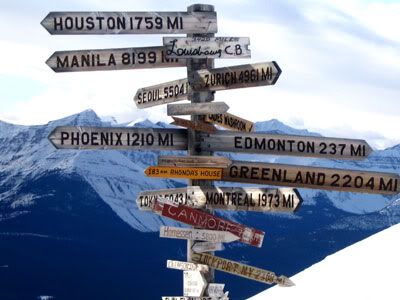
Not many modern Kilometer Zeroes list city distances. That role has largely been relegated to signs that look like this one at Lake Louise Ski Resort in Alberta:
 (source: travelandtransitions.com)
Those are the fun ones, incidentally.
But the undisputed Kilometer Zero champion has to be- and if you've ever driven in South Dakota, you know it already- Wall Drug. It's not every tacky tourist trap that can get itself a sign in Amsterdam. Or Antarctica. Or Bagram AFB in Afghanistan. Or a sign that tells you about their other signs in Kenya and London.
Or this blog.
It's 676 miles to Wall Drug, South Dakota.
As such, it will sometimes happen that one of these places will construct a road sign or a compass or a globe or some sort of large-scale 'You Are Here' sign.
For many countries, this takes the form of something Wikipedia has blanket-referred to as Kilometer Zero. Kilometer Zero is a marker or monument located somewhere in the country- typically the capital, but not always- from which all distances in the country are intended to be measured.
France's Kilometer Zero is this marker in front of the Cathedral of Notre Dame. Spain's is this marker in Madrid's Puerta del Sol. Indonesia's is this building on the west coast of the island of Sabang. Ukraine's is this monument in Kiev. Canada's is the western end of the Trans-Canada Highway on Vancouver Island, British Columbia.
The United States has a Kilometer Zero, called Zero Milestone. It was created in 1923, sitting within eyesight of the White House. However, in practice, it only serves as Kilometer Zero for Washington DC. Everybody else does their own thing. Mile markers might measure the distance to the county line or state line. Highway distance signs have no definitive answer I could hunt down. When looking for what a sign signifying distance to any given city uses as its point of reference, I came up with the post office (though which one?), some other public building, 'a point close to the center of town', and 'the edge of town'. You're on your own for that one.
Italy's current Kilometer Zero is the top of Capitoline Hill in Rome. Back in the days of the Roman Empire, though, they used the Milliarium Aureum, a golden milestone (that's the translated Latin) with gilded bronze finishing. It's thought, but not confirmed, that the Milliarium Aureum had listed on it distances to all the major cities in the Roman Empire (hence the term 'all roads lead to Rome').
Not many modern Kilometer Zeroes list city distances. That role has largely been relegated to signs that look like this one at Lake Louise Ski Resort in Alberta:
Those are the fun ones, incidentally.
But the undisputed Kilometer Zero champion has to be- and if you've ever driven in South Dakota, you know it already- Wall Drug. It's not every tacky tourist trap that can get itself a sign in Amsterdam. Or Antarctica. Or Bagram AFB in Afghanistan. Or a sign that tells you about their other signs in Kenya and London.


Or this blog.
It's 676 miles to Wall Drug, South Dakota.
Monday, July 11, 2011
Send Food
On June 24th, I told you about a lack of food in Niger.
Today, suffice to say that on the eastern end of the African continent, it's even worse. Some 10 million people across the Horn of Africa- Somalia, Ethiopia, Kenya- are facing what is thought to be the worst food crisis in 60 years, after two straight years of drought. Less food means higher food prices for what is there, and that has made food too expensive for many.
You remember when Sally Struthers got on TV and told you about how everyone was starving over there? It's even worse now than it was then.
Let's not mince words: aid organizations need enough money to feed 10 million starving people across three countries, one of which is perpetually politically unstable. That's kind of a lot of money. UNICEF is probably your best bet if you want to contribute.
Sunday, July 10, 2011
Your TV Is Not A Legal Advisor
I promise this is the only time we'll talk about Casey Anthony. Promise with sugar on top.
Now, full disclosure, I have barely followed a word of the trial. I quite honestly could not care less. I think it has something to do with someone dead, but that's it. However, my interest was piqued when I caught Erik Uliasz of Philly2Philly.com chalking Anthony's not-guilty verdict for whatever it is that he did- perhaps insider trading- to the CSI Effect.
That little phenomenon is something we can work with. The CSI Effect's been written about before, by a lot of people, but apparently, we need to go over it some more.
If you're ever on a jury, be advised that most evidence is circumstantial. That's evidence which you need to infer something in order to tie it to the case at hand. By itself, it's not too strong. But as circumstantial evidence builds, it becomes corroborating evidence: each piece of evidence helps the others build a case. It is very possible to make an ironclad case out of nothing but circumstantial evidence. Direct evidence, meanwhile, is something from which you have to infer nothing.
If a witness says "I saw Al shoot Bob", that's direct evidence. You saw Al shoot Bob. If a witness says "I saw Al grab a gun, go into Bob's house, then there was a bang and screaming", that's circumstantial. All signs point to Al shooting Bob, but you didn't actually see it. You have to infer it from all the signs.
Juries, though, tend to not be up on these things. A lot of them don't even want to be there. They just want to call a verdict and go home. All they know is what they see on TV. They're not in the legal world for a living. And what they know is that circumstantial evidence is a Bad Thing. They want direct evidence. In fact, if it's not direct evidence, sometimes they just plain won't convict.
The CSI Effect is an extension of this. Again, all the jurors often know is what they see on TV. And what they see on TV is CSI, where every case is solved with DNA evidence obtained in ways that, a good 40% of the time, are impossible. (The CSI effect has also been linked to other procedural of the era, such as NCIA, Bones and Cold Case.) What happens to the jury is that they demand DNA evidence, or else they won't convict. No matter how strong the rest of the case, if it's not DNA, they might as well replace the whole trial with episodes of the Muppet Show.
Not only that, but they demand absolute 100% slam-dunk conclusiveness. When a forensics expert mentions the 1-in-umpty-gazillion chance (and one does exist) that the DNA could give a false positive, that measurably harms the credibility of that DNA evidence in the minds of the jury, who has taken 'guilty beyond a reasonable doubt' to mean 'they better have found the killer standing over the victim cackling maniacally'.
This is not the first time a TV show has caused juries to be overly critical of the prosecution. TV's black-and-white era brought us a similar phenomenon called Perry Mason Syndrome. This, arguably, was even worse, because in every episode of Perry Mason, they would arrest the wrong guy, but at the end of the episode, the real culprit- who was always in attendance, whether they were called as a witness or not- would just leap up out of their chair and confess.
Perry Mason ran from 1957-1966. No prizes for guessing what the juries of that era were looking for.
Perry Mason Syndrome hit the actual defendants as well. Perry Mason made such an oversimplified mess of the technicalities of the legal system that it caused some defendants to forgo lawyers, thinking that law was so easy they could do it themselves. This tended not to end well. (WARNING: It'll run you $12.50 to the LexisNexis people to read the full text of that linked piece.)
Let's just recap here: Perry Mason, CSI, and every other procedural and legal show out there are TV shows. They're not there to teach you about the legal system. They're there to entertain you. And if entertaining you means whooshy graphics and dramatic confessions and darkened crime labs that in no way resemble how the actual criminal justice system works, that's what you get.
If you would like to see actual TV coverage of how the legal system works, TruTV has it on from 9-3 Eastern on weekdays, called 'In Session'. It's a remnant of their earlier, less reality-intensive life as Court TV. How often do you watch it?
Yeah. Me neither.
Now let us never speak of Casey Anthony again or his acquittal of, I believe, public nudity.
Saturday, July 9, 2011
Venues Less Desirable Than Summerfest
Musicians live and die on their concerts. Getting gigs is how you get your name out there and how you make a lot of your sales and money. It's also a way to get people who only know one song of yours to listen to a bunch of your other songs.
If they hate what they're hearing, though, it also gives the fans direct access to the offender.
Meet, via Wikipedia Roulette, Haji Saifo, a folk singer of Tajik descent, in his prime during the 1980's. Recordings of Saifo's songs are rare- he lived in Central Asia, after all.
Though a video of him is available here.
But recordings of Saifo missed the point of listening to him. The point of listening to Saifo was to see just what he would say next. Saifo's songs were never the same twice. He would follow maybe a particular topic, but then go ranting on that topic, or maybe some other loosely-related topic, long beyond the point where an album could hold him anyway. Sometimes a song might last a half-hour.
And quite often, Saifo would end up dragging the audience into the lyrics, guests of honor included. He was not necessarily flattering, either. Or sometimes he was too flattering. Sometimes he would question the manhood of a groom at his own wedding reception. Sometimes he would hit on the bride, or at least the bride's breasts. How the audience took Saifo's rantings depended on the audience. Some had fun with it, knowing what they were getting themselves into. Some got a little uncomfortable. Some threw food at him.
And according to accounts, this was his downfall. Remember, Saifo was performing in Afghanistan, with a prime in the 1980's. It was only a matter of time before he would rant to the wrong people. As the story goes, in 1998, he found the wrong people: the wedding of a Taliban general. It's not clear what exactly happened, or what he said. But the story maintains that he said something in his lyrics, and the Taliban audience responded by doing something with their guns.
Tough crowd.
Your Atlas Is Obsolete Again
Congratulations to South Sudan on their now-official independence. Best of luck to you.
And, of course, best of luck also to what we should probably start calling North Sudan, which has now lost most of its oil but keeps the long-ongoing Darfur crisis, and sprouts a new crisis in South Kordofan, which wanted to join South Sudan but didn't get the chance.
And, of course, best of luck also to what we should probably start calling North Sudan, which has now lost most of its oil but keeps the long-ongoing Darfur crisis, and sprouts a new crisis in South Kordofan, which wanted to join South Sudan but didn't get the chance.
Subscribe to:
Posts (Atom)