Pages

Showing posts with label travel. Show all posts

Tuesday, July 12, 2011

All Points Bulletin

Everywhere is the center of the universe. Or at least it seems that way sometimes. No matter how isolated a town is from the rest of the world, they're always going to think about places and events in relation to where they are. Any city of any size will, however rightly or wrongly, think of itself as the hub of the county, the region, the state, the country, the world. Everything goes through them (solve for value of "everything").

As such, it will sometimes happen that one of these places will construct a road sign or a compass or a globe or some sort of large-scale 'You Are Here' sign.

For many countries, this takes the form of something Wikipedia has blanket-referred to as Kilometer Zero. Kilometer Zero is a marker or monument located somewhere in the country- typically the capital, but not always- from which all distances in the country are intended to be measured.

France's Kilometer Zero is this marker in front of the Cathedral of Notre Dame. Spain's is this marker in Madrid's Puerta del Sol. Indonesia's is this building on the west coast of the island of Sabang. Ukraine's is this monument in Kiev. Canada's is the western end of the Trans-Canada Highway on Vancouver Island, British Columbia.

The United States has a Kilometer Zero, called Zero Milestone. It was created in 1923, sitting within eyesight of the White House. However, in practice, it only serves as Kilometer Zero for Washington DC. Everybody else does their own thing. Mile markers might measure the distance to the county line or state line. Highway distance signs have no definitive answer I could hunt down. When looking for what a sign signifying distance to any given city uses as its point of reference, I came up with the post office (though which one?), some other public building, 'a point close to the center of town', and 'the edge of town'. You're on your own for that one.

Italy's current Kilometer Zero is the top of Capitoline Hill in Rome. Back in the days of the Roman Empire, though, they used the Milliarium Aureum, a golden milestone (that's the translated Latin) with gilded bronze finishing. It's thought, but not confirmed, that the Milliarium Aureum had listed on it distances to all the major cities in the Roman Empire (hence the term 'all roads lead to Rome').

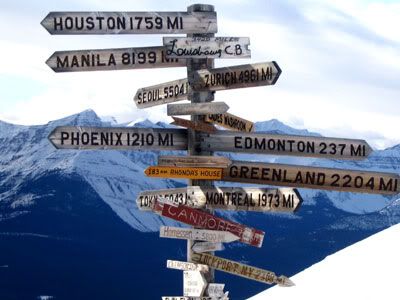
Not many modern Kilometer Zeroes list city distances. That role has largely been relegated to signs that look like this one at Lake Louise Ski Resort in Alberta:

(source: travelandtransitions.com)

Those are the fun ones, incidentally.

But the undisputed Kilometer Zero champion has to be- and if you've ever driven in South Dakota, you know it already- Wall Drug. It's not every tacky tourist trap that can get itself a sign in Amsterdam. Or Antarctica. Or Bagram AFB in Afghanistan. Or a sign that tells you about their other signs in Kenya and London.

Or this blog.

It's 676 miles to Wall Drug, South Dakota.

Tuesday, February 8, 2011

Above The Tree Line

When you think of Mont Ventoux--

...what?

...Well, you are now. Go with it.

Mont Ventoux, when AND IF you think of it, you know as one of the more storied climbs in the Tour de France.

...Yes, the Tour de France has characteristics beyond that of so many people doping that we've just about come all the way back around to a level playing field again. Stop interrupting.

The climb has gained notoriety over the years as one of the most difficult, downright brutal ascents in France, despite an elevation of only 6,263 feet, with no trees to provide shade, winds that blow riders all over the road, and the knowledge in the back of every cyclist's mind that the climb has in the past taken a life. In the 1967 Tour, Tom Simpson of the United Kingdom rode himself to exhaustion, collapsing and dying one kilometer from the summit. His last words were "Put me back on my bike." A memorial stands where he fell.

...what now? Oh, fine, let me go look. ....yes, he had amphetamines on him when he died. Shut up already.

In any case, there is more to this mountain than a bike race. This peak, while brutal to bikes, does not pose a great deal of challenge to straight climbers, though the lack of trees might necessitate carrying a decent amount of water. Mont Ventoux, because of that ease to ascend without a bike, is therefore about as good a mountain as any to be considered the birthplace of mountaineering.

To be sure, mountains have been climbed since time immemorial. But before 1336, it was done purely out of necessity- migration, military maneuvers, some sort of religious purpose. Mountains were not climbed merely to be climbed. However, on April 26, the Italian poet Petrarch, alongside his brother and a pair of servants, became the first to do it for fun. As he wrote after his climb, in 'The Ascent of Mont Ventoux', he states right off the bat, "To-day I made the ascent of the highest mountain in this region, which is not improperly called Ventosum. My only motive was the wish to see what so great an elevation had to offer." Certainly he was not doing it to be first to the peak. Petrarch himself met someone who had, many years before, gotten to the top, but while the exact reason is not stated in the text, Petrarch's predecessor certainly did not have fun...

"We found an old shepherd in one of the mountain dales, who tried, at great length, to dissuade us from the ascent, saying that some fifty years before he had, in the same ardour of youth, reached the summit, but had gotten for his pains nothing except fatigue and regret, and clothes and body torn by the rocks and briars."

Petrarch was no expert climber. The easiest way to get up mountains is generally to find a ridge- the high road, basically- and follow that. By taking the high road, you are, obviously, climbing from a higher position, making for a flatter incline. Petrarch's brother followed this guideline, but Petrarch describes in the text how he instead elected to take valley routes, which is fine at the start of an ascent, but you have to cover the same amount of vertical either way, and a valley route just makes you do the vertical all at once at the end. Petrarch made this mistake several times, picking routes that in fact descended at some points.

"Suffice it to say that, much to my vexation and my brother's amusement, I made this same mistake three times or more during a few hours."

He did, of course, eventually reach the summit, and there, staring out into the distance, is where Petrarch cemented Mont Ventoux's place in the climbing world, not as a challenge, not as a feat, but as a pilgrimage:

"At first, owing to the unaccustomed quality of the air and the effect of the great sweep of view spread out before me, I stood like one dazed. I beheld the clouds under our feet, and what I had read of Athos and Olympus seemed less incredible as I myself witnessed the same things from a mountain of less fame. I turned my eyes toward Italy, whither my heart most inclined. The Alps, rugged and snow-capped, seemed to rise close by, although they were really at a great distance; the very same Alps through which that fierce enemy of the Roman name once made his way, bursting the rocks, if we may believe the report, by the application of vinegar. I sighed, I must confess, for the skies of Italy, which I beheld rather with my mind than with my eyes. An inexpressible longing came over me to see once more my friend and my country. At the same time I reproached myself for this double weakness, springing, as it did, from a soul not yet steeled to manly resistance."

And so it is that, to this day, when not occupied by the Tour de France, Mont Ventoux is occupied by climbers that, if they so choose, can follow Petrarch's exact route, GR4.

And not all of them are on steroids.

Friday, January 28, 2011

'Yeehaw' In A Dignified Context

Earlier this month, we talked about Hobe Sound, Florida, which in an attempt to become the next Hollywood changed its name to Picture City. They are not the only Florida city to change their name.

There's a good possibility that, if you've been to Orlando, you've stopped in nearby Yeehaw Junction at some point, if only for coupons. It's a tiny town, so you probably took 'Yeehaw' as a sign that you're in the sticks. In fact, there are two schools of thought about where 'Yeehaw' came from: a mule, or the Creek Indian word for 'wolf'.

It's still a step up from the previous name: Jackass Junction.

This was absolutely a mule-related name- mules were used to haul lumber back when the town got roads in the 1930's- but you could also pin it to the patrons of the Desert Inn, which was, let's not mince words, a whorehouse. And the local watercooler.

This was fine when there were no tourists around. Eventually, of course, tourists came. So did the Florida Turnpike. A town called "Jackass Junction" was not good for business. In 1957, the state legislature ordered Jackass Junction to change their name.

One can imagine how gritted the teeth were as they accepted the new name.

Tuesday, December 28, 2010

I Will Turn This Plane Around If You Don't Settle Down Back There

What follows is a list of countries. Alongside those countries is what I have to the best of my abilities determined to be the single most-visited attraction in that country. 'Attraction' is the operative word; most places I looked at excluded places like shopping malls and casinos and I just kind of had to cobble together a know-it-when-you-see-it personal definition. (One place excluded the Mall of America. I disagree. When I was there in May, I confirmed with a mall employee that there are people that fly into the United States, stay overnight, go to the mall, and then fly home, the mall being all they do in the United States. The airport is literally right across the street. I call that an attraction.) Otherwise, I'm kind of going by what's given to me.

Why? Because I can. Why do I post half the content around here? For lack of a better term, intellectual masturbation. Facts for the sake of facts. The kind of thing that makes onlookers go 'Well, that's rather interesting, but wow, you've got way too much time on your hands.'

This was a lot more difficult than anticipated, though. This is a surprisingly inexact thing; numbers were not always supplied and so in several cases I had little choice but to follow a consensus; the link being a reflection of same. The list of countries is not complete- it was a total bear to pull more than one country's top attration off of any one link- but it's as large as I could make it before exhaustion set in. Really, I'm a bit shocked that this kind of thing isn't vastly better-documented than it is. You would think that this would be the kind of thing that gets trumpeted in the travel industry. Granted, a lot of countries on Earth aren't exactly known for tourism, but lack of documentation was a problem even with the countries that actually expect tourists on a regular basis-- Hungary, Uruguay, United Arab Emirates, Belgium, Czech Republic, Romania, Thailand, Chile, Costa Rica, Malaysia, Argentina, Morocco. I never was able to get anything resembling confirmation for any of them.

The countries are not in competition with one another; even if I wished that the case, that would be near-impossible, except to say that number one overall is Times Square of the United States. Speaking of, if the Americans want a state-level equivalent, someone else has you covered already.

And just to clarify: most-visited does not mean best.

Sound good? Here we go.

Anguilla- Shoal Bay East
Aruba- Natural Bridge, never mind that the bridge actually collapsed in 2005; people go look at the rubble
Australia- Great Barrier Reef
Austria- Schonbrunn Palace, Vienna
Bahamas- Two places are equally claimed: the Royal Naval Dockyard and the Bermuda Aquarium, Museum and Zoo. I'd probably give it to the aquarium if forced to guess.
Bangladesh- Cox's Bazar, Dhaka
Barbados- Harrison's Cave
Belize- Ambergris Caye
Bolivia- Yungas Road, and you people are absolutely fucking sick
Botswana- Okavango Delta
Brazil- Christ the Redeemer statue, Rio de Janeiro
Cambodia- Angkor Wat
Cameroon- Waza National Park
Canada- Niagara Falls
Cayman Islands- Can't call it one way or the other. It's either the Turtle Farm or Stingray City. Gun to my head, I'd guess the Turtle Farm.
China- Great Wall of China
Colombia- Chicamocha National Park
Croatia- Plitvice Lakes National Park
Denmark- Tivoli Gardens, Copenhagen
Ecuador- Galapagos Islands
Egypt- Pyramids of Giza
Finland- Linnanmäki Amusement Park, Helsinki
France- Euro Disney, Paris
Gambia- Abuko Nature Reserve
Germany- Neuschwanstein Castle
Greece- Acropolis, Athens
Greenland- Ilulissat
Guam- Two Lovers Point
Guatemala- Xocomil/Xetulul, Retalhuleu (Lonely Planet Guatemala)
Honduras- Bay Islands
Hong Kong- Hong Kong Disneyland
Iceland- Blue Lagoon
India- Taj Mahal, Agra
Indonesia- Borobudur
Ireland- Guinness Storehouse, Dublin
Israel- Western Wall, Jerusalem
Italy- Vatican City, or if you count the Vatican separately, the Roman Coliseum, Rome.
Jamaica- Dunn's River Falls, Ocho Rios
Japan- Tokyo Disneyland, Tokyo
Jordan- Petra
Kenya- Maasai Mara Reserve
Kuwait- Failaka Island
Macedonia- Lake Ohrid
Malawi- Lake Malawi
Mali- Bandiagara Cliffs (aka Dogon Country), Mopti (Mali: the Bradt Travel Guide)
Mexico- Tenochtilan
Monaco- Rock of Monaco, Monte Carlo
Mongolia- Terelj National Park
Namibia- Etosha National Park
Nepal- Mount Everest
Netherlands- Efteling, Kaatsheuvel
New Zealand- Sky Tower, Auckland
Norway- Floibanen, Bergen
Oman- Nizwa Fort, Nizwa
Panama- Panama Canal
Peru- Machu Picchu
Poland- Auschwitz
Portugal- Nothing overly certain here; my best reckoning is the National Coach Museum, Lisbon
Russia- Hermitage Museum, St. Petersburg
Saudi Arabia- Kaaba, Mecca
Senegal- Goree Island
Seychelles- Beau Vallon Bay, Mahe Island
Singapore- Sentosa Island
Slovakia- Aquacity, Poprad
Slovenia- Postojna Caves
South Africa- Victoria and Alfred Waterfront, Cape Town
South Korea- Everland, Kyonggi-Do
Spain- Alhambra, Granada
St. Lucia- Pitons
Sweden- Liseberg Nojespark, Gothenburg
Switzerland- Matterhorn, Zermatt
Tanzania- Serengeti National Park, though it and Mount Kilimanjaro help make up what is more commonly referred to as the 'most popular' attraction, the "Northern Circuit"
Turkey- Hagia Sophia, Istanbul; the link shows a museum exhibit that overtook it, but that exhibit has since closed
United Kingdom- Trafalgar Square, London
United States- Times Square, New York City
Venezuela- Angel Falls
Vietnam- Halong Bay
Zambia- Victoria Falls
Zimbabwe- Also Victoria Falls

If anyone has corrections (with numbers; you're certain to find disagreeing sites), or if anyone can fill in some of the countries I didn't get, if you put it in the comments, that'd be great. If you do launch a search, though, note that there is a huge difference between "one of the biggest attractions" and "the biggest attraction".

Thursday, November 25, 2010

"Free Copy - Take It. We'll Replace It!"

And so it was that I obtained the oddest souvenir of my Hawaii vacation: the SkyMall catalog from the plane.

For anyone who has either never been on a plane, or who has never looked in that pouch in front of their seat, SkyMall is a catalog full of things you can buy- via credit card, of course- during the flight (or during the 48 hours post-flight, at least if you'd like bonus miles or discounts).

It is also some very fine in-flight entertainment.

Founded in 1990, SkyMall was created when Robert M. Worsley, flying to Seattle to Phoenix in 1989, thumbed through a Giftmaster catalog on the plane and was "startled by the poor merchandise". He set out to replace it with expensive and oddball merchandise which initially sold so poorly that SkyMall was forced to cover the cost of the extra fuel required to carry the catalogs. On top of all that, Wolsley had a heart attack in the middle of the 1991 company Christmas party. The company nearly died, being saved only when they started charging vendors by the page to appear in the catalog, and ceasing to carry inventory themselves, instead having merchandise directly sent to consumers (an initial plan was to have them order on the plane and have the purchases waiting for them at their destination). Since then, things have slowly, steadily improved for SkyMall.

That established.

When looking through the Holiday 2010 SkyMall catalog, the ridiculousness hits hard and heavy. In no particular order, and remember that all of these are actual products, linked to prove it:

"The water squirting remote controlled car." That's right, for those times when a Super Soaker just won't do, now there's an RC car you can fill with 8.5 ounces of water that can then shoot a target from 15 feet away. It's the Predator Drone of water gun battles! Amaze and piss off your friends by hiding in the living room while you get everyone wet in a manner where they can't get you back! Then gaze in awe, or actually, don't gaze, as the second the car's out of your line of sight, you accidentally run it into a wall, and then your friends stomp on it until it's a little pile of scrap! Only $99.95!

"The touchscreen video poker game." You know those little handheld poker games you can get at just about any store of sufficient size for around $15? Well, now you can get one with "touch-sensitive, color LCD with crystal-clear resolution" and seven kinds of poker included, all for the low, low, not actually low price of $99.95!

"The remote controlled tarantula. This remote-controlled tarantula scurries across flat surfaces like an actual arachnid, moving forwards and backwards on command. The spider's thorax and abdomen conceal two motors: one that drives a set of wheels that provide directional movement and one that enables the eight legs to twitch, allowing you to frighten unsuspecting arachnophobes day or night from 25' away. It has a hairy exterior, similar to the urticating hairs that cover a tarantula's abdomen, and its chelicerae suggest two hidden fangs." And you too can be an incredible dick to anyone you know who's scared of spiders for only $29.95!

"The "Keep Your Distance" bug vacuum." It's a two-foot vacuum, for bugs, that sucks them up and then zaps them. And if YOU'RE too lazy to swing a fly swatter, this can all be yours for $59.95!

"The marshmallow shooter." It's a toy gun. It shoots marshmallows 30 feet. It can also shoot foam pellets, but those aren't included. That's $24.95, BUT WAIT! THERE'S MORE! Are you just not sure what to shoot your marshmallows at? Then get the Marshmallow Target, which "plays one of four different sounds when hit. Requires two AA batteries", for only $19.95 more!

"The voice-interactive alarm clock." Knows 12 phrases, none of which are "Shut the hell up, I'm trying to sleep." $49.95.

"The Brobdingnagian sports chair." It's one of those fold-up fabric chairs, but 5 and a half feet tall. Sure to irritate any poor schmucks behind you, but the back serves as an ideal shield for any beer they wish to throw at you! Unless they stand up and are over 5 feet, 6 inches tall. This golden shower comes for only $149.95!

"These little helmets are guaranteed to be a big hit with true NFL fans." Namely, miniature helmets of all 32 NFL teams. I have a set of these helmets myself. They did not come with a wooden display case, but then, I don't need a wooden display case. And in any event, the helmets cost me far, far less than $99.99.

Speaking of, let's move on to the coasters. The SkyMall catalog provides for eight teams, five baseball, three football: the Cubs, Dodgers, St. Louis Cardinals, Yankees, Red Sox, Cowboys, Jets, and New York Giants. The rest of Major League Baseball, though, is available through the website, along with the Alabama Crimson Tide. You get a set of four per team for the low, low, price of $39.99. That's only $10 per coaster. But really, what's the cost compared with the unthinkable scenario of that little tiny bit of wetness on your table?

Or dirt? On second thought, scratch that: you can buy the dirt! Authentic dirt! The baseball coasters come with a small bit of actual dirt included (the football ones with authentic FieldTurf)! You can also buy dirt in paperweight form, coming from either the inaugural season of the Minnesota Twins' Target Field, the final season of Old Yankee Stadium, or any old dirt from Fenway Park! Again, it's authentic; we're not screwing you with that garbage you've got in your front yard. It will, however, run you $49.99.

Or-- OR-- if you're a Twins fan and don't want your dirt authenticated from the inaugural season of Target Field, you can get your dirt alongside a picture of Joe Mauer! It's an extra $10, making it $59.99, but... Joe Mauer! A picture of him! You can also get Phillies dirt with a picture of Roy Halladay, Giants dirt with a picture of Tim Lincecum, Rockies dirt with a picture of Troy Tulowitski, Nationals dirt with a picture of Stephen Strasburg, or Yankees dirt with a picture of Derek Jeter getting his 2,722nd career hit! (That was the one where he passed Lou Gehrig for the Yankees team record, which everyone will immediately forget about the second he reaches 3,000.)

Or, if you're on a budget, you can get stupid old Wrigley Field dirt for $29.99. You cheap bastard.

Yankees fans can also have sod from Old Yankee Stadium- dirt with freeze-dried grass attached- for $99.99, a brick from Monument Park for $179.99, an even older brick from Old Yankee Stadium for $349.99, an autographed picture of Alex Rodriguez for $499.99, or a seat from Old Yankee Stadium for $799.99, which I hope you're buying for the historic value, because the seat itself is about as comfortable as you'd expect a baseball stadium seat to be.

"Take your favorite car for a spin every time you work on your computer." These are Road Mice, miniatures of various cars that function as computer mice. They're basically computer mice, but with turning circles. Wired for $34.99, wireless for $44.99, or you can have 'premium' computer-mice models of fancier cars for only $64.99!

"Give a gift of money or a gift card inside one of these games- they'll have to win the game to get their prize." For $14.99, you can force your friend to play pinball to claim their gift. For only $12.99, you can make them shuffle a little ball through a cubic maze difficult enough to where there's a chance they will never claim their gift at all and proceed to hate you even more than if you hadn't given them a damn thing! So much more thoughtful than doing something silly like tacking the cost of the game onto the value of the gift and just giving that to the friend, and so much more exciting than the utter predictability of still having a friend at the end of the night!

You know those inflatable floppy dancing guys you see outside car dealerships? Why, from the comfort of an airplane, you can buy your very own for $499! Or a hot air balloon for $1,895 (catalog includes inflatable Godzilla)! Or a giant inflatable panda with a shirt on for $2,295!

"Personalized New York Times birthday book." This is a book consisting of a reprint of the New York Times from the day you were born- a complete reprint, with the ads, the personals, everything. Perfect for anyone in your family who doesn't know enough to Google the same exact thing. Only $99.95!

"Irrational numbers wall clock." Are your clocks usable by normal human beings? You can fix that problem for only $34.95 by replacing the numbers 1-12 with a series of irrational numbers, such as pi, or the square root of 2! It's always 3.14159-o'clock somewhere! And if you're too embarrassed by your hometown to say it outright, why not get a personalized latitude/longitude welcome mat for $32.95? It says "WELCOME TO" and then the coordinates of your hometown.

For four dollars more, it's also available as a watch.

Is your garden just too tasteful? Why not mar the entire neighborhood with with a statue of a naked peeing child? "This classic image will bring timeless art to your home or garden." As well as many interesting visitors! A replica of Brussels' Mannekinpis can be had, complete with a "recirculating pump to create a fountain display" for a mere $198!

"Lightsaber Chopsticks." For the Star Wars fan who has everything! Everything. A disturbing amount of things. Quick, shuffle through any random catalog you can find and look for something he might not have yet. Aside from a girlfriend. Only $21.99. Or you can get a Jawa garden gnome for $34.99, a Darth Vader toaster for $54.99 (burns an image of Darth Vader into the toast!), or a Death Star cookie jar for $49.99.

And, of course, if you don't have the skill to hit a golf ball 200 feet with a golf club- that's 67 yards- you can purchase a trebuchet to do the job for you for $149.

Get moving. Black Friday's tomorrow.
Hawaii's Art Scene and the Shocking Difficulties of the Rapid-Fire Book Club

I am a day back from vacation, and that means I'm back online. This is the first Internet access I've had; I came home to a busted modem. First off, the Rapid-Fire Book Club has two entries to be made:

Farquhar, Michael- A Treasury of Deception: Liars, Misleaders, Hoodwinkers, and the Extraordinary True Stories of History's greatest Hoaxes, Fakes, and Frauds
Keale Sr., Moses K.; Tava, Rerioterai- Niihau: The Traditions of an Hawaiian Island

That second one did not come easy. Hawaii has a vibrant creative culture. They have their own music style (Don Ho, anyone?), and practice it extensively. Pre-existing songs will commonly be covered in the Hawaiian style, and even if you didn't want to hear it, it's pretty tough to get away from. Artists are even easier to find. I stumbled upon one by accident at one point, named Midori, when a painting caught my eye at a gift shop at Byodo-in Temple. As it turned out, she was the gift shop's cashier. (If you happen to be in the area, stop on by; she's quite good. Wish I could link her, but she doesn't seem to have a link to go to.) Dance is particularly alive and well; not just hula can be found, but also urban-style dancing, clubbing, and if you head out to the Polynesian Cultural Center, the show 'Breath of Life' will take it away, especially when the fire comes out. Paintings, sculptures, murals, jewelry, physical movement, and much any other kind of creative expression is completely at home on Oahu.

Except books, apparently.

Sure, there are your Hawaiian books, there are places to buy them. But there aren't many. It's Borders, Barnes and Noble, and then a smattering of utterly forgettable places that you forget even as you drive past them. And it's understandable. In a city that is such a global cultural nexus as Honolulu, visual and aural art can speak to everyone present, but the written word can only speak to those who speak that language. And when English, Hawaiian, Chinese, Japanese, Korean, Tagalog, and your more popular European languages all try to fight for airtime in one place, any one book will only have a limited audience.

Which makes it tough to find something good that you aren't just as, or more, likely to find back home.

Eventually, though, I settled on the book on Niihau. The reason for that is, as tough as it was to find a good Hawaiian book, it would be even tougher to set foot on Niihau.

Why? I'm not a native of Niihau. There are only just a few hundred natives of that island, and while they are able to freely travel to and from Niihau, you and I are not. It's known as the Forbidden Island for this reason. Niihau is a place that hangs on, as best it can, to old Hawaiian tradition. Niihauans keep their history primarily through storytelling which sometimes mixes with Paul Bunyan, Pecos Bill-style tall tales. The book I purchased was originally published in 1989, and was the first real written history of the island. There are still very few titles out there about the place.

Which, being a guardian of old Hawaiian tradition, likely serves to further explain the dearth of literature on the islands. But seeing as the Hawaiian creative soul has been channeled into so many other outlets, it's rather hard to complain much about it.

Friday, October 15, 2010

The Golden Age Of Travel (Sort Of)

The 1950's and 60's are considered by many to be the 'golden age' of travel. Planes came into vogue and had a reputation of 'Yay! I get to go in an airplane!' as opposed to 'Stupid freaking delays in an uncomfortable metal tube WHAT DO YOU MEAN I CAN'T TAKE MY SODA ON THE PLANE I'M A TAXPAYER I PAY YOUR SALARY'. The world was exotic and romantic and a little on the dangerous side but that was okay because it wasn't all touristy yet. It seemed like everyone wanted to go to Cairo, Hong Kong, Rio, Bora Bora and Hawai'i (always with the pronounced second I), and, on a second tier, Paris, Morocco and 'Meh-he-co'. All the travel pictures were washed out and grainy.

All of them. Even National Geographic's. My mom kept a bunch of old issues of National Geographic; they still sit up in our attic after a redecoration. One is from July 1959; it chronicles Alaska's entry into the United States, and the 49-star flag that would last only a short time before Hawaii joined as well. Another is from April 1967; it includes an ad (I love these old ads) for Expo '67 in Montreal; the namesake for the Montreal Expos that showed up two years later. All the photos are grainy, slide-showy, a few were so bad that I thought they were artist's interpretations until I found out that 'super anscochrome' did in fact mean a photograph.

As if to prove my point, the older issues are loaded with ads in the front and back of the magazine, many offering travel every which way. April 1967 runs ads for travel to not only Montreal, but also southern California, Idaho, Montana, Wyoming, Utah, Colorado, Missouri, Wisconsin, Mississippi's gulf coast, Pensacola, Washington DC, Nantucket, the Canadian Pacific, Manitoba, Newfoundland/Labrador, and cruises to the Mediterranean and South America, as well as two pages of classified ads for camps and schools. (One entire page and half of the other is for 'boy's schools', which include military academies; the other half-page is for camps, girls' schools, co-ed schools, home study, and a secretarial school.)

There is one important thing to note, however, about these two National Geographics from the Golden Age of Travel:

Every single person that is doing any traveling is white.

In fact, the only non-whites that show up anywhere in either issue, be it ads or articles, are the drawn-in South Pacific dancers in an ad from the 1959 issue. When they said 'golden age of travel', they meant a golden age for white people. Minorities, particularly blacks, were busy fighting for civil rights at the time. There were many, many places where blacks- or some or all other demographics- were simply not welcome. We're not talking individual diners or stores. Entire towns made a point of actively driving out non-whites and preventing them from living in town by any means necessary. These were referred to as 'sundown towns', because if you weren't white, you had best be out of town by sundown, or else. A number of them went so far as to prominently display a sign on the outskirts of town, most saying "N*****, don't let the sun set on you in (name of town)", or some paraphrasing of same. (Jews were a popular secondary target.) Some sundown towns are still of a sundown mentality even today.

Needless to say, most of the sundown towns don't like to talk about it anymore, as James Loewen found out when he wrote the 2005 book Sundown Towns: A Hidden Dimension of American Racism. His website contains a database of possible sundown towns across the country.

But these people still wanted to travel too. How could they travel with minimal fear of harassment?

If they're black, they would turn to the Green Book.

Have you ever heard of the Green Book? If you're not black, and you said no: good. That was the point. You weren't supposed to know unless you were in it or might need it. Beginning in 1936, the Negro Motorist Green Book was published and distributed within the black community in order to inform black travelers places which were safe to travel to without fear of harassment. The quality of said places was a secondary concern; no ratings were given, though if travelers wrote in and found that a destination was simply awful, they could see to removing it.

As the intro to the 1949 edition stated (available here in PDF): "There will be a day sometime in the future when this guide will not have to be published. That is when we as a race will have equal opportunities and privileges in the United States. It will be a great day for us to suspend this publication for then we can go wherever we please, and without embarrassment. But until that time comes we shall continue to publish this information for your convenience each year."

That time came in 1964, when that year's Civil Rights Act was passed. The Green Book was promptly discarded, and almost completely forgotten until recently, when Calvin Alexander Ramsay discovered it. He is currently working on a documentary about the Green Book, in order to raise awareness of just what travel was like in those days.

And, perhaps, get people considering that the Golden Age of Travel might just be now.

Tuesday, September 7, 2010

The Splendiferous Balloon Escapades of S.A. Andree

If you are trying to be the first person in the world to get to a certain place on Earth- and these places do still exist; there are mountains still unclimbed, though they're obviously becoming rarer and rarer, and less and less worth climbing- it is as a rule incredibly dangerous. There's almost to a man a very good reason why nobody's been there yet. There's no local support structure; if you get stranded and in deep trouble, you're pretty much on your own. This is still to a degree the case with Mount Everest even though it's been climbed so many times that there are established camps along the most popular routes up (on the Nepal side, there's base camp and four higher camps; the Tibetian side sees a base camp, advanced base camp, and four higher camps). When someone dies on Everest, they're normally left where they drop.

The thing is, when you're trying to reach one of these places, the general rule is you have to lay a foot on it in order for it to count. To do otherwise would be kind of cheating. You might also wish to be in full control of your movement; you never know when a freak wind gust might screw you over.

Basically, don't be S.A. Andree.

The first to reach the North Pole's in a bit of dispute. Some say Robert Peary of the United States in 1909 (alongside American Matthew Henson and Inuits Ootah, Seeglo, Egingwah and Ooqueah); some say Roald Amundsen of Norway in 1926, who flew over it with American Lincoln Ellsworth (though Amundsen himself doesn't); some say a Soviet party in 1948 containing an indeterminate amount and assortment of people.

What's important for our purposes, though, is that all of these happened after Andree's foray in 1897. This, of course, meant Andree was attempting to be the first. This was also prior to the Wright Brothers' flight at Kitty Hawk, so planes were not an option. Working ones, at least.

Andree would go in a balloon.

Why a balloon? Andree was a balloonist. He rode in balloons. The quest for the North Pole did not concern him so much as the determination to prove balloons could go to these places. This is a fine way of thinking if this is a place someone has actually gone before; someone who has simply made it there by any means necessary. In fact, this line of thinking works best when the destination has been reached repeatedly and you're trying to prove that your mode of transport can get there too.

This does not work so well if you're trying to be the first to get there, period. Style points aren't a concern.

But, fine. A balloon it is. A mode of transport Andree had only been at for five years, taking his first balloon ride at age 38 in 1892. A mode of transport originally intended for a flight from Africa to South America to see how long a balloon could stay aloft.

Between 1893 and 1895 he would go up in a balloon 12 times, after which he started to publicize the North Pole attempt. Most who heard of it were optimistic and encouraging, perhaps due to whimsy, perhaps because it wouldn't be them in the damn thing. Most had not seen Andree's previous voyages, in which he was routinely thrown around by the wind, slammed into coastal rocks, and once thought the Baltic Sea was just a big lake and that he was actually over land even though he saw a lighthouse and some breakers.

Andree would end up with ample funds for the voyage- think the equivalent in today's money of about a million dollars- including a full-on media frenzy (up to and including board game) and a top-of-the-line balloon. Andree placed his faith as far as steering into drag ropes, which were intended to drag along the ground and make some parts of the balloon go slower than others, allowing it to turn by way of sails Andree had attached. Modern balloonists have described Andree's steering mechanism as, to put it nicely, a bunch of crap.

But never mind all that. Time to pick a crew for what had been dubbed Ornen (The Eagle). And there was no shortage of suckers- er, people to pick from. Andree selected fellow Swedes Nils Ekholm and Nils Strindberg, both of whom were brilliant scientific minds, but neither of whom had anything in the way of survival skills. Andree didn't figure survival skills were all that necessary. After all, this was only the North Pole, not one of those breakneck expeditions over the Baltic.

Ornen was delivered directly to the hangar at Danskoya on the Norwegian archipelago of Svalbard without so much as a test flight, and in 1896, the attempt was made.

Well, the first attempt, anyway. This was everybody's introduction to how the winds would actually be behaving up there. And the winds were howling. Not that it would have mattered much; Ornen was leaking at a disturbing rate due to eight million stitch holes that would not seal. It would get aloft, but it would not stay aloft. The balloon was designed to stay aloft for 30 days; Ekholm figured it was only good for 17 at best. The winds never allowed Ornen to get airborne; but unless Andree got himself a better-sealed balloon, he was not going up in it. This was something Andree was not prepared to do; the media pressure had been crippling and he couldn't bear to not only come back to southern Sweden empty-handed, but to ask for another balloon to boot. Ekholm was out.

Knut Fraenkel, a hiker and civil engineer from Karlstad, Sweden, was in.

Take 2 was on July 11, 1897, and this time the winds were better; good enough to go. Andree, Strindberg and Fraenkel set off.

This was more or less the last anyone back home heard of them, up to and including an early version of National Geographic, which back in 1897 was not a magazine but a real, honest science journal, established only a decade earlier in 1888. National Geographic had something of a handle on how things would turn out nonetheless; it states that "Many eminent geographers have regarded this expedition as an impracticable if not absolutely foolhardy enterprise". The article, published sometime after takeoff, also notes Ekholm, the one who backed out, who figures that Ornen would have come down somewhere between the Pole and Franz Josef Land, and that the group would start making their way towards a preestablished safe haven there. From here on in, though, for absolute information, we rely on expedition notes, which are extremely thorough.

This is how we find out that, within minutes of takeoff, the drag ropes were dumped. The drag ropes that were supposed to be the balloon's steering mechanism. Andree had added some screw holds so as to more efficiently get rid of any ropes that got caught on the ground, but the ropes had decided all at once that they hated the screw holds, and they mostly had to go right away. Also gone was 210 kg of sand, dumped to get Ornen up out of a close encounter with the water, but when the ropes went out as well, the balloon shot up to 2,300 feet, and the lower air pressure encouraged Ornen to leak faster than ever.

Essentially, now we have a very leaky balloon with three people and no steering, headed for, if all goes well, the North Pole.

Then it rained.

Then the rain froze as ice on the balloon. On the plus side, that will plug up some of those airholes.

Needless to say, the balloon did not stay aloft for 30 days. It did not stay aloft for 17 days. It lasted 10 hours and 29 minutes, followed by another 41 hours of what was essentially hopping, coming to a final stop 2 days, 3 hours, 29 minutes after takeoff.

The good news: everybody was unhurt and all the remaining equipment was fine.

The bad news: we have three people stranded someplace or other in the Arctic with little-to-no survival skills. They had a gun- which they would use frequently for hunting- but some of the food had been thrown overboard as ballast. (They did, however, keep the alcohol on board.) The North Pole was out of the question now. It wasn't even brought up anymore. Now it was a matter of heading for some sort of sanctuary, and they knew of two: Cape Flora in Franz Josef Land to the east, and Seven Islands back at Svalbard to the west. Seven Islands was much, much closer, but maps back then were pretty terrible, and they decided to head for Camp Flora.

Just as Ekholm had predicted in National Geographic.

About a week later, they noticed that the ice drift was making them virtually run in place, and on August 4, they started trying for Seven Islands instead.

The terrain wasn't any good that way either. Sometimes they had to crawl on all fours. And when they turned towards Seven Islands, the wind turned to push them away from that as well. The Arctic was positively merciless. They continued to push, but made no headway, and by September 12 it was clear that neither of the safe havens was to be reached. They decided to winter on an ice floe, building a hut out of water-reinforced snow.

The Arctic was not done with them yet. Not only did the ice floe launch itself south, but when the floe neared the island of Kvitoya, it cracked up directly underneath the hut. There was little choice but to gather up what was left of the supplies and make landfall on Kvitoya.

To the very end, Andree seemed determined to at least leave a good-looking corpse for the public. The last coherent entry in his diary reads "Morale remains good. With such comrades as these, one ought to be able to manage under practically any circumstances whatsoever."

It's figured that everybody died a few days later.

If it's any consolation to Andree, the original Africa-to-South America trip he had planned wouldn't have gone any better. There wouldn't have been any place to land the balloon. There would have been no hopping, no skidding along the ground before a final stop, just one big splash. And when the remains were found- in 1930- the crew was, in fact, treated as heroes by a nation that, as it had turned out, had lost the race to both of the poles.

They even built a museum exhibit for them, the Andréeexpeditionen Polar Centre in the Grenna Museum in Granna, Sweden, Andree's hometown.

Monday, August 23, 2010

Do You Know Aboot How Fast You Were Going, Sir?

Not overly in the mood for a big piece today, so it's YouTube time. I give you a timelapse of a trip from Montreal to Vancouver in eight minutes.

Tuesday, May 4, 2010

Disrespect The Met

Having returned from Minneapolis, the obvious must be noted that Twins fans are eternally grateful for the return of outdoor baseball, and their new home, Target Field, is every bit as spectacular as you've heard. It's no Wrigley- Wrigley is a baseball religious experience that no new stadium can match, something sports fans are told they have to do before they die- but it's an outstanding, amazing ballpark. (And the Twins ran away early, winning 10-4.)

But now that it's here, even given the constant nods to the history of Minnesota baseball, not just Twins baseball (but only Minnesota- don't try looking for the Washington Senators because you won't find them), with memories invoked in all corners of the park, with all Twins logos prominent, all teams at all levels, all five retired Twins numbers (Jackie Robinson's #42 excepted) commemorated with their own individual entry gate, every single person who ever played for the Twins noted outside between Gates #29 and #34 on 'Tradition Wall', the walkway to Gate #29 showcasing every vaguely professional stadium ever built in the Twin Cities and every member of the Twins Hall of Fame... I worry that one part of that history may end up unduly forgotten: their previous outdoor stadium, Metropolitan Stadium, aka 'The Met'.

Metropolitan Stadium was the Twins', and for that matter the Vikings' home as well, from 1961-1981, and previously the home of the minor-league Minneapolis Millers from 1956-1960, deserves a degree of enduring affection even as Target Field shines anew. After all, had it not been for the Met, the Twins may not have come into town in the first place. It was built specifically to lure a major-league club from somewhere else.

The Millers, like all Minnesota baseball teams, stand fondly remembered in Target Field, as is, admittedly, Metropolitan Stadium, most notably commemorated by the flagpole used during the Met's life and seeing service at a local American Legion after the Met was demolished. Also remembered, very prominently, is the Twins' immediately preceding stadium, the Metrodome.

The Metrodome is not remembered fondly, mind you. But it is remembered prominently, particularly in the vast majority of the nostalgic clips played in the introductory vignette prior to the start of the game as the Twins display their finest hours.

This was the Metrodome's strength. While a bare-bones venue for fans- a spokesman at the time, according to the Baseball Hall of Shame 2, was quoted as saying "The idea is to get the fans in, let 'em see a game, and then let 'em go home," the noise kept in by the dome, as well as the unique conditions crated by a bouncy turf, the white roof that could conceal fly balls, and the 'Baggie' in right field, created a powerful home-field advantage that ultimately brought the Twins two World Series championships in 1987 and 1991, to the degree that the Twins were lucky to have home-field advantage for both Series, as in each case they would win all four home games and lose all three road games.

But it was a terrible place to be for a fan. Or an opponent. As Blue Jays coach Bob Didler said after Alfredo Griffin lost a hop over the mound in the lights, also according to the Baseball Hall of Shame 2, "Only in Minnesota could someone lose a ground ball in the lights during the day."

The day prior, I had been to the Mall of America, a much nicer place to be than the Metrodome in any sense of the word. After Metropolitan Stadium was demolished in 1985, the Mall of America was built on the site. I had heard that the place home plate stood in the Met was marked somewhere in the Mall, and resolved to, along with the other in-mall destinations I had set, find home plate.

It wasn't easy. Home plate was not marked on any of the Mall's maps or directories. I'd have to find it manually. Also preserved was a red seat commemorating the exact landing spot, elevation included, of the longest home run ever hit in the stadium, a 520-foot blast by Harmon Killebrew in 1967.

I would never find the seat. Nor could any Mall employee I asked tell me where it could be found.

It's a confusing thing. The Met saw an American League champion Twins side as well, in 1965, though here they would be defeated by the Dodgers, again in 7 games. Again, the Twins would lose all their road games, but in 1965, they only won three of four home games, with Sandy Koufax throwing a three-hitter in Game 7.

Metropolitan Stadium was built with no team in particular in mind, but in Minnesota, it really didn't need to be. Though common and in fact expected now, the Met was revolutionary in respect to its wholly cantilevered grandstands, drastically reducing obstructed-view seats. Even modern stadiums don't go all the way with it like the Met did; only New Yankee Stadium does this today as much as Metropolitan Stadium. And besides, what the stadium wouldn't do, the weather would. Minnesota in late March/early April, and deep into October, is not known for its warmth. Prior to their Metrodome days, the Vikings were as feared as any current cold-weather team, going 8-3 in home playoff games at the Met.

The big knock was the Met's poor state at the end of its life- in its final season, the upper deck was condemned as a safety hazard. But this was the Twins' fault; they failed to perform any sort of substansive maintenance on the Met. The other big knock was the poor sightlines. But the Metrodome was a multipurpose stadium built for football first and baseball second, and sightlines are never good in that circumstance either.

As BallparkTour puts it, "The final baseball game ever played there was on Sept. 30, 1981. It was played in a light rain, a condition similar to that of the major league opener 21 seasons earlier. Between those rains an entire generation was introduced to professional sports at the Met. That it was all outdoors will stand as the Met's lone heritage."

Outdoor baseball, though, is played heavily on by the Twins, whether at the Met or elsewhere. A banner just outside Target Field, on a nearby skyscraper, reads 'Outdoor Baseball Is Back'. In the second home game of the season against the Red Sox, rain fell, and the fans responded by chanting "OUT-door BASE-ball".

And then there's the Town Ball Tavern, situated by the left field foul pole, celebrating the heritage of amateur baseball in Minnesota. Outside are team photos of various state town ball champions. Inside are photographs of an assortment of local ballparks throughout Minnesota.

But even though outdoor baseball was back, nobody at Target Field, as I strolled throughout the park over the course of the game, gave off a real sense of why they were using the word 'back'. They were simply happy to not be in the Metrodome anymore and knew they played outdoors somewhere prior to that. Some wouldn't even say 'back' at all; the most prominent phrase used by Twins personnel to refer to the stadium was simply "the new capital of Twins Territory". This simply indicates a new stadium of some sort, not a restoration of what once was.

After nearly six hours of traversing the Mall of America the day before, I finally found what once was: home plate of Metropolitan Stadium. That's how long it took for me, amidst my shopping, to find enough people who knew enough of home plate's very existence to slowly direct me to its exact location: somewhere on the floor of the in-mall theme park, Nickelodeon Universe.

As my last act before exiting the mall, I found home plate. It stood utterly uncelebrated. Nobody else nearby, including multiple people wearing Twins paraphernalia, seemed interested or even aware of it. One person, while knowing of the Metrodome, was unaware that Metropolitan Stadium ever existed, despite standing no more than 30 feet from the home plate marker.

I tried, for a time, to imagine the stadium that lured professional baseball to Minnesota, to imagine Sandy Koufax bearing down on Harmon Killebrew, to try and look into the bleachers of the Met.

Had I looked just above the Log Chute ride, there, 520 feet away, was sitting the spot where Harmon Killebrew hit his home run in 1967.

No matter. It proved impossible.

The Rugrats Reptarmobiles were blocking my view five feet in front of me.

Sunday, March 28, 2010

Most Unfortunate Tourist Attraction Ever

The Manneken Pis.

Yes. I said Manneken Pis.