Pages

Showing posts with label business. Show all posts

Saturday, July 30, 2011

The Unauthorized Life Story

On Tuesday, Kentucky Fried Chicken launched colonelsanders.com, a website dedicated to collecting stories about the life of, well, Colonel Harlan Sanders. Sanders, of course, was the founder of KFC and the man who came up with the 11-herbs-and-spices recipe.

Sanders died in 1980, so it's on KFC to gather up stories and documentation about him. Granted, being KFC, you probably are not going to get the unvarnished account, just story after story about how great and nice and occasionally funny he was.

Now, KFC maintains that the site is about preserving Sanders' life story and not about just selling chicken. I find that rather hard to believe. But just in case, I offer this story.

Sanders sold his interest in KFC in 1964 for $2 million to John Brown and Jack Massey, but would spend the rest of his life as a spokesman inspecting restaurants personally right up until his death in 1980 at age 90.

Sanders wasn't to remain idle himself, however. After selling his interest on KFC, he and wife Claudia soon afterwards founded a new restaurant, Claudia Sanders Dinner House in Shelbyville, Kentucky. And while his face would remain with KFC, the menu itself was now out of his control. This didn't sit well with Sanders, who sued the then-owners, the Heublein Corporation, for $122 million. First, they were preventing him from franchising the Dinner House. Second, they were putting his name on the new menu items. (They settled out of court, possibly out of embarrassment. Sanders was allowed to franchise and sell his recipe in the Dinner House.)

So what on KFC's menu did Sanders not like? The Extra Crispy recipe. The 'Original' recipe is called that for a reason. That's the Colonel's recipe, or at least the current version of it. Extra Crispy was introduced by Brown, who swiped the idea for a crispy recipe from one of Sanders' competitors, Church's Chicken. (Which, if you don't live in the South, you should know has a national franchise of its own these days, though only one place in Kentucky itself.)

Sanders was quite happy with the original recipe, thank you. He didn't like Extra Crispy. He hated it, in fact. Just hated it. In fact, he didn't like a lot of the new menu. He hated it so loudly and fervently, in fact, that KFC sued him back in 1978 for defamation. The case was dismissed because none of the claims were deemed sue-worthy.

Among Sanders' comments on the new menu:

"The stuff on the mashed potatoes, for instance.

"My God, that gravy is horrible. They buy tap water for 15 to 20 cents a thousand gallons and then they mix it with flour and starch and end up with pure wallpaper paste. And I know wallpaper paste, by God, because I've seen my mother make it.

"To the 'wallpaper paste' they add some sludge and sell it for 65 or 75 cents a pint. There's no nutrition in it and they ought not to be allowed to sell it.

"And another thing. That new crispy recipe is nothing in the world but a damn fried doughball stuck on some chicken."

If the aim of KFC is really just to tell Sanders' life story, and not to sell chicken, one would think this should be included.

I'm willing to bet it won't, though.

Monday, July 18, 2011

Reverse Ferret

My feelings on the News Corp hacking scandal shouldn't really have to be guessed at. Nor should I waste time mincing words. Assuming News Corp is guilty as charged, I want them to go down and go down HARD. Hacking the phones of your subjects has no place in journalism or decent humanity. Add that to your subjects being murder victims and 9/11 victims, and your hacking actively impeding the investigations of same, and to say the least, you have no place in the journalism industry. Or polite society.

Bribing the cops to give you your scoops? Seriously, come on.

That established: one of my new favorite phrases has come out of this whole sorry affair. You know, one of those phrases you say you're going to start working into everyday conversation, and then you actually do that maybe twice before realizing you have no place for it in everyday conversation. That phrase is 'reverse ferret'.

As the story goes, Kelvin Mackenzie, former editor of The Sun, loved to go after people. When he had a target in his sights, he'd instruct his newsroom to "put a ferret up their trousers." At the same time, though, Mackenzie wasn't stupid. He knew that sometimes, taking this tack, he would have to back off lest The Sun get into trouble, legally, financially, politically or in the court of public opinion. When The Sun was at risk in this respect, he'd go into the newsroom and yell "Reverse ferret!" This was the signal for The Sun to play nice until they were out of danger.

You'll hear the phrase a fair bit over the course of the scandal. First, 'reverse ferret' is the most wonderful phrase in the world and every excuse should be taken to use it as much as possible. Reverse ferret. Reverse ferret. Reverse ferret. Second, the meaning of the phrase- back off the outrage and play nice- describes why Rupert Murdoch, head of News Corp., is completely and utterly screwed. One of his holdings needs a specific, special emergency phrase just to tell them not to be jerks.

Translation: there's really no apology or measure of restitution Murdoch could possibly make to get himself out of this mess on his own terms. Any such measure will simply be called a reverse ferret and all investigations (oh, the glorious, glorious investigations) will simply continue on schedule.

Case in point, take Rebekah Brooks, editor of News of the World when the catalyst for this entire saga, the hacking of the phone of murder victim Milly Dowler, occurred. When Murdoch closed News of the World, the very first thing that crossed people's minds was that it was a move to protect Brooks. There was no celebration, no relief, no 'this is a positive step' editorials. No reaction whatsoever that would have signified a successful reverse ferret. The stink was not with News of the World, even though it was there too. The target was Brooks herself.

A few days ago, Brooks resigned from News Corp. Earlier in the scandal, that might- MIGHT, not a guarantee- have worked as a reverse ferret. Now, though, it's too late to be a successful fix. Enough time had passed to where the scandal had spread to every corner of Murdoch's empire. Brooks' departure was characterized by The Independent as "After 52 years, mogul's ally quits to protect jewel of US empire".

The phrase 'to protect'. Meaning, 'that's nice and all, but we have a bigger target in mind and we're not going away'. And the target is now Murdoch himself. Considering that News Corp. is centralized around Murdoch- structured to be so- to the degree that nothing really gets done without his say-so, that's a gigantic threat. Murdoch's been able to take a slow, steady stream of loyal opposition, but he hasn't dealt with something on the scale of the FBI and a united British Parliament going after him simultaneously.

So what happens to him, ultimately? On the American side of the Atlantic, the major criticism in my social circles is that while England may savage him, America won't care enough, his supporters are entrenched too deeply, for him to suffer in America or for Fox News, his most prominent American holding, to take any true damage.

My rebuttal is twofold. First: reverse ferret.

Sorry. Couldn't help it. First, the 9/11 victim-hacking aspect of this story hasn't fully unfolded yet. There is speculation, investigation, but so far nothing solid. So far, all the official, confirmed aspects of this scandal are UK-contained, and so given America's inclination to only care about America, more airtime has been given over here to Casey Anthony. (Which is downright shameful.) If the 9/11-victim link goes official, though, if the name of an affected victim comes out, well, all bets are off over here. There's no way that can't blow up... at least outside of Fox News, which is Murdoch-owned and thus has every incentive to try to save itself. Those who only watch Fox News still won't have a clue, but they're not the ones conducting the investigations. And the ones conducting the investigations are the ones Murdoch has to worry about.

Second, the kind of empire Murdoch has built isn't really structured so that he can just run to the other side of the Atlantic. If Murdoch goes down hard enough in Britain, it won't matter what he has going for him in America. Rupert Murdoch does not have clones running around. He is one man. If that one man, that one man that the entire empire is structured around, is taken down, the whole fortress is liable to crumble in his absence, like a video game boss whose lair collapses the second you beat him. News Corp., in Murdoch's absence, could do anything from undergoing a semi-orderly transition to shattering into a billion pieces.

And every new wrinkle, every new body found buried, only fuels the investigation further and digs the hooks in deeper, making Murdoch's ultimate departure more and more likely. For example, this newly-breaking news about the original News of the World whistleblower ever-so-magically turning up dead. The police do not, at least initially, consider it suspicious, but even official statements from the police have been rendered suspect, with multiple high-ranking officers of New Scotland Yard under investigation themselves for their roles in the scandal.

As deep as Murdoch's problems are in Britain, whether he suffers fallout in America is almost beside the point. He is liable to suffer a fall in America merely by proxy, rendered unable to operate in America to the degree he has been accustomed due to the damage suffered in Britain. It's all the same empire in the end.

So could he make an orderly transition to save News Corp from maximum damage (and there's almost no telling what 'maximum damage' might entail)? Given that he's 80 years old, he's certainly made plans. He would prefer to hand it down to his children. However, they've all got problems of their own, ranging from inexperience (42-year-old daughter Elisabeth) to past corporate failures (39-year-old son Lachlan) to being consumed by the scandal themselves (38-year-old son James). Elisabeth has been spotted verbally attacking James, saying that he "fucked the company". Shareholder pressure exists to hand control to someone from outside the family entirely, someone that doesn't have the tainted Murdoch name. Were that to happen, whoever took over almost certainly would not run things in so centralized a manner.

Which would probably be the biggest reverse ferret of all.

Friday, June 10, 2011

Maybe It's Because

One particular group of commercials has drawn my ire lately.


No, but that's a really good guess.


Wrong aga-- wait, huh? What? Really? Wow. Just wow.

While these ads are undoubtedly the scrambled transmissions of the Hell-damned desperately trying to communicate their pleas for salvation to the living, they are not our focus here. No, we're focusing on ads that use a certain weasel phrase, one of the many, many finely-tuned techniques designed to separate you from your money or your vote.

That phrase is "Maybe it's because."

The typical set-up for the phrase will be for the ad to ask a question of some sort. A company may ask why their products are so popular or sell so well. A candidate for office might ask why their opponent voted a certain way, holds a certain view, or said or did a certain thing.

They will then answer their own question, starting with the phrase "Maybe it's because..."

Everything said after "Maybe it's because..." should be taken with enough salt to cure every pig in the old Chicago stockyards.

Why? Any definitive, absolute statement in an ad must be proven via FCC rules. If you make a claim without a qualification, and you're wrong, that's false advertising. With a qualification, however- any qualification- you give yourself much more legal leeway. If you make a "100% guarantee" on something, any failure of that guarantee can get you in trouble. But if you make a "virtually 100% guarantee", you have some protection when, say, someone's birth control pill fails. (As Violet Whittington of West Virginia found out in court against Eli Lilly in 1971.) You didn't actually promise 100% success. The "virtually" instilled doubt, at least for legal purposes.

"Maybe it's because" is another one of those qualifiers. Once you've said "maybe it's because," the rest of the sentence can be almost anything you want. It may be the reason. It may not. Your answer may be a total non-sequitur, or a weasel-laden string of words in and of itself.

The unspoken message given is 'Maybe it's the reason. But then, maybe it's not. Who knows? Not us. We're just speculating. It's a potential answer, but not necessarily the actual answer.' Of course, they'll never venture a second guess. And whatever their answer is, any relationship between it and the actual answer is likely to be entirely coincidental.

And that's assuming the question doesn't have flaws of its own. Take this Toyota ad...


The question is why "so many" car companies compare themselves to Toyota. But "so many" isn't defined in any way. All that you can really take from the question is that a plural amount of car companies compare themselves to Toyota. Obviously it's more than that, but you don't get a count. More to the point, you don't get a comparative count- whether more companies compare themselves to Toyota, or compare themselves to Toyota more often, than they do other companies. Maybe they in fact get more comparisons than others. But maybe they don't. Maybe other companies compare themselves more often to Ford, or Honda, or BMW.

And even if they kept a count, maybe Toyota's only counting Japanese car companies, or are using a friendly time frame, or any number of other things. It's not explicitly stated what exactly they mean by the question, and in an ad, if it's not stated explicitly, it's up for some pretty wild interpretation.

The actual "maybe it's because" answer, by the time it's given, is a naked excuse to tout sales rankings. Maybe they compare because Toyota has the sales. But then, maybe it's because the closest comparable car to whatever it is they made happens to be a Toyota. Maybe they like how their car stacks up against a Toyota. Maybe they were pouncing on Toyota's bad publicity gained from their accelerator/floor mat recalls. Maybe a Toyota ran over the opposition ad man's dog. Who knows? Who can truly know why a man does what he does? Certainly not Toyota. All they can do is speculate as to the mysteries of man.

Or, failing that, create their own.

Wednesday, May 25, 2011

Bad Credit? No Credit? No Problem!

Credit is a fickle, fickle mistress. Used the way it's meant to be used, you can break down one gigantic payment into a number of smaller, more manageable payments.

But, as so many people have so harshly learned, there are so many ways credit can come back to bite you. And when it bites, it bites down hard. The Jews in the Old Testament had a novel way of overcoming this. Deuteronomy 15 describes a process where, once every seven years, all debts were cancelled. That simple. The system could, conceivably, be gamed by simply not extending credit as the cancellation day drew near, but this is addressed in Deuteronomy 15:9- "Be careful not to harbor this wicked thought: “The seventh year, the year for canceling debts, is near,” so that you do not show ill will toward the needy among your fellow Israelites and give them nothing. They may then appeal to the LORD against you, and you will be found guilty of sin."

While that essentially was the invention of bankruptcy, we're not quite that lenient these days. Debtors must pay, and creditors must collect.

This story is not about the debtor. Kind of.

W.T. Grant was a dying 25-cent store. (The price point has altered over the years to reflect the times, from Woolworth's beginning the format at the five-and-dime price point, to today's dollar stores.) Poor, uneven design of new stores, and insistence on paying dividends no matter what the balance sheet said, had brought them to the brink by the late 1960's. In an effort to get sales numbers back up, W.T. Grant decided they would set up a generous credit program.

Quite generous.

36-month, $1-per-month repayment plan generous.

In addition, while some companies today advertise that they don't require a credit check, Grant actually meant it. Every single customer was offered credit at the register. Every single one. In fact, if a customer wanted, they could open up multiple credit lines simply by going to multiple stores. The store managers, failing to properly communicate with each other, would not know that the person they were offering credit already had it.

And they had plenty of places to go. Grant had a concurrent plan to open stores in places competitors weren't. Between 1969 and 1973, Grant opened 369 stores in small towns.

Suffice to say that there was a reason the competition wasn't in those places.

Not that the store managers were in much of a position to care where customers got their credit or how many lines they had, just so long as one of those lines was with them. They were under an incentive program for the ages. On one hand, managers were offered a $1 bounty for every customer that was signed up. On the other hand, they had quotas to meet. Managers did not want to miss these quotas. Missing these quotas might mean getting served beans instead of steak at the next promotion dinner. Or getting a pie thrown in their face. Or getting their tie cut off. Or being dressed in a diaper and sent running through a hotel lobby. Or made to push a peanut across the floor with their nose (the last one via Cultural Anthropology: A Problem-Based Approach by Richard H. Robbins).

Of course, the problem about extending credit is making sure people pay the debt back. If they don't pay the debt back, you've essentially given them free stuff. Allow this to happen too often, and you soon run out of merchandise with no money to purchase more. (There are of course the issues with usurious interest rates, but as we've long since established, they do not apply here.) In order to prevent people not paying the debt back, one would do well to not extend credit to people unlikely to repay.

Grant, meanwhile, was offering credit to "every deadbeat who breathed." Even the fact that a large and growing number of accounts showed bad debt was obscured by Grant's accounting system, which would every so often consolidate those multiple accounts from customers into a single account. Every newly-consolidated account was labeled current at the end of the process, even if no component account actually was at the beginning. Two delinquent accounts would be merged into one account in good standing. A customer that was delinquent could also refinance their account and pay a tiny amount of money to make it current again. Remember that the original plans could be for 36 months with $1 minimum payments.

Shockingly, this didn't work.

In 1974, the credit system was scrapped. But by then, the damage was done. They had reached the point where, as it was warned two years earlier, "Grant would run out of money if it paid all of its bills" (as told in the 1975 case Morgan Guaranty Trust Company of New York v. Charles G. Rodman, as Trustee of the Estate of W. T. Grant). The rest of Grant's story consists of various banking maneuvers to keep the company afloat, none of which were able to dig them out of the gigantic hole they'd created for themselves. Eventually, the banks just stopped extending credit.

Something W.T. Grant might have learned from, had they survived the lesson.

Tuesday, May 17, 2011

Random News Generator- Iceland

You may recall that, a few years ago, Iceland's economy went off a cliff. Granted, so did everybody else's. But Iceland stood out for the severity of their downfall.

The good news for Iceland today is that Standard and Poor's has today removed Iceland from their negative credit watch. This was done on the heels of measures taken to encourage- or force- money to remain in the country; Icelandic citizens are less able to invest overseas than they were at the start of the crisis, and non-Icelandic people are less able to exchange Icelandic krona for some other currency.

The bad news is that even after openly becoming a money vacuum, Iceland's financial state is still fragile. In the eyes of Standard and Poor's, Iceland is very nearly a junk investment, a designation Fitch has already assigned. Their situation remains fragile. A program with the IMF expires this year, and voters last month rejected a repayment plan concerning online bank Icesave, a move that very nearly caused S&P to downgrade Iceland to junk.

When Icesave's parent company, Landsbanki Islands, collapsed in 2008, investors in the United Kingdom and the Netherlands moved to repay depositors for their losses. The referendum was on whether to pay those investors 4 billion Euros, plus interest, as compensation. By a 60-40 margin, voters killed the repayment, sending the matter to the European Free Trade Association.

Fitch's junk rating, they warned, could be in place as long as those restrictions on investing outside of Iceland remain in effect. The Icelandic government has made their own warning that those restrictions could be in place until 2015.

For more on just what in blazes happened in Iceland, a new book is out, Deep Freeze: Iceland's Economic Collapse by Philipp Bagus and David Howden. It's available free on Kindle or iBook.

Sunday, May 15, 2011

In Bidding War, There Are No Winners

There are some ads I've been seeing lately that jump out at me. Maybe you've seen them; you very might well have seen at least one of them at some point because Mike and Mike of ESPN are in one of them. They follow a central concept, known as penny auction sites.

Actually, let's run those ads first and get you familiar with them...


The description of the second ad precedes the driving point here. Listen up, because we're going to break down just exactly how these two ads constitute a stupid tax. We'll take them as a group, because the sites work on the same principle, as do a multitude of others.

First and foremost, note the "small fee" you pay to make a bid, and SkoreIt offering "$10.00 in free bids".

Let us repeat that: you are paying to make a bid. Not paying for the item. Paying for the bid to attempt to gain the item that you may or may not actually win. That's on top of whatever it is you're paying for the item itself, if you win it, which you might not. If you get into a bidding war with a guy and bid 28 times in a single auction, you're paying for 28 bids, with no guarantee of winning the item.

On eBay, bids are free. Always have been.

Also, please take note of the price going up by "as little as" one penny. The addition of "as little as" means it can go up by more. SkoreIt will increase its price by up to 8 cents. The actual price of the item can still be kept low. It doesn't have to go up by large amounts.

Why doesn't it have to go up by more? Because the sites are making their money off of the bid fees. Every bid placed generates one bid fee that is paid no matter what. The goal of the site, therefore, is to generate as many bids as possible. If the auction price gets too high, people stop bidding. If the auction price is low, people keep bidding. They won't internalize the price of the bid, only the price of the item itself. How often do you internalize a sales tax- that is to say, how often do you take the sales tax into account prior to the moment of purchase? That's a key principle at play here.

They also keep bidding if the increment is low. Again, the bid fee is not internalized, only the It's Only One Penny More mentality that you're supposed to have.

What's the bid fee? Quibids tells you up front when you type its name into Google: 60 cents per bid. SkoreIt advertises the same. So in a bidding war for an item in which you place 35 bids because the price went up by Only A Penny, you've in fact paid $21 and stand a chance of getting nothing in return. After all, this is an auction. Not everybody can win. If you do win, you've paid $21 plus the price of the item itself.

Doesn't sound so good now, does it?

Also consider the odds of your actually winning. If you've ever bid on eBay, you know full well the horror stories of getting sniped at the last second. You probably have them yourself. You're frustrated enough when the bids are free. Imagine your reaction when you've paid for all those bids.

And on penny auction sites, sniping is common. In fact, sniping is encouraged, with invitations to snipe repeatedly on the same item. Every bid placed adds a small amount of time to the clock on a given auction, sometimes with a forced minimum the clock resets to if a bid is placed with less than that amount of time left. A clock that reads 20 seconds left is essentially meaningless. The auction can theoretically go on eternally, as long as bids continue to be placed.

And they will continue to be placed for a while. Brian Kongszik of the Florida Council for Compulsive Gambling told USA Today back in February that he had taken calls from people seeking help because penny auctions had sucked them in too deeply.

And, of course, even if you win- not when, but if- you must take into account not only what you paid for the item, but what you paid for all the items you didn't win.

Stick with eBay, and that's not something you have to worry about.

Wednesday, April 27, 2011

Are You Using Friendster?

I'll wait for you to stop laughing.

...oh, come on, it wasn't that funny.

Fine, let's rephrase it. Have you ever used Friendster at some point? If you have, you may want to head on over and clean out anything in your account you may have forgotten you had, because on May 31, they're going to delete it all so they can relaunch as a games site aimed at Asians. They were bought in 2009 by a Malaysian digital payment company called Money Online. Your account will still be there, but your data won't.

Why Asians? Because Friendster, against all odds, is still popular in Indonesia, Singapore, Malaysia and the Philippines.

...what? No, they didn't "ban Facebook".

Anyway. Friendster's set up an exporting app that will help get your data off of Friendster and placed somewhere else. This is of course assuming that you have data at Friendster that you don't have somewhere else already. I, of course, being what the kids today refer to as a "hep cat", have already done so by virtue of never having an account there in the first place.

Tuesday, December 21, 2010

Dumb Money

Jonathan Spicer of ABC News came up with this piece on Friday regarding something referred to as "dumb money" that for decades has been a consistent moneymaker for a handful of Wall Street firms.

What is dumb money? Most trades that you make. The proper term is 'payment for order flow', and it works like this:

1. You make a transaction via an online broker.
2. The online broker doesn't put your transaction to the stock exchange directly. Instead, they put it through a middleman known as a market maker.
3. The market maker undercuts the stock exchange's price by a minute amount, a tenth of a penny per share, and that's the price you're charged. They then give the online broker a little bit of money for their trouble.

The big profit made by the market makers isn't really in the trades themselves. The real profit is the knowledge they gain from being able to see all of these trades before anyone else. They know where the money's flowing, making them better able to execute trades at more advantageous prices. They are, to put it another way, the smart money.

Why is this bad? A lot of these trades end up skittering over the stock exchange entirely, and when a trade skips over the exchange, that trade does not effect the price of the stock. The SEC currently estimates that a third of all stock trades do not have any effect on stock prices. That's a modern-era record.

Essentially, the more trading that skips over the exchange, the less stock prices have anything to do with what's actually going on in the world, and the more it resembles playing a slot machine that's been tampered with. Miscommunication among market makers, it was found, was a major factor of the 'flash crash' that occurred in May. Trades that a market maker does not deem profitable are routed to the exchange, and somewhere along the way, one automated trade somewhere kicked off a whole slew of sell orders. Not knowing what was going on, the market makers choked, pretty much stopped buying stocks entirely, dumped a whole mess of stocks on the exchange, and just about all that was getting through were the sell orders.

The SEC does not want this happening again, obviously. Something they'd like to do to curb it is called a 'trade-at' rule, in which a market maker could not execute a trade unless it could beat the market price by a full penny, not just a tenth. If it couldn't do that, the trade would have to go to the exchange. It would pretty much kill dumb money and the market makers hate it.

On your end, you personally just need one thing: for the exchange to know your trade happened. No sense having the exchange itself being dumb money.

Thursday, November 25, 2010

"Free Copy - Take It. We'll Replace It!"

And so it was that I obtained the oddest souvenir of my Hawaii vacation: the SkyMall catalog from the plane.

For anyone who has either never been on a plane, or who has never looked in that pouch in front of their seat, SkyMall is a catalog full of things you can buy- via credit card, of course- during the flight (or during the 48 hours post-flight, at least if you'd like bonus miles or discounts).

It is also some very fine in-flight entertainment.

Founded in 1990, SkyMall was created when Robert M. Worsley, flying to Seattle to Phoenix in 1989, thumbed through a Giftmaster catalog on the plane and was "startled by the poor merchandise". He set out to replace it with expensive and oddball merchandise which initially sold so poorly that SkyMall was forced to cover the cost of the extra fuel required to carry the catalogs. On top of all that, Wolsley had a heart attack in the middle of the 1991 company Christmas party. The company nearly died, being saved only when they started charging vendors by the page to appear in the catalog, and ceasing to carry inventory themselves, instead having merchandise directly sent to consumers (an initial plan was to have them order on the plane and have the purchases waiting for them at their destination). Since then, things have slowly, steadily improved for SkyMall.

That established.

When looking through the Holiday 2010 SkyMall catalog, the ridiculousness hits hard and heavy. In no particular order, and remember that all of these are actual products, linked to prove it:

"The water squirting remote controlled car." That's right, for those times when a Super Soaker just won't do, now there's an RC car you can fill with 8.5 ounces of water that can then shoot a target from 15 feet away. It's the Predator Drone of water gun battles! Amaze and piss off your friends by hiding in the living room while you get everyone wet in a manner where they can't get you back! Then gaze in awe, or actually, don't gaze, as the second the car's out of your line of sight, you accidentally run it into a wall, and then your friends stomp on it until it's a little pile of scrap! Only $99.95!

"The touchscreen video poker game." You know those little handheld poker games you can get at just about any store of sufficient size for around $15? Well, now you can get one with "touch-sensitive, color LCD with crystal-clear resolution" and seven kinds of poker included, all for the low, low, not actually low price of $99.95!

"The remote controlled tarantula. This remote-controlled tarantula scurries across flat surfaces like an actual arachnid, moving forwards and backwards on command. The spider's thorax and abdomen conceal two motors: one that drives a set of wheels that provide directional movement and one that enables the eight legs to twitch, allowing you to frighten unsuspecting arachnophobes day or night from 25' away. It has a hairy exterior, similar to the urticating hairs that cover a tarantula's abdomen, and its chelicerae suggest two hidden fangs." And you too can be an incredible dick to anyone you know who's scared of spiders for only $29.95!

"The "Keep Your Distance" bug vacuum." It's a two-foot vacuum, for bugs, that sucks them up and then zaps them. And if YOU'RE too lazy to swing a fly swatter, this can all be yours for $59.95!

"The marshmallow shooter." It's a toy gun. It shoots marshmallows 30 feet. It can also shoot foam pellets, but those aren't included. That's $24.95, BUT WAIT! THERE'S MORE! Are you just not sure what to shoot your marshmallows at? Then get the Marshmallow Target, which "plays one of four different sounds when hit. Requires two AA batteries", for only $19.95 more!

"The voice-interactive alarm clock." Knows 12 phrases, none of which are "Shut the hell up, I'm trying to sleep." $49.95.

"The Brobdingnagian sports chair." It's one of those fold-up fabric chairs, but 5 and a half feet tall. Sure to irritate any poor schmucks behind you, but the back serves as an ideal shield for any beer they wish to throw at you! Unless they stand up and are over 5 feet, 6 inches tall. This golden shower comes for only $149.95!

"These little helmets are guaranteed to be a big hit with true NFL fans." Namely, miniature helmets of all 32 NFL teams. I have a set of these helmets myself. They did not come with a wooden display case, but then, I don't need a wooden display case. And in any event, the helmets cost me far, far less than $99.99.

Speaking of, let's move on to the coasters. The SkyMall catalog provides for eight teams, five baseball, three football: the Cubs, Dodgers, St. Louis Cardinals, Yankees, Red Sox, Cowboys, Jets, and New York Giants. The rest of Major League Baseball, though, is available through the website, along with the Alabama Crimson Tide. You get a set of four per team for the low, low, price of $39.99. That's only $10 per coaster. But really, what's the cost compared with the unthinkable scenario of that little tiny bit of wetness on your table?

Or dirt? On second thought, scratch that: you can buy the dirt! Authentic dirt! The baseball coasters come with a small bit of actual dirt included (the football ones with authentic FieldTurf)! You can also buy dirt in paperweight form, coming from either the inaugural season of the Minnesota Twins' Target Field, the final season of Old Yankee Stadium, or any old dirt from Fenway Park! Again, it's authentic; we're not screwing you with that garbage you've got in your front yard. It will, however, run you $49.99.

Or-- OR-- if you're a Twins fan and don't want your dirt authenticated from the inaugural season of Target Field, you can get your dirt alongside a picture of Joe Mauer! It's an extra $10, making it $59.99, but... Joe Mauer! A picture of him! You can also get Phillies dirt with a picture of Roy Halladay, Giants dirt with a picture of Tim Lincecum, Rockies dirt with a picture of Troy Tulowitski, Nationals dirt with a picture of Stephen Strasburg, or Yankees dirt with a picture of Derek Jeter getting his 2,722nd career hit! (That was the one where he passed Lou Gehrig for the Yankees team record, which everyone will immediately forget about the second he reaches 3,000.)

Or, if you're on a budget, you can get stupid old Wrigley Field dirt for $29.99. You cheap bastard.

Yankees fans can also have sod from Old Yankee Stadium- dirt with freeze-dried grass attached- for $99.99, a brick from Monument Park for $179.99, an even older brick from Old Yankee Stadium for $349.99, an autographed picture of Alex Rodriguez for $499.99, or a seat from Old Yankee Stadium for $799.99, which I hope you're buying for the historic value, because the seat itself is about as comfortable as you'd expect a baseball stadium seat to be.

"Take your favorite car for a spin every time you work on your computer." These are Road Mice, miniatures of various cars that function as computer mice. They're basically computer mice, but with turning circles. Wired for $34.99, wireless for $44.99, or you can have 'premium' computer-mice models of fancier cars for only $64.99!

"Give a gift of money or a gift card inside one of these games- they'll have to win the game to get their prize." For $14.99, you can force your friend to play pinball to claim their gift. For only $12.99, you can make them shuffle a little ball through a cubic maze difficult enough to where there's a chance they will never claim their gift at all and proceed to hate you even more than if you hadn't given them a damn thing! So much more thoughtful than doing something silly like tacking the cost of the game onto the value of the gift and just giving that to the friend, and so much more exciting than the utter predictability of still having a friend at the end of the night!

You know those inflatable floppy dancing guys you see outside car dealerships? Why, from the comfort of an airplane, you can buy your very own for $499! Or a hot air balloon for $1,895 (catalog includes inflatable Godzilla)! Or a giant inflatable panda with a shirt on for $2,295!

"Personalized New York Times birthday book." This is a book consisting of a reprint of the New York Times from the day you were born- a complete reprint, with the ads, the personals, everything. Perfect for anyone in your family who doesn't know enough to Google the same exact thing. Only $99.95!

"Irrational numbers wall clock." Are your clocks usable by normal human beings? You can fix that problem for only $34.95 by replacing the numbers 1-12 with a series of irrational numbers, such as pi, or the square root of 2! It's always 3.14159-o'clock somewhere! And if you're too embarrassed by your hometown to say it outright, why not get a personalized latitude/longitude welcome mat for $32.95? It says "WELCOME TO" and then the coordinates of your hometown.

For four dollars more, it's also available as a watch.

Is your garden just too tasteful? Why not mar the entire neighborhood with with a statue of a naked peeing child? "This classic image will bring timeless art to your home or garden." As well as many interesting visitors! A replica of Brussels' Mannekinpis can be had, complete with a "recirculating pump to create a fountain display" for a mere $198!

"Lightsaber Chopsticks." For the Star Wars fan who has everything! Everything. A disturbing amount of things. Quick, shuffle through any random catalog you can find and look for something he might not have yet. Aside from a girlfriend. Only $21.99. Or you can get a Jawa garden gnome for $34.99, a Darth Vader toaster for $54.99 (burns an image of Darth Vader into the toast!), or a Death Star cookie jar for $49.99.

And, of course, if you don't have the skill to hit a golf ball 200 feet with a golf club- that's 67 yards- you can purchase a trebuchet to do the job for you for $149.

Get moving. Black Friday's tomorrow.

Monday, October 11, 2010

IT LOOKS LIKE A DOG'S DINNER! SWITCH IT OFF! GET OUT! GET OUT!

Recently, Domino's Pizza began running this ad. Or, at least, a shorter version of same. Watch the ad before continuing on.


The intended message is clear, and in fact stated explicitly. As ads will do. Domino's makes good pizza- or at least, it does now- and though a bad pizza may slip through, they're working to make sure they stop slipping through. And since this customer in Byron, Minnesota had such a bad experience, we're going to make it up to him with a replacement pizza- two of them, in fact- and $500 in gift certificates.

That's the intended message, at least. A combination of a marketing degree and a job in customer service has given me a quite different perspective that, once seen, I cannot unsee.

The perspective of the Kasson Domino's, the place in the next town over that made it.

Think about it. Here you are, some little rinky-dink franchise in southeastern Minnesota, a town of a couple thousand people 13 miles west of Rochester. The place is full (an easily-accomplished task) of people who probably aspire to more out of life than slinging mass-produced pizza to who knows who. And someone in your little rinky-dink franchise made a pizza- one single solitary pizza- bad enough that it caused the CEO of the giant multinational corporation for which they work to make a handwritten apology, send a guy from corporate to not only make a replacement pizza because you can't be trusted, but then also tell you that your rinky-dink franchise is going to be the star of a nationally-aired commercial telling America about the kind of pizza Domino's is NOT supposed to make. The gift certificates were probably taken out of the store's coffers.

And imagine the length and volume of the butt-reaming for the ages that must have taken place with the cameras off from at least one if not several of the guys from corporate that were present at the time.

The morale of that place is probably shot to hell now. They probably never want to make a pizza again as long as they live. Every day from here on in, every person that works there- even the ones they hire post-commercial- is going to have to come in to work every single day knowing that if they screw up one single pizza- just one- whoever gets the pizza is probably going to be waiting with a camera, so they can take a picture of it and send THAT to the CEO in the hope of scoring a bunch of free stuff themselves, and stand a very real chance that the CEO may very well come in himself and do who knows what. And every time they try to put that behind them and move on, there will be some customer coming in making a note of some sort about how your place is "the one that made that awful pizza". Someone in the place probably quit almost as soon as the cameras were gone.

And imagine being the poor small-town schlub that actually made the pizza in the first place. God help that guy if anyone figures out that was their pizza that brought the full wrath of the CEO down on the building. They'd probably fire him on the spot as a face-saving measure. Imagine what you'd have to put on the resume:

Reason for leaving last job: "Brought shame on entire company, causing CEO to personally step in and spend significant amount of company funds to handle incident, and then apologize to customer and general public."

If you're in the area, and wish to patronize the Kasson Domino's, try to be nice to them. They've suffered enough.

Wednesday, September 29, 2010

This Is Why There Are Fat People

Today, a quickie; this is a commercial profiling a popular diet candy of the 70's and 80's.


Anyone hazard a guess as to why these could possibly have stopped selling?

Saturday, September 4, 2010

How To Run A Successful Toy Company Into The Ground Like A Plane You Just Go KYAAAAAAA Into A Farm Somewhere

Okay, that title got away from me.

The post I was going to make got eaten somehow. So while I start that one over, let's talk Mego.

In 1975, Mego made a game called Ball Buster. I am far from the first on the Internet to bring this puppy up, so let's get it over with and run the ad.


You'll note that in the clip, YouTube shows a credit to UNKLE's song, 'Getting Ahead In The Field of Artist Management'. UNKLE make that song in 1997; they grabbed dialouge from this ad.

Mego was a big name when they decided to make Ball Buster, having specialized in action figures. This was primarily due to their having snagged a number of big-name licenses: Star Trek, Wizard of Oz, DC and Marvel, as well as a number of celebrities of the time, with Sonny and Cher kicking that line off in 1975, the same year as Ball Buster.

Then came 1976, and a little movie called Star Wars.

Mego turned it down.

They were at the moment busy hammering out a deal with Takara on a line called Micronauts, which took up their time as far as science fiction goes. The Mego Museum theorizes that the turndown happened simply because the pitch never reached senior management, and had it, it would have been accepted if only to protect Micronauts.

In any case, the deed was done, and Kenner became the luckiest bastards in the toy industry. While Mego did a fine job with Micronauts, Star Wars ate at them, and they were determined not to miss the next sci-fi boat, grabbing up every subsequent sci-fi line that they thought even had a chance at success, including Buck Rogers, Moonraker, Doctor Who (then still a show unknown in the US), Logan's Run, The Black Hole, and Star Trek: The Motion Picture.

The next Star Wars wasn't coming. It still hasn't. Mego quickly went into a tailspin, and by 1982, the company was bankrupt. As if to add insult to injury, three top executives, including president Martin Abrams, wound up indicted for shareholder fraud.

Saturday, July 31, 2010

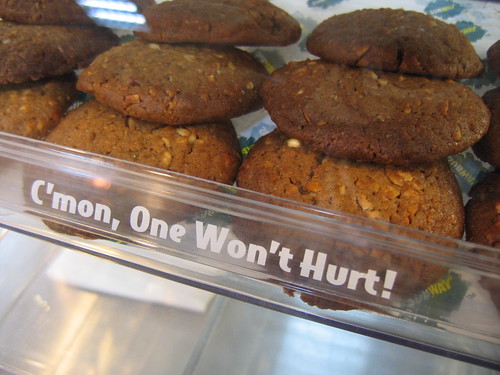
C'mon, One Won't Hurt!

Over the past decade, Subway has gained a reputation as a fast food restaurant that... isn't. The fast food place that you can actually eat at and have a reasonable chance of eating healthy. The restaurant Jared Fogle ate at, and of which they've said since 2000. Subway: Eat Fresh. As seen on The Biggest Loser. Everywhere you look, there are healthy options. Instead of the cheese, have some lettuce. Instead of that root beer, have some lemonade. Or milk. Instead of those Doritos, have some Sun Chips. Or don't have any chips. Have some apple slices.

But then you hit the cash register, and amongst all this potentially healthy food, there they sit.

Cookies.


Oh yes. Yes, they will. According to Calorie Count, the, well, calorie count of Subway's various cookies reads as follows:

Peanut butter: 220
Sugar: 220
White macadamia nut: 220
Chocolate chip: 210
Double chocolate: 210
M&M: 210
Chocolate chunk: 200
Oatmeal raisin: 200

By comparison, the turkey breast wrap pulls down only 190 calories.

As several Subway sandwiches are (properly) advertised as having 6 grams or less of fat, one sugar cookie has 6 grams of saturated fat, never mind the overall, which stands at 12. The peanut butter cookie has 16 grams of sugar; the 6-inch cold cut combo has 8. Just about any wrap has fewer carbs than just about any cookie- the oatmeal raisin, for instance, has 30 total carbs, while the tuna wrap has only 16.

Just to remind you, we're comparing a single cookie to six inches worth of sandwich.

Subway is privately owned and doesn't release sales figures, so there's no information available on how many cookies- or how much of any other item- are sold in a given period. The fact that the cookies have remained on the menu for so long, though, surviving all those years of healthy-eating efforts, suggests a substantial amount of cookie sales.

How much fatter does America get from just those cookies? How many collective pounds could consumers shed just by cutting them out? Just by skipping that cookie at the register?

Subway did not respond to an e-mail asking for an explanation.

Tuesday, June 22, 2010

Don't Eat The Soap

You might recognize cocoa butter as a common ingredient in beauty products. But the cocoa butter is unscented. It wasn't always unscented.

Milton Hershey, you see, had some spare ingredient laying around. Lots of spare ingredient. He hated to let things go to waste, and there were a million pounds of surplus cocoa butter strewn about the Hershey factory. He tried to think of a use for it, and in 1936, he came up with the idea of chocolate soap.

To Hershey, that was that. He called in the manager of the Hershey Department Store, John Hosler, told him he was leaving for Cuba until March 1937 and to have a soap plant up and running by the time he got back. Why Hosler? Well, he sold soap, so surely he must know how to make soap.

That mistake was remedied; Hosler would eventually, after running into problems getting the cocoa butter to do what he wanted it to do, called people who actually knew what they were doing.

The bigger problem was the fact that the cocoa butter smelled like, well, cocoa. A perfume would have to be found to mask the smell, which would be fine except for the fact that Milton Hershey didn't want to spend a lot of money on the perfume. He arranged to test all the potential perfumes himself, every time asking how much each one cost while he smelled it. By some amazing coincidence- or rather due to the fact that Hershey had a cold that day and couldn't actually smell anything- he told them to use the cheapest one.

El Cheapo didn't work- what a surprise- and resulted in a long delay while they went through 300-plus perfumes anyway to find one that did.

Eventually, though, they did manage to get some actual soap made. That was Step 1. Step 2 was getting it sold. That process would begin in 1938.

And that would pose its own problems. Take the hockey game in Hershey Sports Arena on March 9, 1939. The Hershey Bears of the AHL (the only team to have uninterrupted AHL membership from then to now, by the way) were playing the Philadelphia Ramblers, with whom they had quickly developed a rivalry. Hershey wished to hand out soap as a promotion. He was advised to have it handed out as the fans left, so they couldn't throw it onto the ice during the game, but Hershey wanted it handed out before the game because a) they might miss some fans on the way out, and b) who would throw free soap?

As it turned out, enough people to stop the game for ten minutes in the second period. (Hershey won 7-3.)

That wasn't the biggest problem, though. Remember that cocoa smell? Once people actually took the soap home, they had... a brown, rectangle-shaped Hershey product that smelled like chocolate. Take a wild guess what the kids ended up trying to do.

Meanwhile, according to the book Hershey: Milton S. Hershey's Extraordinary Life of Wealth, Empire, and Utopian Dreams by Michael D'Antonio, Hershey was busy peeling layers off of his own skin to try to prove that the soap had healing properties.

You're welcome.

He was also setting up shop on the Atlantic City boardwalk so as to give personal demonstrations of the soap to potential customers. Often he would take up residence at the register. "Mr. Hershey will be pleased," he would tell customers, "very pleased, when he learns of your purchase."

You're welcome again.

The soap sold terribly, piling up below the Hershey Sports Arena. Despite the bad sales, Hershey wouldn't stop production until after World War 2, when the price of the raw cocoa butter became more valuable than the soap. That, not the poor sales, was ultimately what got the chocolate soap pulled off store shelves. (Except in the Hershey area, where it would for some reason still be sold until 1953.)

The odd scattered bar is actually still floating around if you're willing to look, though not enough to peg down a going rate.

Tuesday, June 1, 2010

BP Now Stands For 'Big Problem'

There are people that say boycotting BP gas stations won't actually hurt BP; that doing so just hurts the individual gas stations. Maybe they're even right.

When the stock plunges, though, that will smack around any company in a hurry.

Friday, May 21, 2010

Boycotts For All!

As long as we're already boycotting Arizona, it's probably long past time to add BP to the pile in the wake of the oil spill in the Gulf of Mexico which has been going for something on a month now. There was a live feed activated yesterday, which can be found, really, pretty much anywhere (all one must do is type 'bp' into Google to get an option of 'bp oil spill live feed'), but according to BP, it had been available for two weeks prior, not released to the public but rather to Congress. So we know they had the video, we know we would have been able to see just how big the gash was, but they sat on it for two weeks. At least.

And that's BP's version of events.

In the wake of it all, if you're not already doing so, it's a simple thing to stop at gas stations other than BP. It's not 'reduce gas consumption', granted, though you should be doing that too if possible. It also, granted, gives additional business to other oil companies.

Those other oil companies, at least in this specific case, are not the ones at fault. Chevron didn't have anything to do with this. Shell had nothing to do with the leak. It's BP and BP alone. All you have to do is skip the BP stations and stop at the next place down the road.

If you want to, you can skip the Exxon stations too, as we're still trying to get them to properly pay up for the Valdez spill. From 1989.