Pages

Showing posts with label food. Show all posts

Thursday, September 1, 2011

And I'm Hungry For More

On Tuesday's edition of Countdown with Keith Olbermann (remember, it's on Current now), Anthony Bourdain sat down to talk obesity in the United States, and specifically, how to get people to stop getting fatter.

According to Bourdain, "We're not going to win it on the facts, clearly. We've been publishing dietary information. If anything, we seem to be polarizing it into a red state/blue state issue, a rich/poor issue, which is all wrong, wrong, wrong." He figures the way to go is to make it a matter of patriotism, of defending the country-- after all, the obese aren't about to be able to run down al-Qaeda. The thing he would hate to have to do is to advance the issue by force, to start throwing around fat taxes and banning certain foods or ingredients.

If you happen to have bought his book Medium Raw, you may have already seen this argument. There, as he explains,

"It is repugnant, in principle, to me-- the suggestion that we legislate against fast food. We will surely have crossed some kind of terrible line if we, as a nation, are infantilized to the extent that the government has to step in and take the Whoppers right out of our hands. It is dismaying-- and probably inevitable. When we reach the point that we are unable to raise a military force of physically fit specimens-- or public safety becomes an issue after some lurid example of large person blocking a fire exit-- they surely shall."

It may or may not have to go that far, Tony. But look around at the landscape, some of the contributing factors, and the signs appear grim.

Much has been made, for example, about the impact of suburbia and urban sprawl. In compact, highly dense cities- New York, for example- most of what you need on a daily basis is within walking distance. It had better be, because the glut of cars on the road make it difficult to drive anywhere. Because everything's nearby, because you walk so much, the walking is deemed by your body to be exercise. You get slimmer as a result.

But in suburbia, or in sprawling cities like Phoenix or Los Angeles, walking is not feasible much of the time. You have to drive to do your daily business- to go to the store, to get to work, to get even within your neighborhood. And while you drive, you sit down. Sometimes you sit down while getting your food, going through a drive-thru. And food that works in a drive-thru is decidedly not fine dining. It's burgers, fries, tacos, fried chicken, soda, the like.

Bourdain hits upon the second factor in the interview with Olbermann:

"This is not a class issue, though some would like to portray it as that; that poor people, the working poor can't afford to eat well. This is nonsense. We are sending a message that this is what the poor should eat. We're telling, these are what your options are, these are the flavors you should expect. And in fact, you see people eating the deep-fried butter sticks recently at this political circus out there-- somehow, you're making a positive political statement by eating a stick of butter in batter? In what way is this good for our country?"

What Bourdain is finding here is what I see as a culture of gluttony. We have two competing cultures in this country regarding food, a culture of gluttony and a culture of healthiness.

The culture of healthiness works its butt off to get people to eat better and to exercise. There's a gigantic industry surrounding the idea, from weight-loss DVD's to new diet books out every week to everything that has Jillian Michaels in it to various periodic efforts from the White House. They all encourage you to get up off your butt, eat less, get in shape, because you'll feel so much better about yourself and you'll live longer and have all these other health and self-esteem benefits.

On the other side, you have the culture of gluttony. It's not nearly as well-funded. It doesn't have to be. The messaging is more attractive. The rewards are simpler, easier, more in tune with the instant-gratification, reality-TV era in which we concurrently live. Jillian Michaels may tell you that losing weight will give you self-esteem and let you live a long time down the road, but that's a long time down the road and it's only friends and family. Here's Adam Richman on Man Vs. Food telling you that if you can down a 5-pound cheesesteak in an hour at a restaurant near you, you'll get to be famous by way of getting your face on a restaurant wall, and the whole restaurant will be cheering you on the whole time. And if you win, you might get your meal free! Richman may denounce this kind of eating as a regular thing, but any anti-gluttony messaging is thoroughly lost in the fervor of Richman shoving hot wing after hot wing down the hatch.

People look at the two and, however many overtures are made about the rest of the country being too fat, they join in. They may diet, once in a while, but as soon as dieting starts being hard, they stop and reach for the ice cream. Or they rationalize their body as a lifestyle choice and proudly reach for the ice cream because That's What America Is All About.

I'm not saying I'm perfect myself. Far from it. I eat more junk than I really should, less foliage than I should. But I have my limits. I do at least try to keep from going balloon-y. When I go buy a steak, I try and find one without any strips of outright fat, or at least as little as possible. There is a point at which I look at a food product and go 'okay, that's just disgusting'. For me, the line turned out to be Oreo Cakesters, which tasted fine enough in the abstract, but after four or five- not in one sitting, but overall- the feeling became 'geez, do I really want to keep eating this?' Double Downs and Quad Stackers and whatever ode to clogged arteries that Carl's Jr. came up with this time just aren't going to happen.

Bourdain, though, makes a misstep when he introduces shame as a tactic:

"I'm all for shaming people into behaving better. I see nothing wrong with a little shame and ridicule in this war, honestly. When it takes you ten minutes to get out of your car, this is a problem. It's not a body image question. Someone's going to have to help you, and i think as a society, we should be willing to help you and encourage you in every way. You know, you're slowing people down. You are blocking means of egress. We're in a burning building, and we're all leaving together. You're 600 pounds, you're a problem for the people behind you. So you're a societal problem, you're not a lifestyle choice."

Is shame a thing in America right now? Is shame even a word in the dictionary anymore? I mean, look around. Seriously look around. The kind of people that need shaming are utterly shameless. Worse, many are or have become shameless contrarians, who will do something self-destructive simply because they were told not to.

And that gets into the "red state/blue state issue" point he brought up at the top. He thinks that's able to be overcome with making healthiness patriotic, but the thing is, how do you get from here to there when 'here' is a nation that introduces the most horrifyingly fattening things we can think of as beloved Americana while barely even batting an eyelash? After all, state fairs are a piece of Americana, and anything you can eat at a state fair must be Americana too by extension, and so by one of the most twisted applications of deductive reasoning since 'she did X and our crops failed, so she's a witch', fried butter is now what makes America great. To have someone try to take it away, or be perceived as doing so, is thus somehow un-American.

We haven't yet figured out how to de-politicize much of anything else, at least in this environment. I don't hold out much optimism that obesity will be much different. Words and even logic aren't really going to work right now. Jamie Oliver has made healthy eating his personal battleground and look how hard the poor guy has to fight just to get heard, much less listened to. Structural changes, like making cities more dense and more pedestrian-friendly, are needed, but in addition to that, the fat tax is, unfortunately, probably as inevitable as Bourdain claims- at least, as soon as a Congress more inclined towards action is seated. We probably don't have to go so far as banning foods, but perhaps some of the more destructive chemicals- such as red 40- could stand to go.

After that, if people want to eat themselves into the grave, well, that's their lifestyle choice.

Saturday, August 20, 2011

Rapid-Fire Book Club, Farmers' Market Edition

If you happen to ever be in Madison on a Saturday- ever, even in the dead of winter- and there aren't massive protests going on, the Dane County Farmers' Market is something you really need to do. Every week, enough vendors from around the area set up shop to run a ring around the entire Capitol Square, which when it's not the dead of winter, is exactly what they'll do.

Your task is to walk a lap around Capitol Square- you will go clockwise because the oncoming rush of humanity behind you will force you to- and load up on as much fruits, vegetables, meat (in deer, cow, chicken, turkey, duck, pig, trout, bison, emu and dog-bone varieties), cheese from cows, goats and sheep (minding the sheer volume of bottleneck at the Brunkow Cheese booth surrounding the samples of juusto), baked goods, honey products, maple products, and assorted offerings from auxiliary food stalls without ending up like that guy from the Monty Python skit that got detonated by a wafer-thin mint. And just to keep things interesting, every time you round a corner of the square, there's some sort of person wanting some sort of support for some sort of political cause. Whether we're angry or not.

And then you can buy little trinkets as the market empties out on one corner onto State Street, where you will be assaulted by so many restaurants that you will soon no longer fit into your car and have to walk home, which is why State Street is pedestrian-only, according to the sources in my head.

That established, after nearly bursting, off I went to Avol's Bookstore, just off State, to add two books to my shelves:

*A.V. Club- Inventory: 16 Films Featuring Manic Pixie Dream Girls, 10 Great Songs Nearly Ruined By Saxophone, and 100 More Obsessively Specific Pop-Culture Lists
*Rich, Katherine Russell- Dreaming in Hindi: Coming Awake in Another Language (there was a celebration of India's independence day, which was on the 15th but celebrated today because it's the weekend)

Thursday, August 18, 2011

Phrases You'll Probably Never Want To Use Again

Have you ever used the phrase "cakewalk"? You probably have, in the context of seeing something very, very easy.

You awful, awful racist, you.

The original cake walk was conducted on plantations in the South, and surely you can already see where this is going. Its original intent- or at least, its stated intent- was to give slaves a temporary chance to get back at their masters. Were they to actually get back at their masters, they likely would have done so through grievous bodily harm, which would be kind of bad for the master, so that wasn't done. Instead, they could just mock him for a little while, parodying overly genteel aristocratic mannerisms. This is something they were already doing in private, only now it was done in front of the master. (That's a $12 article, by the way.)

At the conclusion of this mocking, the slaves would pair up to form couples, and do a high-stepping walk, a promenade. The master would then judge all the walks, and award a cake to the best one. Thus the term.

The issue, of course, is that it's no longer really mocking the master if the master's throwing the party, awarding the prize for the best mocking, and has the last laugh by sending everyone back to work as his slaves afterwards. But that was never brought up much.

In fact, the whites eventually took the cakewalk for their own purposes, using it in minstrel shows by whites in blackface. Some tellings go that the whites didn't know they were being mocked, and maybe some never did, but now it was a moot point. Now the blacks were the ones being mocked, and it wasn't exactly subtle. No longer sending up their masters, now they were portrayed as really, honestly trying to be like their masters. And, of course, the other whites in the audience ate it up. Ha ha, look at those black people that aren't really black people but we'll pretend they are because then that makes it okay!

Eventually, though, the black community managed to take the cakewalk back, using it as something of a forerunner to other dance styles, such as the Charleston and the Lindy Hop. If those whites like the cakewalk, maybe they'll like some other dances of ours.

Over time, the meaning of the word 'cakewalk' shed all connotations except the recreational nature of the original event, and from there changed into a term meaning something easy (even though the dance itself isn't).

The cakewalk still survives to this day, though partially due to its history and partially due to its age, its usage has shrunk drastically. It survives in a very unlikely home: the Highland Dance community, where the high-stepping fits in with the generally athletic, ballet-like nature of the other dances used.

No word on if they bake any cakes for the occasion.

Saturday, July 30, 2011

The Unauthorized Life Story

On Tuesday, Kentucky Fried Chicken launched colonelsanders.com, a website dedicated to collecting stories about the life of, well, Colonel Harlan Sanders. Sanders, of course, was the founder of KFC and the man who came up with the 11-herbs-and-spices recipe.

Sanders died in 1980, so it's on KFC to gather up stories and documentation about him. Granted, being KFC, you probably are not going to get the unvarnished account, just story after story about how great and nice and occasionally funny he was.

Now, KFC maintains that the site is about preserving Sanders' life story and not about just selling chicken. I find that rather hard to believe. But just in case, I offer this story.

Sanders sold his interest in KFC in 1964 for $2 million to John Brown and Jack Massey, but would spend the rest of his life as a spokesman inspecting restaurants personally right up until his death in 1980 at age 90.

Sanders wasn't to remain idle himself, however. After selling his interest on KFC, he and wife Claudia soon afterwards founded a new restaurant, Claudia Sanders Dinner House in Shelbyville, Kentucky. And while his face would remain with KFC, the menu itself was now out of his control. This didn't sit well with Sanders, who sued the then-owners, the Heublein Corporation, for $122 million. First, they were preventing him from franchising the Dinner House. Second, they were putting his name on the new menu items. (They settled out of court, possibly out of embarrassment. Sanders was allowed to franchise and sell his recipe in the Dinner House.)

So what on KFC's menu did Sanders not like? The Extra Crispy recipe. The 'Original' recipe is called that for a reason. That's the Colonel's recipe, or at least the current version of it. Extra Crispy was introduced by Brown, who swiped the idea for a crispy recipe from one of Sanders' competitors, Church's Chicken. (Which, if you don't live in the South, you should know has a national franchise of its own these days, though only one place in Kentucky itself.)

Sanders was quite happy with the original recipe, thank you. He didn't like Extra Crispy. He hated it, in fact. Just hated it. In fact, he didn't like a lot of the new menu. He hated it so loudly and fervently, in fact, that KFC sued him back in 1978 for defamation. The case was dismissed because none of the claims were deemed sue-worthy.

Among Sanders' comments on the new menu:

"The stuff on the mashed potatoes, for instance.

"My God, that gravy is horrible. They buy tap water for 15 to 20 cents a thousand gallons and then they mix it with flour and starch and end up with pure wallpaper paste. And I know wallpaper paste, by God, because I've seen my mother make it.

"To the 'wallpaper paste' they add some sludge and sell it for 65 or 75 cents a pint. There's no nutrition in it and they ought not to be allowed to sell it.

"And another thing. That new crispy recipe is nothing in the world but a damn fried doughball stuck on some chicken."

If the aim of KFC is really just to tell Sanders' life story, and not to sell chicken, one would think this should be included.

I'm willing to bet it won't, though.

Saturday, May 14, 2011

Do Not Let This Man Near Your Smartphone

So let's recap where we stand on the upgrade-ancient-computer front...

THE INTENT: Buy a webcam. Also, buy computer- as it turns out, an HP carrying 4 GB of RAM- to replace the current computer carrying 256 MB.

THE REALITY:

Hoo boy.

Buy webcam, buy computer. Have brother install computer because I know not what the hell I'm doing. Things go semi-smoothly right up to the point I install the brand-new webcam which should now easily run on the literally-just-out-of-the-box computer. A restart is required to complete installation. I restart. The webcam works fine- though it turns out my voice, long thought to be at about the pitch of Local Newscaster, is actually about at the pitch of Star Wars Basement Dork- and also the Internet no longer connects. Call to Charter tech support ensues. Call ends when, instructed to disconnect the router, I discover that the very first plug out of the router was for the phone I was currently using. Call to HP tech support ensues. An hour and 26 minutes later, I have reformatted my just-out-of-the-box computer and am now stuck at a screen where I'm asked the name and password the computer is registered under. This information has been lost to the mists of time as the person who supplied it has since moved to Colorado and changed his phone number. Many blind guesses ensue. Shockingly, none of them work. A SECOND call to Charter ensues, in which we start by asking for the password. They don't have that. After long-winded bouts of frustrated babbling, I hand the computer off to a member of the family that can sort of speak Tech Supportese. Bouts of alchemy later, a guy is scheduled to come over on Monday, and until then I will have essentially swapped my old, fuddy-duddy 256 MB computer for a spanking-new, freshly reformatted 0 MB computer.

In the meantime, I attempted to throw a pizza in the oven for lunch. By the time I was roused from computer malinstallation long enough to remove the pizza, it had turned roughly the color of Selena Gomez's hair and could be turned upside down without losing its shape or any ingredients. Potential use as a Frisbee was considered.

In the meantime, here are people with brains.

Monday, April 4, 2011

Eats, Shoots And Leaves

When Americans go out for Chinese food, one of the items they are most often going to see is General Tso's chicken. (Actual Chinese people, not so much. Anyone that's ever seen a travel or food show that's visited China will know that American Chinese food and actual Chinese food are two completely different worlds. If you go to China, General Tso's chicken in all likelihood won't be on any menu.)

You, however, have probably wondered at some point just who General Tso is and why does he have chicken named after him.

Well, isn't this your lucky day. Assuming your lucky day wasn't when Salon answered the question, or NPR, or the Washington Post, whose direct link is wonky but it was reprinted elsewhere so here. It's new to you, right?

General Tso is Zuo Zongtang, born in Hunan province in 1812. He was planning on a career in civil service, but in Imperial China, he needed to pass an exam in order to enter civil service, and he failed seven times.

That wasn't actually particularly embarrassing as far as the Imperial examination system went. China's bureaucracy is historically where everyone wanted to be; that's where the political power and perks have always been. There was no stigma in failing, even in failing repeatedly, so as not to discourage anyone from keeping interest and trying again later on. It was tough to get into the bureaucracy; it was supposed to be. Only 5% of exam-takers passed.

After seven times, though, Zuo called it quits and headed back home to farm silkworms, and was living quietly when the Taiping Rebellion erupted in 1850.

What's the Taiping Rebellion? In brief, it was a huge civil war from 1860-1864, that pitted the ruling Qing dynasty against the Taiping Heavenly Kingdom, which was led by Hong Xiuquan, who had failed the exams four times himself. After his last failure, he found Christianity. In fact, he found that he was Jesus' younger brother. He found followers, two of which claimed to be channeling Jesus himself, as well as God, and as such they tried to usurp authority from a mere younger sibling of Jesus. This of course led to Jesus' younger brother killing God in 1856.

Bet that's the first time you've ever read that sentence.

Hong and what was left of his followers found a Confucianist government in charge, and decided China needed to be a Christian nation. An eye-popping 20 million dead people later, he and the movement found their grave. (He also, in all likelihood, found a very sad Jesus asking him how 20 million deaths could get brought on by someone claiming to be the younger brother of a guy known for loving everyone.)

Zuo's part in this was to, over the course of the war, march into the Taiping capital of Nanjing and assist in dethroning the second and final Taiping leader, Hong Tianguifu, who was handed the reins after Xiuquan's death and thus subsequently executed at age 16 despite by all appearances having absolutely no idea what was going on at any point in the proceedings.

Taiping started Zuo up the Chinese military ranks. He would be called upon in three more conflicts: the Nien Rebellion in 1868, the Dungan Revolt lasting from 1862-77, and the Sino-French War in 1884-85.

Nien, by the way, is notable as it stemmed from men who turned to banditry because there were not enough women to go around and single men- 'bare branches' had a much harder time sustaining themselves economically. In 2007, China's one-child policy had led to families preferring sons that could support them in their old age, leading to an imbalance of 119 men for every 100 women. In 1850, pre-dating the one-child policy (and the Nien Rebellion, but not the Niens), the ratio was 129:100. Not only was there an economic incentive, it was exacerbated by a famine, meaning not only was a girl less valuable in the long term, in the short term a girl was just another mouth that families could not afford to feed.

But back to the main question. Why does Zuo- or Tso- have a chicken dish named after him, and why is it not an actual Chinese dish? There are two possible origins. One has Zuo's wife making him the dish one day, but that's the less likely origin. The much more likely origin is that during the Communist revolution that put Mao Zedong into power, one person, Peng Changkuei, fled China, settled in New York, and invented the dish there. It was a toned-down dish, replacing spicy Hunan elements with sweeter Cantonese elements to appeal to a larger Cantonese community in New York. It became popular because Henry Kissinger was in the neighborhood a lot, ate at Peng's restaurant all the time, liked the chicken, and spread the word.

Why it got named for him, though, is hard to peg. Maybe it was just named after a big name in Hunan history, as Peng was Hunan. Maybe it had something to do with the fact that it was a new dish and Peng wanted some sort of unique name to be able to advertise with. Maybe it was a bit of gallows humor. General Tso's chicken is chopped, and General Tso chopped up a lot of his enemies- they still used swords in China during the Taiping Rebellion- and so perhaps the chicken got his name that way.

Coming soon: how Happy Family traces its origins to the movie Soylent Green. Or not.

Wednesday, March 9, 2011

Government Cheese

As you know it, 'government cheese' is an inherently funny-sounding phrase we all got a hold of in the 1990's, and then it became increasingly played-out until the only people that would touch it were the most desperate of hack comics.

But how many people got through that entire time without ever actually knowing what government cheese is?

(source: 2.bp.blogspot.com, now defunct)

This is government cheese. Its distribution began in 1981, the act of which would soon come under the auspices of the Emergency Food Assistance Program. (PDF file.) The cheese served a dual purpose: in addition to providing food assistance for those on welfare, it also helped solve the government's problem of what to actually do with surplus food supply from the Commodity Credit Corporation- other staples such as powdered milk, butter and flour also come government-issue. Eventually, you want someone eating that food. Better to make a welfare program out of it than to throw it away. (In more recent years, it's also been distributed as part of disaster-relief programs.)

Here is the official USDA guideline on making it. (Another PDF file.) It is made in two- and five-pound blocks, intended for distribution once a month.

What kind of cheese is it? This discussion thread about it on the website Chowhound pegs it as something of a cross between American cheese and Velveeta. That's about what the USDA is going for; according to the guidelines, "Its flavor shall be pleasing and characteristic of process cheese made from mild to medium cured American cheese, and shall be free from undesirable flavors and odors."

Stories from those who've eaten it tend to differ: some like it with nachos or macaroni, others can't wait to get away from the stuff. One person on Chowhound assigned a plastic-like favor to it.

While we're on the subject of government food, there are also two varieties of government peanut butter: one for issue under these same premises, and a second one, called "Standard Reference Material No. 2387", designed to be absolutely scientifically perfect. It costs $220 for a six-ounce jar, but you can't actually buy it because it's used as quality control for the stuff you can buy.

It's probably best if you don't read too much into the implications.

Sunday, February 20, 2011

Something Old, Something New, Something Flaky Over You

Weddings, whenever possible, tend to be almost prohibitively expensive. Any wedding party, particularly those marrying for the first time, will readily justify it, as it's a once-in-a-lifetime event they hope to remember fondly until death do they part, and how can you possibly put a price on memories?

We're not going to delve into the merits of this. I'm not opening that can of worms. It's still too nippy out to be running for my life.

What we can do, though, is check off all the different things (in addition to the actual wedding license) that contribute to the price tag, of which one apparently must purchase as many as financially possible: the church, the reception, the tux rentals, the wedding dress, the catering, the photographer, a DJ or other entertainment, the honeymoon, limo rental, and of course the multi-tiered cake.

Have you considered smashing the cake over the bride's head?

If not, clearly you are not an ancient Roman. (Several other signs may point to this, chief among them the fact that you are not a skeletal zombie.) This was what was done with the earliest version of the wedding cake, which wasn't cake so much as crumbly barley bread. The bride and groom would both nibble at the bread, and then the bread was broken over the bride's head. The guests, for good luck, would then run in and try to pick up the crumbs.

Over time, the bread became a bunch of biscuits after Rome conquered England, buns (possibly topped with marzipan) in Elizabethian times, and fruitcakes with sugar icing in 17th-century France; all were still broken over the bride's head. The United States was the one to dump the cake-breaking custom, replacing it with cutting it into slices. They made two cakes- a pound cake for the bride, a fruitcake for the groom. Eventually, the two were stacked on top of each other. For a while, the fruitcake remained the top layer, until people decided they didn't feel like having fruitcake on their wedding day, at which point people just started flavoring the cake however the hell they wanted.

Why would someone decide that breaking cake over the bride's head was a good idea? It was thought that breaking the cake was symbolic of breaking the bride's virginity.

Today, if you broke the cake over the bride's head, it would be a symbol of you maintaining yours.

Programming note; I'm hoping to be in Madison tomorrow.

Monday, December 27, 2010

Just Because Christmas Is Over Does Not Detract From Tastiness

The thing I was working on today is getting to run up the hours on me, so I need a quickie to keep you occupied in the meantime.

So... we Allermanns, having a Norwegian ancestry, make these every Christmas. Baking class!


I should say, though, this guy's not doing it quite like we do. The finished product shouldn't be quite that... burnt. It does take some doing to get the timing right on them. There's a very small window in which to get the krumkake right: too quick off the griddle and they retain too much pliability; too long on and they burn.

Also, two stylistic notes: you'll note a cone shape in his finished krumkake; ours take a tube form. And some people like to fill the krumkake afterwards; we however do not.

Monday, November 8, 2010

Not-Recommended Diet of the Day

27 pounds lost on Twinkies, Doritos and Oreos.

This was undertaken by Matt Haub of Kansas State, who did this diet in an effort to drive home the point of calorie-counting in weight loss. He also tossed in celery, vitamins and protein shakes, but now watch as porkenheimers the nation over start gleefully sucking down the Twinkies (while ignoring the celery, vitamins and protein shakes) while claiming it's healthy and that it's a "lifestyle choice" to not move under their own power.

Sunday, October 24, 2010

The Real Dollar Menu

Found this off the Facebook page of Nari Kye, producer of Anthony Bourdain's No Reservations.

Jonathan Blaustein of Taos, New Mexico went to McDonald's and saw a cheeseburger on the Dollar Menu. He also saw a double cheeseburger on the Dollar Menu, which to him didn't make a whole lot of sense, because you would think another patty and another piece of cheese would make the burger more expensive.

It led him to wonder what, exactly, a dollar gets you in terms of food (at least as far as northern New Mexico is concerned), and photograph it for posterity. And he does mean exactly: he set out to photograph food in its "most realistic" form. No packaging, no preparation beyond how the food was received by him. When he took a picture of shrimp-flavored ramen noodles, you see a pile of flavoring powder and, just to the right, seven boxy wads of uncooked noodles stacked on top of each other.

This is what he came up with.

Monday, October 11, 2010

IT LOOKS LIKE A DOG'S DINNER! SWITCH IT OFF! GET OUT! GET OUT!

Recently, Domino's Pizza began running this ad. Or, at least, a shorter version of same. Watch the ad before continuing on.


The intended message is clear, and in fact stated explicitly. As ads will do. Domino's makes good pizza- or at least, it does now- and though a bad pizza may slip through, they're working to make sure they stop slipping through. And since this customer in Byron, Minnesota had such a bad experience, we're going to make it up to him with a replacement pizza- two of them, in fact- and $500 in gift certificates.

That's the intended message, at least. A combination of a marketing degree and a job in customer service has given me a quite different perspective that, once seen, I cannot unsee.

The perspective of the Kasson Domino's, the place in the next town over that made it.

Think about it. Here you are, some little rinky-dink franchise in southeastern Minnesota, a town of a couple thousand people 13 miles west of Rochester. The place is full (an easily-accomplished task) of people who probably aspire to more out of life than slinging mass-produced pizza to who knows who. And someone in your little rinky-dink franchise made a pizza- one single solitary pizza- bad enough that it caused the CEO of the giant multinational corporation for which they work to make a handwritten apology, send a guy from corporate to not only make a replacement pizza because you can't be trusted, but then also tell you that your rinky-dink franchise is going to be the star of a nationally-aired commercial telling America about the kind of pizza Domino's is NOT supposed to make. The gift certificates were probably taken out of the store's coffers.

And imagine the length and volume of the butt-reaming for the ages that must have taken place with the cameras off from at least one if not several of the guys from corporate that were present at the time.

The morale of that place is probably shot to hell now. They probably never want to make a pizza again as long as they live. Every day from here on in, every person that works there- even the ones they hire post-commercial- is going to have to come in to work every single day knowing that if they screw up one single pizza- just one- whoever gets the pizza is probably going to be waiting with a camera, so they can take a picture of it and send THAT to the CEO in the hope of scoring a bunch of free stuff themselves, and stand a very real chance that the CEO may very well come in himself and do who knows what. And every time they try to put that behind them and move on, there will be some customer coming in making a note of some sort about how your place is "the one that made that awful pizza". Someone in the place probably quit almost as soon as the cameras were gone.

And imagine being the poor small-town schlub that actually made the pizza in the first place. God help that guy if anyone figures out that was their pizza that brought the full wrath of the CEO down on the building. They'd probably fire him on the spot as a face-saving measure. Imagine what you'd have to put on the resume:

Reason for leaving last job: "Brought shame on entire company, causing CEO to personally step in and spend significant amount of company funds to handle incident, and then apologize to customer and general public."

If you're in the area, and wish to patronize the Kasson Domino's, try to be nice to them. They've suffered enough.

Sunday, September 19, 2010

Mmmm.... Sugar....

If you've been looking to reduce your intake of high-fructose corn syrup- a food ingredient widely thought to be leading the charge of What's Making America Fat- I've got good news and bad news.

The good news: you'll be seeing a lot less of it.
The bad news: that's because its name is being changed to 'corn sugar'.

I'm not sure how many people it's going to fool. Historically, changing the name of a product or organization that's had image problems tends to work, but usually the name change is total. Halliburton becomes XE. Philip Morris becomes Altria.

The word 'corn' is still in the name, and it's probably the biggest keyword in 'high fructose corn syrup'. If a consumer is looking for 'high fructose corn syrup', and they instead see 'corn sugar', the word 'corn' is still there, ringing a bell. You're not looking for 'fructose'. You're not looking for 'syrup'. You're looking for 'corn'. (If you're looking for 'high', that's another type of product entirely.)

Some probably are going to get fooled. Never underestimate the stupidity of the public. But it's not going to be nearly as many people as would get taken in had the corn industry somehow managed to get the word 'corn' taken out.

Friday, September 17, 2010

Random News Generator- French Guiana

The United States is depressing to look at right now. Let's fire up the Random News Generator and look away, at least for a day.

And certainly nobody looks at French Guiana much, but guess where we've landed today. It's a French territory, the easternmost of those three teeny little countries sitting on top of Brazil. In fact, a suspect in a French spy scandal was reassigned there recently while the government figures out what to do with him. You'd think spy scandals would be intriguing and thrilling, but this particular scandal involves political fundraising, marital infidelity, government agencies used for partisan purposes, and from here it just seems like a whole bunch of stuff I could just stay Stateside and look at every single day.

I fired up the RNG to get AWAY from that. If I could make it, I'd be at the just-announced Rally To Restore Sanity as a message that I'd like to see less of that.

This post is now about Dutch cheese markets. Suck it, French Guiana, for being secondarily related to a scandal I'm sick of hearing about on sight. I am petty like that.

The Netherlands has five cheese markets, in the cities of Alkmaar, Edam, Gouda, Hoorn and Woerden. (Yes, that is where the names of Edam and Gouda cheeses came from; a whole lot of cheeses get their names from their places of origin. Those cities, as you might imagine, feature those cheeses.) A cheese market works roughly like so, at least in the seemingly most popular of the markets in Alkmaar:

The first thing to note is that, while stalls line the periphery, kind of like any farmer's market you've ever been to, the 'traditional' part of the market, dating back to the 14th century, simply places a bunch of cheese wheels on a platform just barely off the ground.

There are men in white outfits and variously-colored straw hats; these people carry and weigh the cheese, using wooden barrows to move it. (What's a barrow? What's a wheelbarrow? Ditch the wheels and you've just about got it.) The colors designate which of four groups, or vemens (singular veem), they're aligned with; this seems to be primarily to split everyone into manageable groups.

The vemen start by arranging the cheese by supplier. They inspect it by knocking on it (to check hardness), scooping out small samples of the cheese, crumbling it, sniffing it, and passing it around the crowd to taste. (This is the crowd's primary function; the traditional method is more a spectator sport these days than anything else, causing some locals to think it something of a tourist trap.)

When a prospective buyer wishes to purchase some cheese, he and the supplier engage in a system called handjeklap- a system in which they clap hands to haggle over the price. Once a price is settled on, a veem takes the cheese and carries it to a weigh station, thereby arriving at a final price.

Here's what handjeklap looks like, in the Edam market:


French Guiana also likely eats a quantity of cheese.

In conclusion, the Rally To Restore Sanity is October 30th on Washington DC's National Mall.

Saturday, July 31, 2010

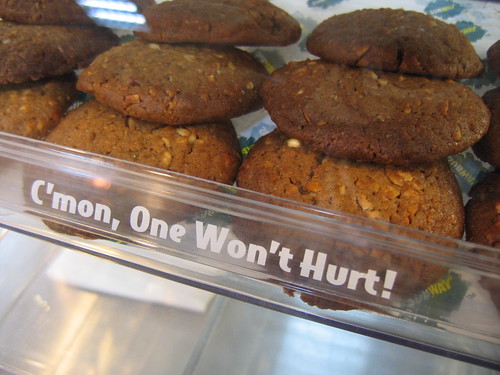
C'mon, One Won't Hurt!

Over the past decade, Subway has gained a reputation as a fast food restaurant that... isn't. The fast food place that you can actually eat at and have a reasonable chance of eating healthy. The restaurant Jared Fogle ate at, and of which they've said since 2000. Subway: Eat Fresh. As seen on The Biggest Loser. Everywhere you look, there are healthy options. Instead of the cheese, have some lettuce. Instead of that root beer, have some lemonade. Or milk. Instead of those Doritos, have some Sun Chips. Or don't have any chips. Have some apple slices.

But then you hit the cash register, and amongst all this potentially healthy food, there they sit.

Cookies.


Oh yes. Yes, they will. According to Calorie Count, the, well, calorie count of Subway's various cookies reads as follows:

Peanut butter: 220
Sugar: 220
White macadamia nut: 220
Chocolate chip: 210
Double chocolate: 210
M&M: 210
Chocolate chunk: 200
Oatmeal raisin: 200

By comparison, the turkey breast wrap pulls down only 190 calories.

As several Subway sandwiches are (properly) advertised as having 6 grams or less of fat, one sugar cookie has 6 grams of saturated fat, never mind the overall, which stands at 12. The peanut butter cookie has 16 grams of sugar; the 6-inch cold cut combo has 8. Just about any wrap has fewer carbs than just about any cookie- the oatmeal raisin, for instance, has 30 total carbs, while the tuna wrap has only 16.

Just to remind you, we're comparing a single cookie to six inches worth of sandwich.

Subway is privately owned and doesn't release sales figures, so there's no information available on how many cookies- or how much of any other item- are sold in a given period. The fact that the cookies have remained on the menu for so long, though, surviving all those years of healthy-eating efforts, suggests a substantial amount of cookie sales.

How much fatter does America get from just those cookies? How many collective pounds could consumers shed just by cutting them out? Just by skipping that cookie at the register?

Subway did not respond to an e-mail asking for an explanation.

Thursday, July 29, 2010

Must... Have... Coffee...

For today's historical bit of stupidity, we go to Sweden in the 1700's, and King Gustav III. Gustav didn't think much of coffee. It was fairly widely consumed in Europe at that time, but Gustavus thought it to be poison. He set out to prove it.

It just so happened that in a Stockholm, he happened to have two twin brothers condemned to death. The perfect foils for a little experiment. In lieu of being actively executed, Gustav would order one to drink three pots of coffee a day, and the other three pots of tea, as a control. Then they'd simply wait and, under the watch of two doctors, see who died first. Surely, the coffee drinker wouldn't last very long.

So who was the first to die? The head doctor. The prisoners, of course, weren't going anywhere. Soon thereafter, the other doctor died. Still no sign of weakness from the prisoners.

Okay, fine, then. We still have a coffee drinker and a tea drinker. Who dies first?

King Gustav III, that's who. In 1792, he was assassinated at the Royal Opera House. Or at least, he was shot, and died two weeks later from an infected wound.

The two brothers, though, continued to drink, though it's uncertain whether they were at this point ordered to continue or whether they themselves decided to keep it up. Finally, though, one of them did actually die.

At age 83.

It was the tea drinker. (The coffee drinker would last a few years longer; I've seen end ages of 85 and 87.)

Tuesday, July 6, 2010

One Way To Use Less Oil

When you look at the list of ingredients on food or drink, at the very end you'll notice some pairs of colors and numbers. For example, this bag of Doritos sitting next to me shows Yellow 6, Yellow 5, and Red 40.

That's not good.

Those are dyes, meant to make a lot of the food you buy look like something you'd want to eat. There are plenty of drinks out there that could easily go without any color at all. But you as a consumer don't want that. You want your grapes to be purple, your oranges to be orange, your razzleberries to be somewhere in the color spectrum you normally associate with berries.

Red 40 is one such dye, and it is widely used in the United States. Like clothing made in China, you have to go way out of your way to even start reducing the amount of it in your house.

Why is that bad? Because Red 40 is a petroleum-based dye, linked to health problems on down the road. Not immediately, but later on. It's been banned in Austria, Belgium, Denmark, France, Germany, Sweden and Switzerland. (Yellow 5 and Yellow 6, the other two mentioned on the Doritos bag, have shown a good deal of molecular similarity to Red 40.)

Essentially, every time you buy a food product with Red 40, you buy a tiny bit of oil. And then you eat it.

That second link is part of a website devoted entirely to Red 40. It's worth a click.

Sunday, June 27, 2010

American Ethnic Food

This is footage of a gourmet grocery store in Berlin, in which someone came across an American 'ethnic' food section.

International readers, let me show you the food of my people:


More need not be said.