1. ...well, okay, usually it's just a straight-up 'don't fly a drone', but I don't know that I'd go quite that far. Let's go with 'you probably don't need to be flying a drone'.
2. If you must fly a drone, be very very careful about where you fly it.
3. Do not fly your drone in a place where people are obviously going to get upset about it.
4. This is a lot of places.
5. Drones are not permitted, for example, in national parks.
6. So do not fly your drone in a national park.
7. When in a national park, do not do anything to damage the natural beauty of the setting. Doing so defeats the entire purpose of having a national park.
8. Upon acquiring your drone, read the manual. Learn to properly control your drone. Mechanical flying machines, as one might expect, are not much good when they're nose-first in the ground.
9. You're probably getting a good idea of the punchline by now, so: do not crash your drone into a Yellowstone hot spring. The park rangers will be quite miffed in between attempts to figure out how in the world they're going to get it out of there.
Thursday, August 7, 2014


Wednesday, August 6, 2014
Can You Dig It, Sucka?
A museum, as you probably already know, doesn't display all the stuff it has on hand. It might like to, but it can't. There isn't nearly enough room. The museum only has so much space and they keep acquiring things that may or may not be display-worthy. Anything not on display goes into the archives, in back rooms and underground storage facilities that will often contain many times the amount of contents on display. That's where they maintain or restore it, that's where they research it, that's where they keep it when they're not taking a good look at it.
A lot of the time, an object in the archive has never really been looked at at all. The museum will take it after a comparatively cursory glance and store it, intending to get around to examining it more fully at some point down the line... and then it just sits there, sometimes for decades, without even having been cataloged. In Stealing Rembrandts, a book I reviewed back in June, at least some artwork is noted to have been stolen this way: if you're working in the archives, who's going to pursue you for stealing a piece of artwork when the museum never realized they had it in the first place?
On this page, from the Smithsonian American Art Museum, you will see a recording of some of their photograph archives. As an instructional aid, I direct you to the listing for the Walter Rosenblum Collection. The Smithsonian states that they acquired it in 1976. They also state that they are "in the process" of cataloging it, now, 38 years later. Another collection, the Library of Congress Copyright Deposit Collection, was acquired in 1987 and hasn't been cataloged at all.
And so now you have some idea of how a 6,500-year-old human skeleton, originally excavated from Iraq around 1930, turned up suddenly on Tuesday in the archives of the Penn Museum, run by the University of Pennsylvania. The museum was working to digitize the findings of an expedition by Penn and the British Museum that began in 1922 and ran for 12 years. It arrived at Penn in 1931, and originally went unrecorded by them because first, they didn't have anyone at the time who knew much about skeletons, and second, there was a little something called the Great Depression that was preoccupying a lot of minds at the time. So the skeleton sat there... and sat there... and sat there.
Until looters ransacked the Baghdad museum in 2003. At that point, for reasons that I will remind you what country this excavation happened in, Penn decided to digitize their Iraqi artifacts. Along the way- right now being 'along the way', because even when you start these processes it takes years- they saw a letter dated 1931, saying they were going to receive a couple skeletons. Skeletons are more of a British Museum thing, so even then, most of the Penn staff figured the letter was a mistake and they were actually in London (or maybe even Baghdad)... but eh, might as well go rummaging through storage just in case. And lo and behold, there was a crate that nobody had cataloged and that, because it wasn't cataloged, nobody in the anthropology department had any good reason to open up until then.
Luckily, it was very well-preserved, in wax no less, so it had held up. Penn has no intent of returning the skeleton, partially because they have a lot of research to do on it (skeletons from the 5500-4000 BCE era are vanishingly rare, especially in as complete a set as this one), and partially because again, there's a reason they decided to digitize the Iraqi collection and that reason has yet to subside over a decade later.
In case you're curious, they're naming it Noah.
A lot of the time, an object in the archive has never really been looked at at all. The museum will take it after a comparatively cursory glance and store it, intending to get around to examining it more fully at some point down the line... and then it just sits there, sometimes for decades, without even having been cataloged. In Stealing Rembrandts, a book I reviewed back in June, at least some artwork is noted to have been stolen this way: if you're working in the archives, who's going to pursue you for stealing a piece of artwork when the museum never realized they had it in the first place?
On this page, from the Smithsonian American Art Museum, you will see a recording of some of their photograph archives. As an instructional aid, I direct you to the listing for the Walter Rosenblum Collection. The Smithsonian states that they acquired it in 1976. They also state that they are "in the process" of cataloging it, now, 38 years later. Another collection, the Library of Congress Copyright Deposit Collection, was acquired in 1987 and hasn't been cataloged at all.
And so now you have some idea of how a 6,500-year-old human skeleton, originally excavated from Iraq around 1930, turned up suddenly on Tuesday in the archives of the Penn Museum, run by the University of Pennsylvania. The museum was working to digitize the findings of an expedition by Penn and the British Museum that began in 1922 and ran for 12 years. It arrived at Penn in 1931, and originally went unrecorded by them because first, they didn't have anyone at the time who knew much about skeletons, and second, there was a little something called the Great Depression that was preoccupying a lot of minds at the time. So the skeleton sat there... and sat there... and sat there.
Until looters ransacked the Baghdad museum in 2003. At that point, for reasons that I will remind you what country this excavation happened in, Penn decided to digitize their Iraqi artifacts. Along the way- right now being 'along the way', because even when you start these processes it takes years- they saw a letter dated 1931, saying they were going to receive a couple skeletons. Skeletons are more of a British Museum thing, so even then, most of the Penn staff figured the letter was a mistake and they were actually in London (or maybe even Baghdad)... but eh, might as well go rummaging through storage just in case. And lo and behold, there was a crate that nobody had cataloged and that, because it wasn't cataloged, nobody in the anthropology department had any good reason to open up until then.
Luckily, it was very well-preserved, in wax no less, so it had held up. Penn has no intent of returning the skeleton, partially because they have a lot of research to do on it (skeletons from the 5500-4000 BCE era are vanishingly rare, especially in as complete a set as this one), and partially because again, there's a reason they decided to digitize the Iraqi collection and that reason has yet to subside over a decade later.
In case you're curious, they're naming it Noah.
Tuesday, August 5, 2014
Just How Much Fame Are We Talking Here?
I had my suspicions about something like this, but it seemed rather instructional.
I'm going to put you in front of four Sporcle quizzes asking you to name the players inducted into the halls of fame for baseball, football, basketball and hockey. What I will also do is give you the average score for each achieved by previous takers.
MLB: 240 names (including this year's), 20 minutes. Average score: 53%. The most commonly-answered name was identified 95.3% of the time.
NFL: 250 names (including this year's), 18 minutes. Average score: 39%. The most commonly-answered name was identified 91.1% of the time.
NHL: 259 names (as of 2013), 20 minutes. Average score: 31%. The most commonly-answered name was identified 93.7% of the time.
NBA: 163 names (as of 2013), 14 minutes. Average score: 22%. The most commonly-answered name was identified 96.5% of the time.
When you hear a debate about Hall of Fame induction procedures, usually, almost inevitably, it will be baseball's that will draw fire, and for any number of things. Who's in. Who ought to be in. Who ought to be kicked out (even though that's only happened twice total in any of the halls, and both were because they directly threatened the hall itself: Gil Stein "turned down" induction to hockey's hall once it came out that he engineered his own induction, and Alan Eagleson was removed nine years after his induction for raiding the NHLPA pension, causing 19 other Hall of Famers to threaten to resign unless Eagleson was ousted.) How the vote should be held. How many people should be going in per year. How long it should be before someone goes in- immediately? After a short delay? When they're old and grey? Posthumously?
In fact, many view the Baseball Hall of Fame's procedures as so wrongheaded and mistaken that they regard the building as broken. That it doesn't matter anymore. Bill Simmons started down this road in 1998, when Don Sutton was voted in ahead of Jim Rice (who has since been elected himself), and said as far back as 2002, "none of us really care about the Baseball Hall of Fame, and the only people who do care -- ancient baseball writers -- will be dead soon, anyway. It's almost a lost cause. Almost." In 2007, when Mark McGwire entered the fray, he graduated all the way to 'lost cause', and on the back of anger that PED candidates won't be getting in anytime soon if ever, he no longer wishes to discuss it.
But look up there. Look at those scores. That's how much of each hall that the average person can name off the top of their head. What does that tell you? It tells you that for all its pains, people still care about baseball's hall more than the others. That the people that get through that mess and get themselves a plaque have- at least for the most part- well and truly earned immortality, which is the point of a hall of fame in the first place. In fact, they care angrily, will get into heated, impassioned arguments over players that need- need- to be inducted Right Now.
Meanwhile, football's Hall of Fame arguments, when they even happen, generally revolve around positional representation (who needs more of it), or more representation for the pre-Super Bowl era. Never less. It CAN'T be less, as the bylaws require 4-7 people to go in every year, and typically the classes trend towards seven. In fact, a secondary criticism is that seven is too small. But how well do all these people really register? Are they really all the best of the best after a certain point, or do the doors get thrown open a little too far? Football is by far the most popular sport in the country. Wouldn't you think the best would be more easily recognizable? (Or alternatively, has the NFL adopted so much of a 'now' mentality that everything that isn't 'now' is quickly devoured by time, leaving fans to forget, to be encouraged to forget, anything that isn't in front of them right at that moment?)
If you don't want to do the whole suite of quizzes, let me simply it for you: name the most recent class of each. Football just got done giving everybody their busts. I'm speaking generally, so your results may vary, but: there were seven people. How many can you name? And can you name any of basketball or hockey's? But naming baseball's class is probably no big deal.
Heck, do you know anything about how basketball or hockey induct their Hall of Famers, or hear anything about it save when a particularly no-brainer inductee gets in? Again, some of you might, but we're talking generally here. Football gets 'oh, hey, how nice for those guys.' Basketball and hockey get '...meh.' The other three are not nothing, far from it. But baseball is the only one that gets all the press, all the debate, all the anguish.
But, as the numbers show, they also get the fame.
I'm going to put you in front of four Sporcle quizzes asking you to name the players inducted into the halls of fame for baseball, football, basketball and hockey. What I will also do is give you the average score for each achieved by previous takers.
MLB: 240 names (including this year's), 20 minutes. Average score: 53%. The most commonly-answered name was identified 95.3% of the time.
NFL: 250 names (including this year's), 18 minutes. Average score: 39%. The most commonly-answered name was identified 91.1% of the time.
NHL: 259 names (as of 2013), 20 minutes. Average score: 31%. The most commonly-answered name was identified 93.7% of the time.
NBA: 163 names (as of 2013), 14 minutes. Average score: 22%. The most commonly-answered name was identified 96.5% of the time.
When you hear a debate about Hall of Fame induction procedures, usually, almost inevitably, it will be baseball's that will draw fire, and for any number of things. Who's in. Who ought to be in. Who ought to be kicked out (even though that's only happened twice total in any of the halls, and both were because they directly threatened the hall itself: Gil Stein "turned down" induction to hockey's hall once it came out that he engineered his own induction, and Alan Eagleson was removed nine years after his induction for raiding the NHLPA pension, causing 19 other Hall of Famers to threaten to resign unless Eagleson was ousted.) How the vote should be held. How many people should be going in per year. How long it should be before someone goes in- immediately? After a short delay? When they're old and grey? Posthumously?
In fact, many view the Baseball Hall of Fame's procedures as so wrongheaded and mistaken that they regard the building as broken. That it doesn't matter anymore. Bill Simmons started down this road in 1998, when Don Sutton was voted in ahead of Jim Rice (who has since been elected himself), and said as far back as 2002, "none of us really care about the Baseball Hall of Fame, and the only people who do care -- ancient baseball writers -- will be dead soon, anyway. It's almost a lost cause. Almost." In 2007, when Mark McGwire entered the fray, he graduated all the way to 'lost cause', and on the back of anger that PED candidates won't be getting in anytime soon if ever, he no longer wishes to discuss it.
But look up there. Look at those scores. That's how much of each hall that the average person can name off the top of their head. What does that tell you? It tells you that for all its pains, people still care about baseball's hall more than the others. That the people that get through that mess and get themselves a plaque have- at least for the most part- well and truly earned immortality, which is the point of a hall of fame in the first place. In fact, they care angrily, will get into heated, impassioned arguments over players that need- need- to be inducted Right Now.
Meanwhile, football's Hall of Fame arguments, when they even happen, generally revolve around positional representation (who needs more of it), or more representation for the pre-Super Bowl era. Never less. It CAN'T be less, as the bylaws require 4-7 people to go in every year, and typically the classes trend towards seven. In fact, a secondary criticism is that seven is too small. But how well do all these people really register? Are they really all the best of the best after a certain point, or do the doors get thrown open a little too far? Football is by far the most popular sport in the country. Wouldn't you think the best would be more easily recognizable? (Or alternatively, has the NFL adopted so much of a 'now' mentality that everything that isn't 'now' is quickly devoured by time, leaving fans to forget, to be encouraged to forget, anything that isn't in front of them right at that moment?)
If you don't want to do the whole suite of quizzes, let me simply it for you: name the most recent class of each. Football just got done giving everybody their busts. I'm speaking generally, so your results may vary, but: there were seven people. How many can you name? And can you name any of basketball or hockey's? But naming baseball's class is probably no big deal.
Heck, do you know anything about how basketball or hockey induct their Hall of Famers, or hear anything about it save when a particularly no-brainer inductee gets in? Again, some of you might, but we're talking generally here. Football gets 'oh, hey, how nice for those guys.' Basketball and hockey get '...meh.' The other three are not nothing, far from it. But baseball is the only one that gets all the press, all the debate, all the anguish.
But, as the numbers show, they also get the fame.
Monday, August 4, 2014
More Placeholder Stuff
Yep, more podcast feeling-out. Hopefully I don't completely run low on time-buying methods while we get stuff squared away, but it's becoming clear to me that once I get going on this, it's going to eat up a LOT of time on me.
So, the real-estate site Movoto has constructed a map of the richest person in each state. There are a couple things I want you to note from the map:
*Nobody on the map holds elective office, though just about everybody is politically active. Holders of high office are disproportionately wealthy, but when you get to be THAT rich, it tends to be counterproductive to hold down a seat.
*Tennessee is slightly inaccurate. It lists Thomas Frist Sr. He actually died in 1998. Thomas Frist Jr., however, is alive and well and very very rich, and is pretty obviously what the map means to say.
*If the name Frank VanderSloot (Idaho), a principal donor of the Mitt Romney campaign, is unfamiliar to you, well, suffice to say that Frank goes to fairly drastic lengths to keep it that way. It's worth getting to know him.
So, the real-estate site Movoto has constructed a map of the richest person in each state. There are a couple things I want you to note from the map:
*Nobody on the map holds elective office, though just about everybody is politically active. Holders of high office are disproportionately wealthy, but when you get to be THAT rich, it tends to be counterproductive to hold down a seat.
*Tennessee is slightly inaccurate. It lists Thomas Frist Sr. He actually died in 1998. Thomas Frist Jr., however, is alive and well and very very rich, and is pretty obviously what the map means to say.
*If the name Frank VanderSloot (Idaho), a principal donor of the Mitt Romney campaign, is unfamiliar to you, well, suffice to say that Frank goes to fairly drastic lengths to keep it that way. It's worth getting to know him.
Sunday, August 3, 2014
Podcasting Requires Lots Of Talking That Isn't Podcasted, You Know That?
Been spending the night making podcast-setup talk with my co-host, and at this point I think I can go ahead and say that's a solid on the co-host part. So I haven't had time to give you anything to do tonight.
So here is a tutorial on how to sew yourself a reversible hat, courtesy of Tally Heilke of the website Tally's Treasury. Tally does a lot of crafts projects- often commissions- and if you find you're enjoying yourself over there, she does have a Patreon account.
So here is a tutorial on how to sew yourself a reversible hat, courtesy of Tally Heilke of the website Tally's Treasury. Tally does a lot of crafts projects- often commissions- and if you find you're enjoying yourself over there, she does have a Patreon account.
Saturday, August 2, 2014
Chronicles In Unfortunately Timed Puff Pieces
On Wednesday, July 30, as you may or may not have heard, Argentina defaulted. The 99-cent version of what happened is this: in 2002, Argentina, well, also defaulted. Argentina set about offering bonds to victims of the 2002 default, some of which ended up being bought by New York hedge funds. In 2005, Argentina, short on money again, offered to restructure their bond payments with their newfound creditors (cutting about 65-70% off their payments); the hedge funds stayed pat. In 2010, Argentina again tried to restructure, and again, New York said no. Nearly everybody that wasn't the New York hedge funds said yes, so it's basically just the hedge funds holding things up when Argentina, who was by now deriding them as "vultures", comes up short on a payment. The hedge funds take them to court... a New York court. The court ruled that not only does Argentina have to pay the full amount, they also have to stop paying the restructured bonds until the hedge funds get paid. Argentinian law says that they can't do this, because the restructured bonds state that they can't offer the holdouts better terms without giving them to the restructured bonds too.
Which basically meant that obeying the court order means the restructured bonds become unrestructured and they have to make full payment to everyone all over again. Argentina does not have that kind of money (or at least they don't believe they have it). And so they defaulted all over again, meaning nobody gets any money at all. The judge, U.S. District Judge Thomas Griesa, is angry at Argentina for defying his ruling and is ordering them back to the negotiating table with the hedge funds. Argentina has in no uncertain terms told Griesa where he can stick his ruling and any other words that might come out of his mouth in the future. So this is probably going to get worse before it gets better. I advise you to take writeups from the usual sources regarding this with a couple extra grains of salt over and above the usual, because remember, most American business media has feet on the ground in Wall Street, deals with New York traders every day, and in many cases the reporters' personal backgrounds have them going from Wall Street trading straight into journalism. So be really careful with anything beyond basic statements of fact.
That all having been noted... would someone please go over to Treehugger and tell Michael Graham Richard that Friday, August 1st, is literally the worst possible time to run an article with the title "Buenos Aires is doing a fantastic job of transforming itself into a more livable city!" First off, an exclamation point? Really? Second, you not only had two days after Argentina had already declared default to perhaps rethink not only that headline but also the possibility that the sparkly new bus system of theirs might be a thing they suddenly aren't going to have any money to maintain now that Argentina has defaulted, you also had the MONTHS leading up to the default to go 'now wait, this transformation isn't going to suddenly go poof or anything as the result of a default, right?' Maybe if they'd built a park or something, it'd be different. Parks are cheap. You leave stuff sit for long enough, parks more or less build themselves. Ask Detroit sometime. Buses are not parks. Buses stop when you stop spending money to pour fuel into them.
It's not totally fatal to your website's lifespan to just scrap a piece that turns out to be a supremely bad idea to run. You could have binned it and nobody would have noticed. But you didn't and now I'm here to yell at you. Think next time.
Which basically meant that obeying the court order means the restructured bonds become unrestructured and they have to make full payment to everyone all over again. Argentina does not have that kind of money (or at least they don't believe they have it). And so they defaulted all over again, meaning nobody gets any money at all. The judge, U.S. District Judge Thomas Griesa, is angry at Argentina for defying his ruling and is ordering them back to the negotiating table with the hedge funds. Argentina has in no uncertain terms told Griesa where he can stick his ruling and any other words that might come out of his mouth in the future. So this is probably going to get worse before it gets better. I advise you to take writeups from the usual sources regarding this with a couple extra grains of salt over and above the usual, because remember, most American business media has feet on the ground in Wall Street, deals with New York traders every day, and in many cases the reporters' personal backgrounds have them going from Wall Street trading straight into journalism. So be really careful with anything beyond basic statements of fact.
That all having been noted... would someone please go over to Treehugger and tell Michael Graham Richard that Friday, August 1st, is literally the worst possible time to run an article with the title "Buenos Aires is doing a fantastic job of transforming itself into a more livable city!" First off, an exclamation point? Really? Second, you not only had two days after Argentina had already declared default to perhaps rethink not only that headline but also the possibility that the sparkly new bus system of theirs might be a thing they suddenly aren't going to have any money to maintain now that Argentina has defaulted, you also had the MONTHS leading up to the default to go 'now wait, this transformation isn't going to suddenly go poof or anything as the result of a default, right?' Maybe if they'd built a park or something, it'd be different. Parks are cheap. You leave stuff sit for long enough, parks more or less build themselves. Ask Detroit sometime. Buses are not parks. Buses stop when you stop spending money to pour fuel into them.
It's not totally fatal to your website's lifespan to just scrap a piece that turns out to be a supremely bad idea to run. You could have binned it and nobody would have noticed. But you didn't and now I'm here to yell at you. Think next time.
Friday, August 1, 2014
Rapid-Fire Book Club, Frustration Edition
I've just completed the book Golazo!: The Beautiful Game from the Aztecs to the World Cup: The Complete History of How Soccer Shaped Latin America, by Andres Campomar. It came out in May, which means it came out prior to the World Cup. I bought it during, at Books and Company in Oconomowoc. As the full title indicates, Campomar explores the history of soccer in the region ranging from South America up towards Mexico, and how it interacted with life off the field. It needs to be noted, though, that South America gets the bulk of the attention; Mexico and especially Central America get rather light coverage. It also must be noted that, in the book, it's called 'football'; Campomar lives in London and didn't go through and change it to 'soccer' for the American edition.
That would be a minor issue. A much more major issue is that Campomar clearly assumes too much regarding what you already know going in. There are a lot of good stories crammed into the book. Quantity is not the concern here, though. The concern is quality. Campomar tells stories, and the flow through the narrative is fine and all, but there are critical points at which I found him to just plain whiff.
First off, I know some of these stories already, as does anyone with a decent amount of knowledge about the game. And using those known stories as a benchmark, some of his details are at the very least off and at most plain wrong. For example, take Andres Escobar, the unfortunate Colombian defenseman who scored an own goal against the United States in the 1994 World Cup, contributing heavily to Colombia's elimination, and was shot soon after outside a Medellin nightclub because of it. Every time I've heard the story, when the assassin fired, he punctuated each shot by yelling 'gol!', the Spanish word for goal. In Campomar's telling, though, the assassin yells 'autogol!', the Spanish word for 'own goal'. It's a small difference, but noticeable if you've always heard the story told one way. I'm not saying for sure he's wrong, but if you're going to go that far against conventional wisdom, it's customary to flag it as such. Say 'contrary to popular belief' or something like that.
In another instance, at the 1990 World Cup in Italy, a storyline going into the Cup revolved around host city Naples, which sits in Italy's south, lagging economically and in cultural reputation behind the north. It was also the then-club home of Diego Maradona of Argentina, who was playing for Napoli. Maradona attempted to fan the flames, urging Naples to back Argentina in the Cup instead of Italy. In the vast, vast majority of tellings I've seen- and the way Google autocompletes it if you type it in- Napoli fans responded to him with a banner reading (in Italian, of course), "Maradona, Naples loves you, but Italy is our homeland." Campomar, though, goes with a minority translation, "Maradona, Naples loves you, but Italy is our country." Which I can this time tell you for sure is wrong, because here is the banner in question. The word in dispute is 'patria', at the end of the banner. Patria is Italian for homeland. The Italian word for country is paese.
Given that Campomar makes Spanish-to-English translations all over the book, this one sticks out.
However, a particularly galling incident comes when Campomar tells about the time when FIFA attempted to ban matches played above 2,500 meters altitude, a ruling that was essentially aimed at La Paz, Bolivia, aka Bolivia's capital city and the place they put most of their nice things. (High altitude means low oxygen means you tire out faster.) This was a campaign headed up by Brazil, and Brazil alone, as evidenced by the fact that when the ban was announced, nine of the ten members of COMNEBOL, South America's confederation, signed a declaration of support for Bolivia, saying that they would just ignore the ruling. The holdout? Brazil. Maradona, in fact, played an hour-long game in La Paz at age 47, saying that if he could do it at his age, so could players in their prime. He and a team of Argentinians played a team of Bolivians headed by Bolivian president Evo Morales. But in the book, Campomar barely mentions Brazil, pinning the whole brouhaha on Argentina. He mentions Morales playing a match, but not the one featuring Maradona: he picks one Morales played at Nevado Sajama, the highest peak in Bolivia. (He also misses mentioning that Morales, who does in fact play soccer, scored the only goal of the game on Nevado Sajama.)
These were the stories I already knew about. What did he mess up in the stories I didn't know about?
This is the first problem. The second problem is with names. Specifically, Campomar doesn't like to use all of them. Or index them. Soccer is a vast, vast sport. There are legions of players who have made themselves noticable in some soccer story or other over the years, even if only as a footnote. It's a ridiculous ask of a hardcore fan to keep them all straight. It's downright sociopathic to ask it of a casual fan just wanting to learn some soccer history. The least you could do is give full names, first as well as last. Maybe describe who they are a bit. It was infuriating to go through this book and read story after story where Campomar would just toss out the last name of a player who was involved in some game or other and never mention their first name, who they were, or anything else about them... and then never bring them up again the entire rest of the book even in the index. If you're indexing names, these guys need to be in there too. If you're only mentioning them once, say their full name for God's sake.
One sample sentence from page 327, telling of a group-stage match in the 1974 World Cup between the Netherlands and Uruguay: "Pablo Forlan, a tall defender who played for Sao Paulo, should have been sent off for kicking Neeskens." Forlan's description is the kind of thing I'm looking for here. A basic description. That's all I ask. We have his body frame, his position, the club he was playing for. "Neeskens", though, is never mentioned again, in the book or in the index, which is why it took me way longer than it ever should have taken to look the anecdote up for reference here. "Neeskens" is Johan Neeskens, one of the greatest players the Netherlands has ever produced and Johan Cruyff's right-hand man on the Dutch squads of the 70's. Don't you think a guy like that deserves a first freaking name? There might be some people out there who don't know who Johan Neeskens is.
Let's not even get started on the fact that Brazilian players commonly go by only one name, which only serves to amplify the frustration when I couldn't stop wondering if the single name of the latest newly-mentioned Brazilian player unfamiliar to me was really a single name or if he had a first name and it was just left out.
I wanted to recommend Golazo!. I really did. But there's just way, way too much wrong here, things that could have been fixed if only Campomar had cared to do so. It would be nothing to add on a first name. It would be nothing to run Google Image Search and then Google Translate on one lousy word. It wouldn't be nothing, but it would be basic recordkeeping to track the names you're tossing out there. But as it stands in front of me, there are far better books out there to learn the history of the sport. You don't need to wrestle with this one.
That would be a minor issue. A much more major issue is that Campomar clearly assumes too much regarding what you already know going in. There are a lot of good stories crammed into the book. Quantity is not the concern here, though. The concern is quality. Campomar tells stories, and the flow through the narrative is fine and all, but there are critical points at which I found him to just plain whiff.
First off, I know some of these stories already, as does anyone with a decent amount of knowledge about the game. And using those known stories as a benchmark, some of his details are at the very least off and at most plain wrong. For example, take Andres Escobar, the unfortunate Colombian defenseman who scored an own goal against the United States in the 1994 World Cup, contributing heavily to Colombia's elimination, and was shot soon after outside a Medellin nightclub because of it. Every time I've heard the story, when the assassin fired, he punctuated each shot by yelling 'gol!', the Spanish word for goal. In Campomar's telling, though, the assassin yells 'autogol!', the Spanish word for 'own goal'. It's a small difference, but noticeable if you've always heard the story told one way. I'm not saying for sure he's wrong, but if you're going to go that far against conventional wisdom, it's customary to flag it as such. Say 'contrary to popular belief' or something like that.
In another instance, at the 1990 World Cup in Italy, a storyline going into the Cup revolved around host city Naples, which sits in Italy's south, lagging economically and in cultural reputation behind the north. It was also the then-club home of Diego Maradona of Argentina, who was playing for Napoli. Maradona attempted to fan the flames, urging Naples to back Argentina in the Cup instead of Italy. In the vast, vast majority of tellings I've seen- and the way Google autocompletes it if you type it in- Napoli fans responded to him with a banner reading (in Italian, of course), "Maradona, Naples loves you, but Italy is our homeland." Campomar, though, goes with a minority translation, "Maradona, Naples loves you, but Italy is our country." Which I can this time tell you for sure is wrong, because here is the banner in question. The word in dispute is 'patria', at the end of the banner. Patria is Italian for homeland. The Italian word for country is paese.
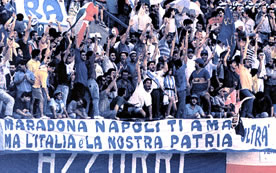
Given that Campomar makes Spanish-to-English translations all over the book, this one sticks out.
However, a particularly galling incident comes when Campomar tells about the time when FIFA attempted to ban matches played above 2,500 meters altitude, a ruling that was essentially aimed at La Paz, Bolivia, aka Bolivia's capital city and the place they put most of their nice things. (High altitude means low oxygen means you tire out faster.) This was a campaign headed up by Brazil, and Brazil alone, as evidenced by the fact that when the ban was announced, nine of the ten members of COMNEBOL, South America's confederation, signed a declaration of support for Bolivia, saying that they would just ignore the ruling. The holdout? Brazil. Maradona, in fact, played an hour-long game in La Paz at age 47, saying that if he could do it at his age, so could players in their prime. He and a team of Argentinians played a team of Bolivians headed by Bolivian president Evo Morales. But in the book, Campomar barely mentions Brazil, pinning the whole brouhaha on Argentina. He mentions Morales playing a match, but not the one featuring Maradona: he picks one Morales played at Nevado Sajama, the highest peak in Bolivia. (He also misses mentioning that Morales, who does in fact play soccer, scored the only goal of the game on Nevado Sajama.)
These were the stories I already knew about. What did he mess up in the stories I didn't know about?
This is the first problem. The second problem is with names. Specifically, Campomar doesn't like to use all of them. Or index them. Soccer is a vast, vast sport. There are legions of players who have made themselves noticable in some soccer story or other over the years, even if only as a footnote. It's a ridiculous ask of a hardcore fan to keep them all straight. It's downright sociopathic to ask it of a casual fan just wanting to learn some soccer history. The least you could do is give full names, first as well as last. Maybe describe who they are a bit. It was infuriating to go through this book and read story after story where Campomar would just toss out the last name of a player who was involved in some game or other and never mention their first name, who they were, or anything else about them... and then never bring them up again the entire rest of the book even in the index. If you're indexing names, these guys need to be in there too. If you're only mentioning them once, say their full name for God's sake.
One sample sentence from page 327, telling of a group-stage match in the 1974 World Cup between the Netherlands and Uruguay: "Pablo Forlan, a tall defender who played for Sao Paulo, should have been sent off for kicking Neeskens." Forlan's description is the kind of thing I'm looking for here. A basic description. That's all I ask. We have his body frame, his position, the club he was playing for. "Neeskens", though, is never mentioned again, in the book or in the index, which is why it took me way longer than it ever should have taken to look the anecdote up for reference here. "Neeskens" is Johan Neeskens, one of the greatest players the Netherlands has ever produced and Johan Cruyff's right-hand man on the Dutch squads of the 70's. Don't you think a guy like that deserves a first freaking name? There might be some people out there who don't know who Johan Neeskens is.
Let's not even get started on the fact that Brazilian players commonly go by only one name, which only serves to amplify the frustration when I couldn't stop wondering if the single name of the latest newly-mentioned Brazilian player unfamiliar to me was really a single name or if he had a first name and it was just left out.
I wanted to recommend Golazo!. I really did. But there's just way, way too much wrong here, things that could have been fixed if only Campomar had cared to do so. It would be nothing to add on a first name. It would be nothing to run Google Image Search and then Google Translate on one lousy word. It wouldn't be nothing, but it would be basic recordkeeping to track the names you're tossing out there. But as it stands in front of me, there are far better books out there to learn the history of the sport. You don't need to wrestle with this one.
Subscribe to:
Posts (Atom)