Pages

Monday, May 31, 2010

Badasses Through History: Audie Murphy

It's Memorial Day, so why not honor a soldier. Specifically, today we honor quite possibly the single greatest soldier in American history.

From Kingston, Texas, Audie Murphy, a veteran of World War 2's European theater, has a list of military decorations that need only be read to get the idea across, and it should be noted that this is a partial list:

*Medal of Honor
*Distinguished Service Cross
*Silver Star (won twice)
*Legion of Merit
*Bronze Star (won twice)
*Purple Heart ('won' three times)
*Combat Infantryman Badge
*Presidential Unit Citation (won twice)
*U.S. Army Outstanding Civilian Service Medal
*French Legion of Honor
*French Croix de guerre (won twice)
*Belgian Croix de guerre
*Marksman Badge on rifle bar
*Expert Badge on bayonet bar

Did I mention that Murphy was fighting off malaria basically the entire time? And that Murphy, in case you're not counting, wound up with a complete set of American military medals for valor? Seriously. They awarded him everything they had, 33 American medals in all, to go with the five French and one Belgian.

And he had to lie to say he was of age to serve, take an Army post after the Marines, Navy and paratroopers rejected him for being too small, and had to fight off an assignment to baker's school after passing out during training- and just having that kind of face- just to get the opportunity.

Let's take the Distinguished Service Cross first. On August 15, 1944, Murphy's division made an amphibious landing in southern France. After a firefight, a German soldier walked forward carrying a white flag. Then the German soldier rescinded the white flag and shot Murphy's friend, Lattie Tipton. This was not a good idea. Murphy went nuts, grabbing a German machine gun and, along with the use of grenades, proceeded to lay waste to every German in the vicinity, spread across several positions.

As for the Medal of Honor, usually one need only read the citation, and here it is.

on 26 January 1945, near Holtzwihr, France, commanded Company B, which was attacked by six tanks and waves of infantry. Lieutenant Murphy ordered his men to withdraw to a prepared position in a woods while he remained forward at his command post and continued to give fire directions to the artillery by telephone. Behind him to his right one of our tank destroyers received a direct hit and began to burn. It's crew withdrew to the woods. Lieutenant Murphy continued to direct artillery fire which killed large numbers of the advancing enemy infantry. With the enemy tanks abreast of his position, Lieutenant Murphy climbed on the burning tank destroyer which was in danger of blowing up any instant and employed its .50 caliber machine gun against the enemy. He was alone and exposed to the German fire from three sides, but his deadly fire killed dozens of Germans and caused their infantry attack to water. The enemy tanks, losing infantry support, began to fall back. For an hour the Germans tried every available weapon to eliminate Lieutenant Murphy, but he continued to hold his position and wiped out a squad which was trying to creep up unnoticed on his right flank. Germans reached as close as 10 yards only to be mowed down by his fire. He received a leg wound but ignored it and continued the single-handed fight until his ammunition was exhausted. He then made his way to his company, refused medical attention, and organized the company in a counterattack which forced the Germans to withdraw. His directing of artillery fire wiped out many of the enemy; he personally killed or wounded about 50.

Lieutenant Murphy's indomitable courage and his refusal to give an inch of ground saved his company from possible encirclement and destruction and enabled it to hold the woods which had been the enemy's objective.


And remember: this was while he had malaria.

Murphy died in a plane crash in 1971; not only is he buried at Arlington, but his gravesite is the second-most visited in the cemetery, behind only John F. Kennedy. It contains no special adornments- which Murphy would have been entitled to; Medal of Honor winners normally are given gold leaf on their tombstones- as Murphy wished to have a gravestone similar to that of an ordinary soldier.

It wasn't the first time he had downplayed himself. This is a man who, in the movie made about his service, To Hell And Back (in which he played himself), asked that his actual, real-life deeds be toned down for the movie because they would not be believable to a movie audience. He also would have preferred not to play himself; he thought it egotistical.

Sunday, May 30, 2010

The Ultimate Equal-Time Challenge

Recently, Ron Johnson stormed into the frontrunnership for the Republican Senate nomination in Wisconsin, picking up that party's nomination to challenge Russ Feingold. As he is a political newcomer- he's only been in the race a few weeks and has never held political office- and few know much about him, I e-mailed him a 10-item questionnaire to try and suss out his identity as a candidate. I have yet to recieve a response; I don't know if I will.

This blog is still pretty much held together by a wish and a shoestring, so I've no idea what kind of candidate, if any, would be willing to consent to an interview of any sort here. Yet. But what I can do is cast a wide net and see what I catch. And I intend to cast the widest possible net.

Basically, I don't even feel like trying to gauge what kind of drawing power I've got.

That is why I hereby issue an invitation to everybody. Anybody and everybody. No filter whatsoever. Any formally declared candidate for any elected office in America is welcome to drop me a line- mtvcdm@yahoo.com; put "Equal-Time Challenge" in the subject line- and I'll give you my best. I don't care if you're an incumbent US Senator, I don't care if you're running for the school board in Lewiston, Maine. (If you are a school board member from Lewiston, Maine, though, you may want to give me a bit of time to bone up on the situation over there.)

I only set down two rules:

1: You must be a formal candidate currently in your race of choice. If you've been eliminated, or have not yet declared, stay away.
2: In the unlikely event that a queue forms, the highest office gets priority. Remaining ties are broken on a first-come, first-served basis.

Come get some, America. Readers, if you've got someone you'd like to see here, go fetch them, or at least fetch me so I can fetch them.

Saturday, May 29, 2010

These Politicians Today

"Nothing is more unpredictable than the mob, nothing more obscure than public opinion, nothing more deceptive than the whole political system."

That was said by Cicero. Cicero lived from 106 BC-43 BC, in ancient Rome. Something you could probably today put in the mouth of any random blogger, but they had their problems, and knew it, even back then.

For our purposes, we'll skip a few centuries past Cicero to 193 AD and one Didius Julianus. On March 28, 193, then-emperor Pertinax was assassinated in a soldiers' camp while trying to calm a mutiny. His assassins, having the benefit of no line of succession whatsoever, then announced that they would award the title of emperor to the highest bidder.

You see, they had a fucking valuable thing. You just don't give it away for nothing-- wait, what? Oh, these politicians today.

Okay. Emperor for sale. Pertinax's father-in-law and city prefect Titus Flavius Sulpicianus would have had a decent argument to the throne normally, but as it stood, he went ahead and started making offers. Meanwhile, Didius Julianus was sleeping at a banquet when his wife and daughter woke him up and filled him in on what was going on. Didius took off in a dead sprint for the camp, and when he found he couldn't gain entry, started shouting offers from the entrance. Titus offered 20,000 sesterces to every soldier- that being the currency of the time; Titus was essentially offering eight years' wages. Didius countered with 25,000. Auction over. Didius wins. Come on into the camp, New Emperor Person.

How did Rome in general react? They hated Didius on sight. Usually, they would cheer the new emperor. This time, they booed their lungs out, calling on multiple generals currently abroad to come home, oust this guy, and take the throne themselves.

Enter Septimius Severus, who simply declared himself emperor and made for Rome. (Another general, Clodius Albinus, would declare himself emperor as well, but Severus would get to Rome first.) Didius, being the corrupt office-buying unrespectable jerk he was and had been throughout his political career, found he didn't really have any allies to even begin to keep Severus out of Rome. People he sent as negotiators wound up defecting. He couldn't block Severus from entering, he sent assassins but they didn't do any good either.

And then he lost the soldiers from which he had bought the office. After some correspondence with Severus, they swapped themselves, proclaimed Severus emperor, and put out a hit on Didius. He would be assassinated on June 1, 193, "reigning" for a grand total of 66 days.

Just about the only person who didn't figure out why Didius Julianus was being killed off was Didius Julianus. Reportedly, his last words, as he was being assassinated, were "But what evil have I done? Whom have I killed?"

Thursday, May 27, 2010

Dangerously Short Tempers

As you may be aware, North and South Korea are getting progressively angrier with each other over the sinking of a South Korean ship by a North Korean torpedo. The two have cut all ties, and North Korea nullified any agreement meant to prevent further escalation.

Will this end in war? I'd give it about a 10% chance. North and South Korea have rising and falling tensions over the years- North Korea does something that angers everyone, they see how far they can push the envelope, and right before everyone gets angry enough to do something nasty to them, they back off and wait for everyone to calm down before the next episode. This episode, however, has a different air to it; unlike most things North Korea has done, this particular act- the deaths of a South Korean ship by North Korean weaponry- is an indisputable act of war and is being treated as such. If anything is going to lead to war, it seems like this would do it.

The mitigating factor, though, is that just about everybody knows basically how such a war would play out, and nobody would be happy with the result or else it probably would have happened decades ago: the second hostilities commence, North Korea fires every bit of artillery they've got directly at whatever has the most people in range, with Seoul tops on the hit list. While most of the artillery could not reach Seoul, and not all of Seoul could get hit by the artillery pieces, it would be squarely in the range of the second phase: the North Korean army swarming across the border. The deaths could easily reach into the millions. After that, though, the gross disparity in technology would take over, and North Korea would be driven back without much additional trouble by just about everybody in the Western world. The only reason North Korea wasn't smashed in the Korean War was because Douglas MacArthur pushed too far, across the Yalu River, and got China involved. It's been 50 years since then, and while South Korea and the Western allies have dramatically upgraded their weaponry, North Korea is using some of the exact same weapons they used last time.

China, meanwhile, would be too busy dealing with the swarms of refugees they've been propping up North Korea for the sole purpose of avoiding. They wouldn't be interested in bailing out North Korea again.

North Korea would this time be smashed, but at a terrible cost, and afterwards there would be a massive catch-up operation by whoever wound up looking after North Korea to bring them somewhat in line with the rest of the world, something nobody is overly thrilled about having to pay for.

In any case, over at Penny Arcade, a discussion has taken place over whether the ship-sinking that caused all this anger is, or ought to be, enough to justify all that.

Whether it is is really up to you. What I can say is that wars have been started over less. Much, much less...

*In 1925, a dog belonging to a Greek soldier scurried across the border with Bulgaria. When the soldier ran after it, he was shot by a Bulgarian border guard. The League of Nations calmed Greece down, but not before over 50 people, mainly Bulgarian civilians, had been killed in response.

*In 1896, the British Royal Navy was in Zanzibar, and stopped in to watch a cricket match. The sultan of Zanzibar, however, had not been informed that the Brits were stopping by, and he was a tad paranoid as he had (illegally) claimed power the previous day. So Zanzibar declared war on Britain. 38 minutes later, the sultan's palace was a pile of rubble, his one-ship navy was on the sea floor, and he was fleeing to German East Africa (modern-day Tanzania/Burundi/Rwanda). It is the current world-record holder for shortest war. The cricket match never took place.

*When Louis VII of France returned from the Second Crusade, he had grown a beard. At the time, according to Charles Mackay's Extraordinary Popular Delusions and the Madness of Crowds, long hair was considered unholy by no less than Pope Urban II, to the point where the unshaven would be excommunicated. Louis shaved. His wife, Eleanor of Aquitaine, wanted the beard back. Louis said no. Eleanor got an annulment and married Henry II of England instead. Henry then told Louis to surrender Aquitaine to England, since according to him it should have gone to England with Eleanor. Louis said no. Cue Anglo-Franco hostilities for the next 301 years, going from 1152-1453.

Hopefully, the Koreas will be a bit more level-headed than that.

Wednesday, May 26, 2010

Western Sahara: A Primer

What do you know about Western Sahara?

Okay, funny joke, smart guy. It's in the western Sahara. Didn't see THAT one coming from a mile away.

What else do you know about it? Don't bother looking in an atlas, or the CIA Factbook, because unlike just about every other place on Earth, you'll primarily find a lot of occurrences of the abbreviation "n/a". Not available. When you see a map comparing how the various countries of Earth perform in almost any statistic, almost invariably, there will be a grey splotch of mystery right below Morocco.

Welcome to the Western Sahara. There's a lot more going on here than 'not available'.

In 1884, the Western Sahara- like the rest of Africa- became a European colony, in their case by Spain. Morocco took a degree of control on the close of the Spanish Civil War in 1939, and would assert further control amidst the end of Generalissimo Francisco Franco's rule, culminating in Spanish withdrawal in 1975.

This created a power vacuum consisting of three forces: northern neighbor Morocco, eastern neighbor Mauritania, and the independence-minded Polisario Front, comprised of a coalition of local Sahrawi tribes. A mutual neighbor to all three, Algeria, sided with the Polisarios, and alongside them would have to deal with Morocco in the north and Mauritania in the south. This came despite a finding from the International Court of Justice that agreed with Algeria and found that the people of the Western Sahara wanted independence. Thus began a period of armed conflict that would last until 1991, with the Polisario forming a government-in-exile in Algeria.

The Mauritanians gave in in 1979. Morocco, however, would wait the Algerians out for an additional decade. A UN peace proposal was floated in 1988, specifying a referendum on whether the Sahrawis preferred independence or to become part of Morocco. However, the referendum stalled, and when Algeria shifted focus to internal matters soon afterwards, Morocco had the upper hand. There would be no referendum. A cease-fire was declared in 1991.

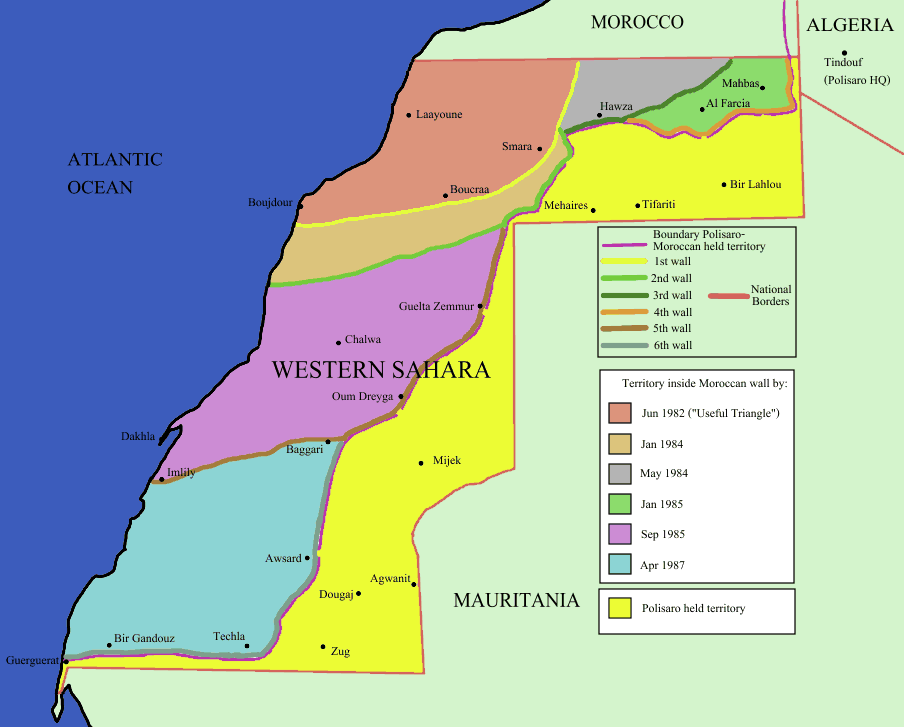
Morocco had not gotten off easy- the war had proven costly even after being backed by aid from Western powers treating it as a Cold War proxy (Morocco was Western-aligned; Algeria was Eastern-aligned), but through the 80's, Morocco had been slowly constructing berms- low sand wall fortifications across various sections of Western Sahara. The berms aren't just sand, though. They include bunkers, trenches, barbed wire fences, landmines, and electronic detection systems, as well as rapid-response forces defending against Polisario incursions.

Here's a map of where the Berm was built and when. The yellow are on the map is Polisartio-controlled. Morocco controls all access to anything of value. This includes all cities of note. Morocco now refers to the area behind the Berm as the 'Southern Provinces'. The Polisario refers to the area not behind the Berm as the 'Free Zone'. The UN, wishing not to take sides, refers to the areas respectively as 'west of the Berm' and 'east of the Berm'.

The Free Zone is largely uninhabited desert, unsuitable for anyone except nomads. Most Sahrawi, and the Polisario leadership, to this day still reside in the Algerian camps in borderland Tindouf Province (also noted on the map), where Algeria is generally happy to have them. Some Moroccans regard even Tindouf as historically theirs, and not just Tindouf and Western Sahara, but the entirety of Mauritania and even parts of Mali. Aside from Western Sahara, though, it's not acted upon much aside from stoking internal emotions.

For a refugee camp in the middle of the Sahara Desert entirely reliant on aid from the host nation, the Sahrawi camps are actually fairly well done. Far from the ramshackle tents seen in Darfur, the Sahrawi have been able to construct solid housing, though tents were deployed after a 2006 flood. As of 1995 (unfortunately the most recent available figures), the literacy rate was pegged at 90%, a total reversal of the sub-10% they saw upon entering the camps. There's a functioning internal democracy, and as of last year, a university is under construction on Free Zone soil. However, there simply aren't enough basic supplies to go around, and sickness and malnutrition are widespread. While the Sahrawi have constructed a semi-livable environment, they'd much rather be home.

The Sahrawi continue to push for a referendum, but difficulties always arise given the fact that there is no reliable count of just how many refugees there are. The Polisario refuses to allow a census for fear of tipping its hand as to their potential strength in such a referendum, and nobody can be sure how many refugees have departed the camps for Mauritania or Mali. A UN mission, MINURSO, was conducted for the specific purpose of conducting the referendum, but it ended without success in 2004. The other major stumbling block is that Morocco insists on having its own Western Sahara settlers take part in the referendum, and since everyone's at least fairly sure that the Moroccan settlers outnumber the grand total of Sahrawis, this is a non-starter.

And so the refugee camps persist.

Tuesday, May 25, 2010

Anthony Bourdain Explains Cricket

My main computer's back, meaning I'm able to resume working on feature pieces. While I do that, have a clip from No Reservations.

Monday, May 24, 2010

Go Hug Your Children, Right Now

Some years back, if you're a fan of Anderson Cooper, you may have seen his 2005 series on Anderson Cooper 360, 'Starving In Plain Sight', concerning a famine that was hitting the country of Niger at the time.

The actual report, for some reason, isn't on YouTube, but there is a follow-up he did two years later in 2007 for 60 Minutes:


There may be a rerun on the horizon. If you'd like to help try and head it off, I'd suggest CARE. No sense waiting until a potential famine becomes an actual famine.