With RNG Week over with, we've got a little housecleaning to take care of, and note two books bought from a couple places on State Street in Madison, Pop Deluxe (which is total kicky quirky art-deco items you'd most expect to see in a 60's-retro party room) and Browzers Books (more of a straight-laced campus-side collection of books mostly decades old, the kind of books you find worm-eaten in your attic right before you move except, you know, not worm-eaten):
*Lunday, Elizabeth- Secret Lives of Great Composers
*Nash, Bruce; Zullo, Allan- The Baseball Hall of Shame
Both are extensions of a couple of book series I've patronized previously, although this is the first non-political Secret Lives Of book I've gone after, choosing the composers over authors, directors, First Ladies and personalities from the Civil War.
Also of note is Paul's Books, another campus-side place right next to Browzers I was in the same day and only off the UW-Madison campus on a technicality. It's Browzers, but more so, with a much larger selection and the prototypical dusty, musty imagery that a good book store thrives on. I didn't find anything that caught my eye in there that day- it traded a bit TOO heavily on the older books to the point of being rather outdated for my liking- but that seemed to be more on me than anything, seeing as on the day I was in there I was pretty much tripping over other customers every 30 seconds. (There were, it should be noted, more foreign-language books than I've seen in any other Wisconsin bookstore to date, regardless of size.)
Sunday, June 5, 2011


Saturday, June 4, 2011
RNG Week- Congo-Brazzaville
We close out RNG Week in Congo-Brazzaville, where today, leaders from 32 countries in the Amazon, Congo and Borneo-Mekong forest basins wrapped up a weeklong conference on deforestation. The three regions combined contain 40% of the world's forest-held carbon and 80% of rainforests.
Over the course of the conference, they agreed to a declaration recognizing it as a priority and noted the need to be able to access international funding; however, a concrete coordinated plan eluded them. This is more than they expected going in, though, and there will be more opportunities to construct that plan. Further meetings are set for South Africa in December and for Brazil next year.
The international funding is key. Despite pledges from more developed nations of monetary support, the nations at the summit were in agreement that the money wasn't actually reaching them. As a result, despite deforestation having dropped by a quarter over the last 10 years, 5.4 million hectares a year are still being lost, mostly to farmland. (That's 13.34 million acres.)
Congo-Brazzaville itself, for its part, is intending to plant one million hectares of trees- 2.47 million acres- by 2020. They have also banned the use of plastic bags.
If you're so inclined to help get trees in the ground, whether in the rainforest or elsewhere, suggested on this end is the Arbor Day Foundation. The default status of a donation is to plant new trees within the United States; however, they also do rainforest-preservation donations. If you're in Canada, Tree Canada plants domestically; and Great Britain's Plant A Tree Today Foundation primarily plants in Southeast Asia.
Of course, without sustainable development, those trees will come right back down, so:
For South America, try the Amazon Conservation Team.
For Africa, try the Clinton Foundation.
For Southeast Asia, try the World Wildlife Federation.
Friday, June 3, 2011
RNG Week- Turkey
TODAY: Turkey
SATURDAY: Congo-Brazzaville
Protesters in 30 cities throughout Turkey marched through the streets in mid-May in opposition to a proposed law that would censor Internet sites displaying pornography, violent content or bomb-making tutorials. The proposed law would require every Internet user to sign up for one of four filters: a 'standard' filter, a 'family' filter, a 'children's' filter, a 'domestic' filter (this last one blocks all non-Turkish websites).
I was going to go on, but then realized you are necessarily an Internet user, and thus, you have probably filled in most of the rest yourself. Deutsche Welle has by far the best write-up on the details. Of course, you know how the Internet works. (You are not Turkish. Turkey blocked Blogger in March over the unauthorized distribution of soccer games. Which of course means I'm now free to call them anything I want and imply I have slept with all of their mothers and they can't do anything about it. But that would be wrong.)
The major problem in Turkey is that a lot of them don't know how the Internet works. We talked here last March about how in the 1995, Turkey was pulling a 70% literacy rate and as a result had problems with newspapers. The literacy rate now is 88.7%. While a big improvement, that's still only good for a rank of 104th worldwide. 70% now is the realm of sub-Saharan Africa.
When basic literacy is out of reach for one out of every eight Turks, Internet literacy is a tough, tough ask. When those in charge are ignorant of the Internet, they will do self-destructive things without realizing it. When average users are ignorant, they will go along with them.
And when those in charge actually do know how the Internet works, and the public at large does not, that opens up the potential for abuse.
Thursday, June 2, 2011
RNG Week- Gibraltar
TODAY: Gibraltar
FRIDAY: Turkey
SATURDAY: Congo-Brazzaville
Gibraltar is reeling from an incident on Tuesday when a fuel tank exploded at a waste treatment facility on the port's north mole at about 3:30 PM local time.
Right next to the affected tank was a Royal Caribbean cruise ship, Independence of the Seas, carrying 3,892 passengers. 12 of those passengers received medical attention on board, most with minor burns. Two passengers were on shore; neither was injured. The ship pulled away from the dock immediately upon the explosion sans the passengers on shore, then headed to its next stop of Cannes, France. The two passengers will be looked after by Royal Caribbean until they can rejoin the ship.
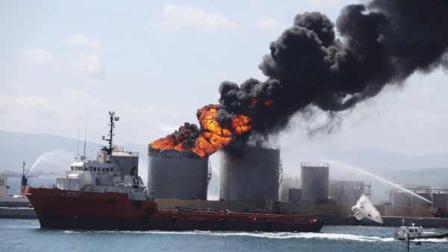 (AP Photo/Alicia Jimenez)
Two workers who were doing welding work were injured. Both are Spanish nationals. One, age 40, was hospitalized in Seville with life-threatening burns covering 70% of his body. He remains in critical condition. The other, age 25, had minor burns.
The resulting fire took 14 hours to put out, being extinguished at 5 AM local time. Some oil made it into the Bay of Gibraltar and neighboring beaches; a cleanup operation is underway.
With the fire out, also underway is an investigation as to the cause of the blast. That as of right now remains uncertain, though preliminary speculation lies chiefly with a stray welding spark. According to Gibraltar's Chief Minister (effective head of state) Peter Caruana, "Once it was established there were welding operations going on, on top of the very tank at the time it exploded, that makes that a frontrunner for a likely explanation."
FRIDAY: Turkey
SATURDAY: Congo-Brazzaville
Gibraltar is reeling from an incident on Tuesday when a fuel tank exploded at a waste treatment facility on the port's north mole at about 3:30 PM local time.
Right next to the affected tank was a Royal Caribbean cruise ship, Independence of the Seas, carrying 3,892 passengers. 12 of those passengers received medical attention on board, most with minor burns. Two passengers were on shore; neither was injured. The ship pulled away from the dock immediately upon the explosion sans the passengers on shore, then headed to its next stop of Cannes, France. The two passengers will be looked after by Royal Caribbean until they can rejoin the ship.
(AP Photo/Alicia Jimenez)Two workers who were doing welding work were injured. Both are Spanish nationals. One, age 40, was hospitalized in Seville with life-threatening burns covering 70% of his body. He remains in critical condition. The other, age 25, had minor burns.
The resulting fire took 14 hours to put out, being extinguished at 5 AM local time. Some oil made it into the Bay of Gibraltar and neighboring beaches; a cleanup operation is underway.
With the fire out, also underway is an investigation as to the cause of the blast. That as of right now remains uncertain, though preliminary speculation lies chiefly with a stray welding spark. According to Gibraltar's Chief Minister (effective head of state) Peter Caruana, "Once it was established there were welding operations going on, on top of the very tank at the time it exploded, that makes that a frontrunner for a likely explanation."
Wednesday, June 1, 2011
RNG Week- Liberia
TODAY: Liberia
THURSDAY: Gibraltar
FRIDAY: Turkey
SATURDAY: Congo-Brazzaville
Liberia's history has been mired in violence and bloodshed, dating back to when the country was first christened as such. When slaves in the United States were freed in the wake of the Civil War, some crossed the Atlantic to settle in Africa and declare the foundation of Liberia. They called themselves Americo-Liberians.
Two problems emerged, though. First, these particular people arriving in Africa had never seen Africa before. Slavery had gone on long enough to where everybody had been born on the American side of the Atlantic. Second, nobody told the actual locals that the people just off the boat were their new rulers.
And the Americo-Liberians ruled the only way they knew: total domination. The Americo-Liberians comprised 5% of the population of Liberia, yet were the only people with voting rights. They built residences that resembled Southern plantations. In 1878, they instituted one-party rule.
Eventually, slavery itself would take hold. The very thing Liberia was created to celebrate against. It continues to this day.
The native Liberians would not wait nearly as long as the Americo-Liberians had to start rebelling. Riots, uprisings and wars would be repeatedly waged until 1980, when the Americo-Liberians were dislodged.
This did not quell the violence even a little bit. By 1989, civil war had kicked off once again; two consecutive wars would take the country into 2003. Only since then has the country even begun to move away from its unending cycle of bloodshed, though the fundamental issue of slavery persists.
Part of the recovery process involves how to account for all those wounded by war, including those who have lost limbs.
This brings us to the Cup of African Nations for Amputee Football, the third edition, which Liberia is scheduled to participate in during October. They are the defending champions, having won on home soil in 2008. This year's tournament, back after a two-year hiatus, is slated for Ghana, who won the inaugural 2007 tournament in Sierra Leone by beating Liberia in the final. Aside from Liberia and Ghana, Angola, Niger, Nigeria and Sierra Leone have confirmed their intent to participate. The organizers expect to also see Algeria, DR Congo, Kenya, Mali and South Africa in the field.
How does amputee soccer work? If you have one leg, you play in the field. If you have one arm, you play goalkeeper. The ball cannot touch an outfield player's crutch (no prosthetic limbs allowed) or a goalkeeper's arm stump. The goal is shrunk by half. More detailed rules are here.
Soccer gives the players hope. Employment in Liberia, as in many, many other developing countries, is difficult-to-impossible to find for people with missing limbs. A soccer tournament set aside specifically for amputees gives them a purpose. It gives them recognition. It also gives them a measure of needed respect. Amputees in Liberia, prior to the 2008 victory, were shunned. An amputee was, in the eyes of non-disabled Liberians, a former soldier, and therefore to blame for the nation's many years of misery and for all the people that died. If they suffered, they were seen to have deserved it. Amputees could not so much as get a taxi. With the prominence of the amputee soccer team, though, Liberia's amputees have slowly begun to be treated as people deserving of compassion as opposed to scorn.
How much prominence? In the Guardian article above, in January 2010, the amputee team was scrimmaging next to the club Invincible Eleven, a 13-time Liberian league champion and 15-time winner of the national cup competition. The amputees were drawing the larger crowd.
In addition to being inspiring, with the main Liberian league (in which Invincible Eleven currently lie 7th out of 20) trying to haphazardly sort out a 15-month league schedule this season, following the amputee team more closely may be the logical thing to do anyway.
Tuesday, May 31, 2011
RNG Week- St. Helena
TODAY: St. Helena
WEDNESDAY: Liberia
THURSDAY: Gibraltar
FRIDAY: Turkey
SATURDAY: Congo-Brazzaville
St. Helena is a small volcanic island in the South Atlantic that is home to fewer than 5,000 people. It's the place Napoleon spent the last six years of his life after Elba proved to be not far enough away from France.
Hopefully, you will forgive me for wishing Napoleon would rise from the dead overnight so there'd be something to cover here. This is not simple 'nothing happening that's worth covering'. This is the RNG sensing arrogance in my resolve to cover whatever it gives me without exception and smiting me with great vengeance. This is the RNG sensing arrogance in my having put a ball saying 'St. Helena' into the virtual bingo hopper in the first place.
The most recent St. Helena story available is from May 5, which you will recognize as nearly a month ago. The story is that two accountants from Sheffield, England were to travel to St. Helena to conduct an audit of Solomon and Company, a UK-registered business resident to the island.
That's it. That's the entire story. Two accountants are traveling somewhere so they can audit something. Your life is now complete.
There is, interestingly enough, a news organization for which St. Helena is part of the regular beat, as well as the other British islands in the South Atlantic. These include Ascension Island, British Antarctic Territory, the Falkland Islands, South Georgia and Tristan da Cunha. If it weren't for the Falklands, one imagines they might be playing Minesweeper all day long.
The most recent article about St. Helena they have on file in from April.
This is not me merely griping about a bad draw. This is actually representative of life on St. Helena, as the BBC reported in January 2010. A ship shows up once a month carrying supplies and groceries and everybody has to live off that until the next ship comes. Unless the ship is in for repairs, in which case there's no ship coming at all. The bandwidth for the entire island is less than some individual households in the UK. Anyone young enough to find employment on the mainland moves there the first chance they get.
In conclusion, Napoleon is buried in Paris.
Monday, May 30, 2011
RNG Week- Canada
TODAY: Canada
TUESDAY: St. Helena
WEDNESDAY: Liberia
THURSDAY: Gibraltar
FRIDAY: Turkey
SATURDAY: Congo-Brazzaville
Canada, today, is seeing a campaign to make 43,000 square kilometers of Manitoba/Ontario boreal forest east of Lake Winnipeg, the largest intact boreal forest on Earth, a UNESCO World Heritage Site. The land is currently home to the Bloodvein River First Nation, as well as Atikaki Provincial Wilderness Park. The effort is being led by a group called Pimachiowin Aki, and is being backed by the province of Manitoba, as well as conservationist David Suzuki.
Suzuki stresses 'intact': "The important thing is the "intactness". If you drive a road through a part of a forest, if you put pipes in, or if you put electrical wires through, you don't have an intact forest left. And then degradation is inevitable."
This comes with opposition. Canada's Conservative Party, led in Manitoba by Hugh McFadyen, wants to put a hydro line through the forest, in the interest of supplying electricity to southern Manitoba, as well as exporting energy to Minnesota and Wisconsin. This fight has been going for several years now; when the New Democratic Party took power in 2007, they moved the proposed line west of Lake Winnipeg- still through boreal forest, but not through the forest in dispute. A provincial election in October, if won by the Conservatives, would see the line put back through the east side, effectively killing the World Heritage bid despite Conservative claims that it would not.
There is precedent for worry about UNESCO's opinion. One of the only two World Heritage sites ever to be delisted, Germany's Dresden Elbe Valley, was delisted in 2009 due to the construction of the Waldschlosschen Bridge, which cut through the valley.
Suzuki, for one, is incredulous, saying, "If the planet in which we live, the very things that keep us alive, become a political issue, we're screwed. We're absolutely screwed. We're talking about the life-support systems of the planet. How can that possibly be a political issue?"
Becoming a World Heritage site wouldn't completely block the area from development, but it would serve as a powerful deterrent. In addition to the prestige, World Heritage status allows the site to apply for a portion of a $4 million (US) annual fund allocated to sites in danger, as well as providing a boost to tourism.
Were the boreal forest to gain World Heritage Site status, it would be the first between Alberta and Ottawa. 15 Canadian sites currently enjoy World Heritage status:
Canadian Rocky Mountain Parks, Alberta/British Columbia
Dinosaur Provincial Park, Alberta
Gros Morne National Park, Newfoundland
Head-Smashed-In Buffalo Jump, Alberta (yes, that is its name. They have a book on sale there, called 'Imagining Head-Smashed-In'.)
Historic District of Quebec, Quebec
Joggins Fossil Cliffs, Nova Scotia
Kluane/Wrangell-St. Elias/Glacier Bay/Tatshenshini-Alsek, Yukon/British Columbia/Alaska (shared with United States)
L'Ase aux Meadows National Historic Site, Newfoundland
Miguasha National Park, Quebec
Nahanni National Park, Northwest Territories
Old Town Lunenburg, Nova Scotia (you may actually know Lunenburg from those Cisco ads done by Ellen Page)
Rideau Canal, Ontario
SGang Gwaay, British Columbia
Waterton-Glacier International Peace Park, Alberta/Montana (shares with United States)
Wood Buffalo National Park, Alberta/Northwest Territories
The annual World Heritage Committee meeting is from June 19-29 in Paris. A majority of committee members must vote in favor for a site to be enshrined. They are currently Australia, Bahrain, Barbados, Brazil, Cambodia, China, Egypt, Estonia, Ethiopia, France, Iraq, Jordan, Mali, Mexico, Nigeria, Russia, South Africa, Sweden, Switzerland, Thailand, and the United Arab Emirates.
42 sites are currently to be considered; the list can, as per Rule 13.4 of the Rules of Procedure, be revised until 48 hours prior to the meeting. No Canadian site is currently among them.
Subscribe to:
Posts (Atom)