During the regime of Generalissimo Francisco Franco, a program was in place in which babies, possibly as many as 300,000, were stolen from their mothers at birth, who were told their babies had died. These were poor mothers, commonly ones who opposed Franco. The babies were then sold to families looking to adopt- some within Spain, some abroad- and all documentation either lost or falsified to make it appear as if the adopting family was the biological family.
Recently, residents of Spain have started to take steps to fix whatever damage they can, as ABC Australia's Philip Williams reports via Journeyman Pictures (which, by the way, yay, an actual name attached to one of these reports!)...
Tuesday, July 19, 2011


Monday, July 18, 2011
Reverse Ferret
My feelings on the News Corp hacking scandal shouldn't really have to be guessed at. Nor should I waste time mincing words. Assuming News Corp is guilty as charged, I want them to go down and go down HARD. Hacking the phones of your subjects has no place in journalism or decent humanity. Add that to your subjects being murder victims and 9/11 victims, and your hacking actively impeding the investigations of same, and to say the least, you have no place in the journalism industry. Or polite society.
Bribing the cops to give you your scoops? Seriously, come on.
That established: one of my new favorite phrases has come out of this whole sorry affair. You know, one of those phrases you say you're going to start working into everyday conversation, and then you actually do that maybe twice before realizing you have no place for it in everyday conversation. That phrase is 'reverse ferret'.
As the story goes, Kelvin Mackenzie, former editor of The Sun, loved to go after people. When he had a target in his sights, he'd instruct his newsroom to "put a ferret up their trousers." At the same time, though, Mackenzie wasn't stupid. He knew that sometimes, taking this tack, he would have to back off lest The Sun get into trouble, legally, financially, politically or in the court of public opinion. When The Sun was at risk in this respect, he'd go into the newsroom and yell "Reverse ferret!" This was the signal for The Sun to play nice until they were out of danger.
You'll hear the phrase a fair bit over the course of the scandal. First, 'reverse ferret' is the most wonderful phrase in the world and every excuse should be taken to use it as much as possible. Reverse ferret. Reverse ferret. Reverse ferret. Second, the meaning of the phrase- back off the outrage and play nice- describes why Rupert Murdoch, head of News Corp., is completely and utterly screwed. One of his holdings needs a specific, special emergency phrase just to tell them not to be jerks.
Translation: there's really no apology or measure of restitution Murdoch could possibly make to get himself out of this mess on his own terms. Any such measure will simply be called a reverse ferret and all investigations (oh, the glorious, glorious investigations) will simply continue on schedule.
Case in point, take Rebekah Brooks, editor of News of the World when the catalyst for this entire saga, the hacking of the phone of murder victim Milly Dowler, occurred. When Murdoch closed News of the World, the very first thing that crossed people's minds was that it was a move to protect Brooks. There was no celebration, no relief, no 'this is a positive step' editorials. No reaction whatsoever that would have signified a successful reverse ferret. The stink was not with News of the World, even though it was there too. The target was Brooks herself.
A few days ago, Brooks resigned from News Corp. Earlier in the scandal, that might- MIGHT, not a guarantee- have worked as a reverse ferret. Now, though, it's too late to be a successful fix. Enough time had passed to where the scandal had spread to every corner of Murdoch's empire. Brooks' departure was characterized by The Independent as "After 52 years, mogul's ally quits to protect jewel of US empire".
The phrase 'to protect'. Meaning, 'that's nice and all, but we have a bigger target in mind and we're not going away'. And the target is now Murdoch himself. Considering that News Corp. is centralized around Murdoch- structured to be so- to the degree that nothing really gets done without his say-so, that's a gigantic threat. Murdoch's been able to take a slow, steady stream of loyal opposition, but he hasn't dealt with something on the scale of the FBI and a united British Parliament going after him simultaneously.
So what happens to him, ultimately? On the American side of the Atlantic, the major criticism in my social circles is that while England may savage him, America won't care enough, his supporters are entrenched too deeply, for him to suffer in America or for Fox News, his most prominent American holding, to take any true damage.
My rebuttal is twofold. First: reverse ferret.
Sorry. Couldn't help it. First, the 9/11 victim-hacking aspect of this story hasn't fully unfolded yet. There is speculation, investigation, but so far nothing solid. So far, all the official, confirmed aspects of this scandal are UK-contained, and so given America's inclination to only care about America, more airtime has been given over here to Casey Anthony. (Which is downright shameful.) If the 9/11-victim link goes official, though, if the name of an affected victim comes out, well, all bets are off over here. There's no way that can't blow up... at least outside of Fox News, which is Murdoch-owned and thus has every incentive to try to save itself. Those who only watch Fox News still won't have a clue, but they're not the ones conducting the investigations. And the ones conducting the investigations are the ones Murdoch has to worry about.
Second, the kind of empire Murdoch has built isn't really structured so that he can just run to the other side of the Atlantic. If Murdoch goes down hard enough in Britain, it won't matter what he has going for him in America. Rupert Murdoch does not have clones running around. He is one man. If that one man, that one man that the entire empire is structured around, is taken down, the whole fortress is liable to crumble in his absence, like a video game boss whose lair collapses the second you beat him. News Corp., in Murdoch's absence, could do anything from undergoing a semi-orderly transition to shattering into a billion pieces.
And every new wrinkle, every new body found buried, only fuels the investigation further and digs the hooks in deeper, making Murdoch's ultimate departure more and more likely. For example, this newly-breaking news about the original News of the World whistleblower ever-so-magically turning up dead. The police do not, at least initially, consider it suspicious, but even official statements from the police have been rendered suspect, with multiple high-ranking officers of New Scotland Yard under investigation themselves for their roles in the scandal.
As deep as Murdoch's problems are in Britain, whether he suffers fallout in America is almost beside the point. He is liable to suffer a fall in America merely by proxy, rendered unable to operate in America to the degree he has been accustomed due to the damage suffered in Britain. It's all the same empire in the end.
So could he make an orderly transition to save News Corp from maximum damage (and there's almost no telling what 'maximum damage' might entail)? Given that he's 80 years old, he's certainly made plans. He would prefer to hand it down to his children. However, they've all got problems of their own, ranging from inexperience (42-year-old daughter Elisabeth) to past corporate failures (39-year-old son Lachlan) to being consumed by the scandal themselves (38-year-old son James). Elisabeth has been spotted verbally attacking James, saying that he "fucked the company". Shareholder pressure exists to hand control to someone from outside the family entirely, someone that doesn't have the tainted Murdoch name. Were that to happen, whoever took over almost certainly would not run things in so centralized a manner.
Which would probably be the biggest reverse ferret of all.
Sunday, July 17, 2011
We Love You (name of city), Good Night!
I want to sink some time into the club-soccer book.
So you're going to get a List X In Y Minutes quiz. Mental Floss, using the 2010 Census, gives you ten minutes to name the most populated cities in America.
Specifically, the largest city beginning with each letter of the alphabet. (My score: 16. I don't know how in blazes I came up with the answer for X.)
Or, if naming those cities is too easy, head to Sporcle and name the 50 largest cities in 2009... that end in 'ville'. You have seven minutes for that. If that seems short, don't fret it. You could have 70 minutes and you would not get them all. (I was brazenly looking through an atlas the whole time and only managed 24.)
Or you can spend 20 minutes trying to work through as many of the 7,500 largest cities on Earth as you can. To make it interesting, the cities are grouped by population into chunks of 25. Give one answer in the group, and you're given credit for the entire group. That makes for 300 groups you have to hit. Tagging one of the 6.7 million-plus cities is child's play. Hitting the mid-64,000 group, that's a bit harder. (Haven't tried this one.)
Friday, July 15, 2011
We'll Put You In One Of Those Crooked Homes We Saw On 60 Minutes
My grandma, Gerda Allermann, died back in 2007. For years leading up to that, she was in a nursing home, Golden Living in Watertown. By that time, we didn't want her in Golden Living. For one, we- and she- would greatly have preferred she die at home. Second, Golden Living was not a good nursing home. There was little stimulation beyond our visits to the point that she was getting bedsores, the physical rehab she was supposed to be getting never happened despite endless prodding from us, and eventually she was left so much to her own devices that Alzheimer's was setting in by the end.
We didn't get her out mainly because she didn't want to go to the other main nursing home in town, and she was the one in charge. By the time we had found a suitable replacement home nearer Milwaukee, she'd taken a turn for the worse and could no longer be moved that kind of distance. She didn't have long after that.
My aunt later found Golden Living listed in one of those ads that was gathering up people for a class-action lawsuit. Last I heard, they're still battling it out in the courts.
As poor as that treatment was, though, there are worse nursing homes. The worst of the worst are listed by the Centers for Medicare and Medicaid Services as "Special Focus Facilities" or SFF's. The idea behind this listing is , normally a facility is inspected once every two years. However, some places would be shown where they're going wrong, make just enough changes to be in compliance, but then by the time the next two-year inspection rolled around, they'd lapsed back into old habits. On that knowledge, the SFF designation was created, under which the facility is inspected every six months until such time as they either show sustained, significant improvement or they're kicked out of the Medicare/Medicaid program, upon which they usually shut down. If they stay open regardless, focus switches to getting the inhabitants somewhere else.
There are five kinds of places listed in the SFF program, the most recent update of which is shown here in full in a PDF file. These are: new listings; facilities that have shown significant improvement since their listing; facilities that haven't; facilities recently graduated from the program; and facilities that got kicked out of Medicare/Medicaid. According to the stat sheet, about half the facilities listed end up graduating within 24-30 months, while 16% are kicked out of Medicare/Medicaid.
By 'significant improvement', as the stat sheet puts it, the CMS "means that the most recent standard survey (and any later compliant investigations" found no deficiencies in which there was actual harm to any resident, and no deficiency in which there was systemic potential for harm".
On that information, from that list, we're going to single out some places: the places that have been kicked out- there are three- and the facilities in the 'not improved' category that have been on the list for the longest time.
While there is caution advised in the stat sheet that there could be some lag time in the data and that there is no substitute for actually visiting the facility yourself, Golden Living wasn't even on the list and my grandma got treated with neglect, so I am advising regardless of lag that if you or someone you know has a loved one in any of the facilities about to be named, get them out. Get them to literally any other nursing home in America.
And if you're considering putting a loved one in a nursing home, I advise first heading here and seeing how places in your area stack up against each other.
First... well, first, here's Golden Living's readout. That done, we go to the ones kicked out of Medicare/Medicaid, and the deficiencies that caused them to get kicked out. For reference, if you see 'actual harm' and 'immediate jeopardy', the latter is the more serious charge.
Arbor Place of Clinton, Clinton, KY
James S. Taylor Memorial Home, Louisville, KY (closed last December)
Fort Worth Nursing and Rehabilitation Center, Fort Worth, TX
And then, the 15 'no improvement' facilities that have been listed the longest, in descending order of months listed as of June 16, each linked to their catalog of exactly what it is that they've done or not done. This is not necessarily the worst 15 of the bunch, but they are the 15 that have had the longest chance to fix things and haven't: If they're not the worst, they're close enough.
1. Hidden Hills Health and Rehab Center, Omaha, NE (77 months) (also known as 6 years, 5 months)
2. Embassy Health Care Center, Wilmington, IL (46 months)
3. Eagle Pointe, Parkersburg, WV (41 months)
4. Mapleshire Nursing and Rehabilitation Center, Morgantown, WV (37 months)
5. The Oaks of Mid City Nursing and Rehab Center, Baton Rouge, LA (32 months)
6. Mount Royal Towers, Birmingham, AL (30 months)
7. Seven Hills Health and Rehabilitation Center, Tallahassee, FL (30 months)
8. Autumn Healthcare of Zanesville, Zanesville, OH (30 months)
9. Cedarwood Villa, Red Lodge, MT (29 months)
10. Pueblo Care and Rehab, Pueblo, CO (26 months)
11. Legend Rehabilitation and Nursing Center, Gardner, MA (26 months)
12. St. Camillus Rehabilitation and Nursing Center, Stamford, CT (24 months)
13. Westview of Derby, Derby, KS (23 months)
14. Britthaven of Chapel Hill, Chapel Hill, NC (23 months)
15. Plaquemine Manor Nursing Home, Plaquemine, LA (22 months)
Thursday, July 14, 2011
Are You Switching To Google+?
Fair enough.
But you should take it under advisement that Google+ is owned by Google, which has your Google account. And if you misbehave on Google+, Google can and will delete your Google account.
Think about all the things you have on your Google account.
I advise against being stupid on Google+. And if you're not willing to risk it, stick to Facebook.
Wednesday, July 13, 2011
How Bad Would Default Be, Really?
The matter of the debt ceiling crisis has left everybody in America scrambling to try and figure out what, exactly, is going to happen. After all, the United States has never defaulted on a debt.
I'm not going to claim I've got an answer either. But I will say that if there are no suitable analogs in the United States, that doesn't mean we have to run around in general chaos going We Have No Idea. In case anyone's forgotten, there are other countries in the world. And the rest of the world has had money problems too.
So what I'm going to do today is provide a sampling of foreign analogs to the American situation.
*The most commonly-referred to situation, when someone does go foreign, is Greece. Their debt per capita is similar, it's recent, it spawns from the same basic global meltdown, they're also tossing around the word 'austerity'. However, the one thing to keep in mind is the manner in which their austerity is being conducted. Namely, the Greek legislature literally has no choice in the matter. They've taken bailout money from the International Monetary Fund. The EU is more or less dictating to Greece what their remedy will be, on pain of possibly being kicked out of the Eurozone, as there has been discussion of doing. The United States has China as its major creditor, and buys a lot of treasury bonds, but a majority of American debt is internal- Medicare, Social Security, etc. Greece has a formal, explicit obligation to follow the rest of the Eurozone's instructions. Surrender of a degree of sovereignty is a condition of membership. The United States, being so fiercely independent, cannot relate. A bailout of the United States would almost certainly come from the IMF, but as that would entail the IMF imposing solutions of its own, taking a degree of control out of the hands of America, such a bailout seems unlikely, even if the IMF and United States have had historically cozy relations.
*There is a second European nation to considering the same Euro crisis, and that's Belgium. Their main characteristic is their partisanship. As the United States has Democrats and Republicans, the Belgians have ethnic Walloons in the south and Flemish in the north to serve a similar purpose. Flanders has a larger population, but the Belgian legislature is split nearly down the middle. Belgium has a multiparty parliamentary system, which if you're one of those people that wants to bust up the Dems and GOP and go to a multiparty system seems just fine. Belgium, however, shows the downside of a parliamentary system. No matter how you slice the population up, once the elections are over, some combination of people has to form a majority in order for the legislature to function and laws debated and passed.
Belgium has gone for over a year now without finding that majority, a world record. As such, the Belgian interim government is crippled and near-powerless to stop the crisis from reaching them unless they find a majority somewhere in their ranks; elections would leave the country completely government-less at a really bad time. And given that they aren't even speaking to each other, that appears an unlikely ask.
Some Flemish are talking of independence, or at least increased autonomy.
It sounds a fair bit like our situation, only turned up to 11. The problem with using this as an analog, though, is that we don't know how their story ends. The whole point here is to figure out what to do in our situation, and to do that, we need to know how the story ended for others in similar situations. We don't know if they get swept up in the Euro crisis, find common ground at the eleventh hour, or what.
So we have to keep looking.
*The largest pre-recession sovereign default was of Argentina in 1999. Their recession lasted until 2002, and while their economy is now growing more stable by the year, some would say they're still trying to get out from under the fallout. The reason for that is that, upon their default, all of their creditors scrambled to be repaid immediately, and first. Likewise, nobody was about to lend them a dollar more.
The tricky thing about Argentina, though, is in how they valued their currency, the peso. While the dollar is used around the world as a reserve currency- a currency everyone else holds in reserve and measures their own currency against- Argentina, pre-default, tied the peso directly to the dollar. Whatever the dollar was worth, Argentina made the peso worth an equal amount. Once the default hit, Argentina floated the peso- that is, stopped tying it to the dollar. The peso's value promptly went down the toilet.
As a side effect, Argentinian TV stations had to rely heavily on reality shows in order to get by, and cancel the more expensive educational programming.
Argentina would have had to gut their budget, just absolutely gut it, in order to pay the money they owed to everybody. What they ultimately did, though, was stand firm for four years- four years where they were shut out of the international financial market- until they got their creditors to agree to a debt restructuring plan where most of their debt payments were reduced and stretched out until 2006, when an uptick in the economy left Argentina more able to pay debts in full. They have come steadily out of their hole since then; the gap between rich and poor has shrunk. About a quarter of the debt's representatives held out, though. As of 2010, 7.4% of the debt remains unrestructured.
The trouble here is in pre-existing standing: while Argentina was shut out of the financial market, the United States to a large degree IS the financial market. The world could go on without
Argentina's participation, but the United States has too many fingers of too large a size in too many pies to just leave alone like that. Argentina itself had, again, directly tied the peso to the American dollar. America is not currently tying the dollar to the Argentine peso, or any other currency. The dollar is in fact a reserve currency- a currency everyone else holds in reserve, just in case something were to happen with their own.
So three analogs, all with a nagging problem that keeps any of them from being 100% perfect. However, all three, along with other defaults we didn't get into such as Russia in 1998 (PDF), Mexico in 1994, Latin America's "La Decada Perdida"- lost decade- in the 1980's, and anything beyond those listed on the timelines here, have a common thread: pain. Lots and lots of pain. Even getting into the situation in the first place causes pain. Anyone that tells you that an American default would not be painful, one way or another, is stupid and/or lying.
The question is simply, how much pain. Are you hitting your hand with a mallet, putting it on a stove, or shoving it into a wood chipper?
Tuesday, July 12, 2011
All Points Bulletin
Everywhere is the center of the universe. Or at least it seems that way sometimes. No matter how isolated a town is from the rest of the world, they're always going to think about places and events in relation to where they are. Any city of any size will, however rightly or wrongly, think of itself as the hub of the county, the region, the state, the country, the world. Everything goes through them (solve for value of "everything").
As such, it will sometimes happen that one of these places will construct a road sign or a compass or a globe or some sort of large-scale 'You Are Here' sign.
For many countries, this takes the form of something Wikipedia has blanket-referred to as Kilometer Zero. Kilometer Zero is a marker or monument located somewhere in the country- typically the capital, but not always- from which all distances in the country are intended to be measured.
France's Kilometer Zero is this marker in front of the Cathedral of Notre Dame. Spain's is this marker in Madrid's Puerta del Sol. Indonesia's is this building on the west coast of the island of Sabang. Ukraine's is this monument in Kiev. Canada's is the western end of the Trans-Canada Highway on Vancouver Island, British Columbia.
The United States has a Kilometer Zero, called Zero Milestone. It was created in 1923, sitting within eyesight of the White House. However, in practice, it only serves as Kilometer Zero for Washington DC. Everybody else does their own thing. Mile markers might measure the distance to the county line or state line. Highway distance signs have no definitive answer I could hunt down. When looking for what a sign signifying distance to any given city uses as its point of reference, I came up with the post office (though which one?), some other public building, 'a point close to the center of town', and 'the edge of town'. You're on your own for that one.
Italy's current Kilometer Zero is the top of Capitoline Hill in Rome. Back in the days of the Roman Empire, though, they used the Milliarium Aureum, a golden milestone (that's the translated Latin) with gilded bronze finishing. It's thought, but not confirmed, that the Milliarium Aureum had listed on it distances to all the major cities in the Roman Empire (hence the term 'all roads lead to Rome').
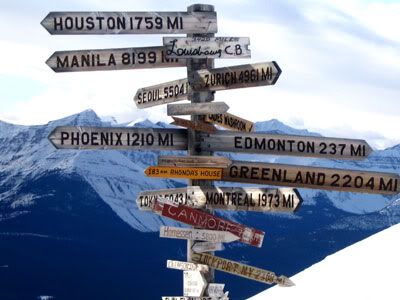
Not many modern Kilometer Zeroes list city distances. That role has largely been relegated to signs that look like this one at Lake Louise Ski Resort in Alberta:
 (source: travelandtransitions.com)
Those are the fun ones, incidentally.
But the undisputed Kilometer Zero champion has to be- and if you've ever driven in South Dakota, you know it already- Wall Drug. It's not every tacky tourist trap that can get itself a sign in Amsterdam. Or Antarctica. Or Bagram AFB in Afghanistan. Or a sign that tells you about their other signs in Kenya and London.
Or this blog.
It's 676 miles to Wall Drug, South Dakota.
As such, it will sometimes happen that one of these places will construct a road sign or a compass or a globe or some sort of large-scale 'You Are Here' sign.
For many countries, this takes the form of something Wikipedia has blanket-referred to as Kilometer Zero. Kilometer Zero is a marker or monument located somewhere in the country- typically the capital, but not always- from which all distances in the country are intended to be measured.
France's Kilometer Zero is this marker in front of the Cathedral of Notre Dame. Spain's is this marker in Madrid's Puerta del Sol. Indonesia's is this building on the west coast of the island of Sabang. Ukraine's is this monument in Kiev. Canada's is the western end of the Trans-Canada Highway on Vancouver Island, British Columbia.
The United States has a Kilometer Zero, called Zero Milestone. It was created in 1923, sitting within eyesight of the White House. However, in practice, it only serves as Kilometer Zero for Washington DC. Everybody else does their own thing. Mile markers might measure the distance to the county line or state line. Highway distance signs have no definitive answer I could hunt down. When looking for what a sign signifying distance to any given city uses as its point of reference, I came up with the post office (though which one?), some other public building, 'a point close to the center of town', and 'the edge of town'. You're on your own for that one.
Italy's current Kilometer Zero is the top of Capitoline Hill in Rome. Back in the days of the Roman Empire, though, they used the Milliarium Aureum, a golden milestone (that's the translated Latin) with gilded bronze finishing. It's thought, but not confirmed, that the Milliarium Aureum had listed on it distances to all the major cities in the Roman Empire (hence the term 'all roads lead to Rome').
Not many modern Kilometer Zeroes list city distances. That role has largely been relegated to signs that look like this one at Lake Louise Ski Resort in Alberta:
Those are the fun ones, incidentally.
But the undisputed Kilometer Zero champion has to be- and if you've ever driven in South Dakota, you know it already- Wall Drug. It's not every tacky tourist trap that can get itself a sign in Amsterdam. Or Antarctica. Or Bagram AFB in Afghanistan. Or a sign that tells you about their other signs in Kenya and London.


Or this blog.
It's 676 miles to Wall Drug, South Dakota.
Subscribe to:
Posts (Atom)